The Egyptian archaeological mission of the Supreme Council of Antiquities at Ihnasya El Madina in Beni Suef governorate, headed by Dr. Mohamed Ibrahim, Director General of Beni Suef Antiquities, has made a number of archaeological discoveries that shed further light on the city's religious and civilizational importance through the ancient Egyptian, Greek and Roman periods.
The discoveries include a reused stone block bearing a relief inscription of the name of King Senusret III, including his throne and birth names, as well as another cartouche bearing the name of the god Osiris-Naref, one of the main deities worshipped in Ihnasya during the ancient Egyptian and Ptolemaic periods.
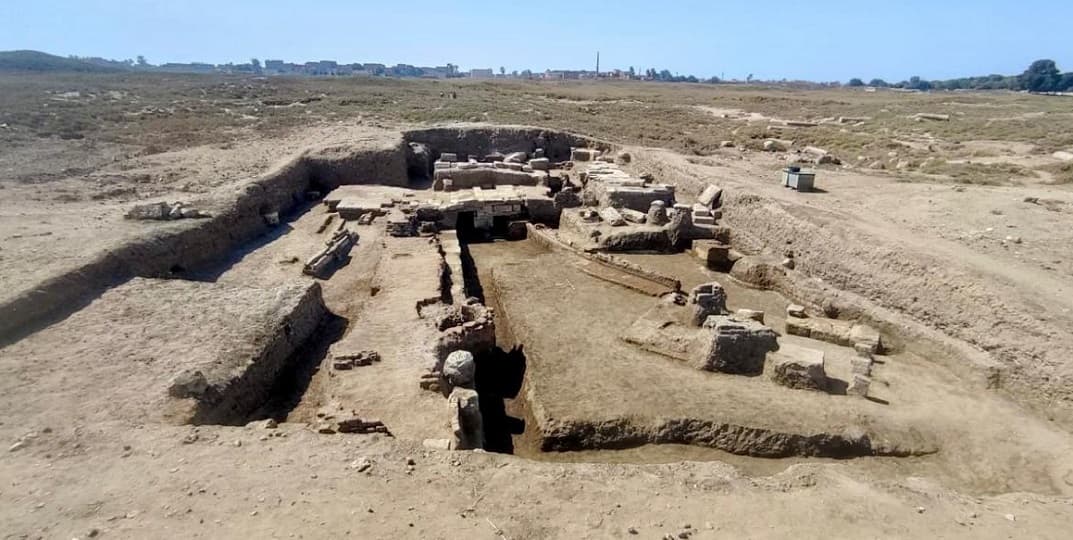
Extensions of a Roman basilica and the remains of an ancient Doric temple were also found, as well as a rare marble head of a statue of the goddess Aphrodite, the Greek goddess of love and beauty, along with parts of wall statues and pottery molds for minting coins dating back to the Roman period.

Minister of Tourism and Antiquities Sherif Fathy stressed that these discoveries are an important scientific and archaeological addition that helps highlight the great historical value of Ihnasya El Madina and reflects the civilizational and cultural diversity Egypt has witnessed through the ages.
For his part, Hisham El-Leithy, Secretary-General of the Supreme Council of Antiquities, explained that the discovery of a cartouche bearing the name of King Senusret III is an important find, especially as this king was associated with a number of important monuments in Ihnasya El Madina, confirming its sacred status for the ancient Egyptians and the interest of Middle Kingdom kings in it.

He noted that the discovery of the extensions of the Roman basilica shows the architectural and functional development of this type of building, as the basilica was used in the Greek period as a public building for meetings and administrative and commercial activities, before being turned into a church for religious rites and church meetings in the early Christian period.
In a related context, Mohamed Abdel Badie, Head of the Ancient Egyptian Antiquities Sector at the Supreme Council of Antiquities, said a preliminary study of the remains of the ancient Doric temple showed that its architectural elements were reused in the 6th century AD as foundations and floors supporting the basilica's columns. The basilica's builders restacked the stones and blocks irregularly to form a strong base able to bear the enormous weight of the columns, some of which are estimated to weigh around 45 tonnes, with 3 still standing in their original positions today.

Regarding the head of the Aphrodite statue, he explained that it is a rare work of art made of marble measuring 24 × 25 cm, distinguished by the precision of its execution and the beauty of its artistic details, showing the facial features and curly hair in a style reflecting the classical artistic characteristics common in statues of deities and prominent figures during that period.

Dr. Samy Derdiry, Head of the Central Department of Middle Egypt Antiquities, noted that the remains of wall statues uncovered, along with the pottery coin molds, reflect the city's status during the Roman period and its continued civilizational and economic prosperity, adding that the mission is currently continuing to study and scientifically date these finds.
Ihnasya El Madina is one of the most important archaeological sites in Egypt, as it was the country's capital during the 9th and 10th Dynasties and the capital of the 20th nome of Upper Egypt. It enjoyed great importance during the Middle and New Kingdoms and the Third Intermediate Period, and flourished during the Greek and Roman periods, when it was known as "Heracleopolis Magna", meaning "the great city of Heracles".