The joint Egyptian-Italian archaeological mission of the Supreme Council of Antiquities and the University of Milan has uncovered a number of rock-cut tombs from the Greek and Roman eras containing well-preserved hieroglyphic inscriptions, in the necropolis surrounding the Aga Khan Mausoleum area on the West Bank of Aswan.
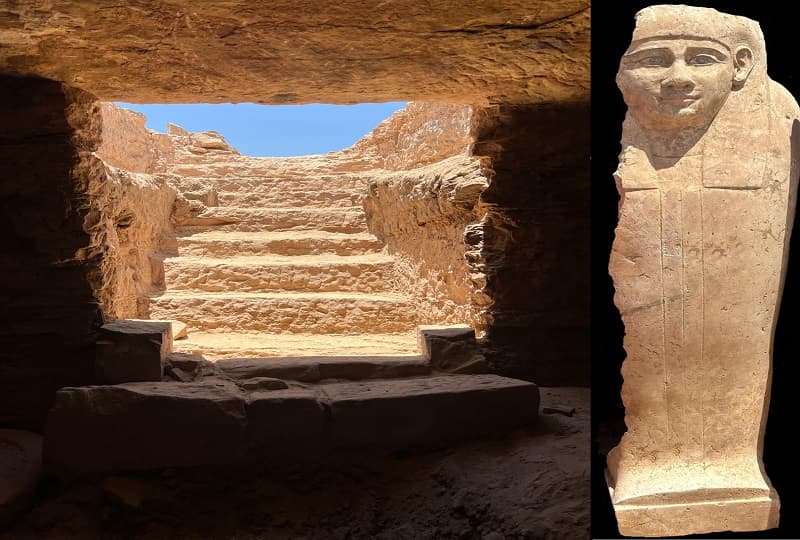
Excavation work during this year's season also led to the discovery of Tomb No. 38, one of the most remarkable tombs discovered so far in terms of design and structural condition. It lies more than two meters underground and is reached by a stone staircase of nine steps flanked by mudbrick benches that were used to place funerary offerings.
Inside the tomb, a limestone sarcophagus about two meters high was found, placed on a rock platform carved directly into the mountain. It features an anthropoid lid bearing the clear features of a human face adorned with a wig and stunning decorations, in addition to two columns of hieroglyphic texts recording prayers to the local deities of the Aswan region and the name of the tomb owner, “Ka-Mesiu”, one of the senior officials of his time, along with the names of members of his family. Mummies were also found, some of them of children.

Sherif Fathy, Minister of Tourism and Antiquities, described the discovery as a qualitative addition in Aswan Governorate that reflects the diversity and richness of ancient Egyptian civilization across the ages. It also underscores the importance of international scientific cooperation in supporting archaeological discovery efforts, as the discovered tombs open new horizons for understanding the nature of the local community in Aswan during the Ptolemaic and Roman eras and highlight the historical status of the region as one of the important civilizational centers in southern Egypt.
For his part, Dr. Mohamed Ismail Khaled, Secretary General of the Supreme Council of Antiquities, said this discovery is clear evidence of the continued funerary use of the area by various social classes, from the elite who were buried in the upper tombs on the plateau to the middle class who settled on the slopes of the necropolis. The inscriptions and finds will also provide rich scientific material for researchers in Egyptology, especially regarding funerary traditions and religious symbolism during the late periods of Egyptian civilization.
The Secretary General explained that the mummies discovered inside these tombs, which include a number of children, will undergo CT scans and biological analyses during the coming autumn season, which will contribute to a more precise understanding of these individuals' identities, living conditions and causes of death.
Mohamed Abdel Badie, Head of the Egyptian Antiquities Sector at the Supreme Council of Antiquities, explained that on the plateau at the top of the hill there are huge underground tombs dating back to the Ptolemaic era that were allocated to wealthy elite families and were reused during the Roman era.
In previous seasons, the mission also uncovered a number of funerary mastabas and tombs carved into the rocks of the Sidi Othman mountains in the area, revealing a distinctive architectural style that reflects human interaction with the natural terrain of the site.
The discovery came as part of this year's work by the archaeological mission at the site, which has been working there since 2019, headed by Dr. Patrizia Piacentini, Professor of Egyptology at the University of Milan, and Fahmy El-Amin, Director General of Aswan Antiquities. These successive discoveries in the necropolis of the Aga Khan Mausoleum area are tangible evidence of the archaeological importance of the area and one of the pillars of the archaeological landscape in Aswan.