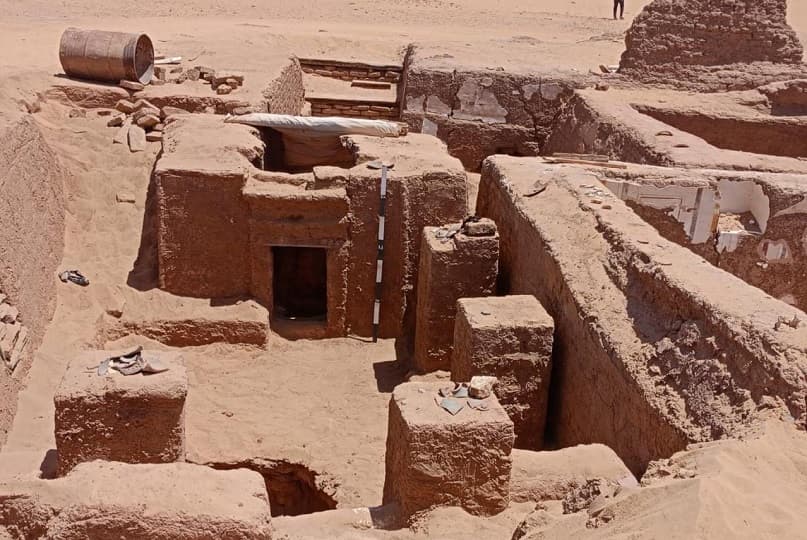
The Egyptian archaeological mission of the Supreme Council of Antiquities working at the Bir El-Shaghala archaeological site in Dakhla Oasis, New Valley Governorate, has uncovered a pyramid-shaped tomb built of mudbrick dating to the Roman era. The tomb was built for the burial of a man and his wife and stands out for its unique architectural layout and its rare inscriptions and funerary texts.
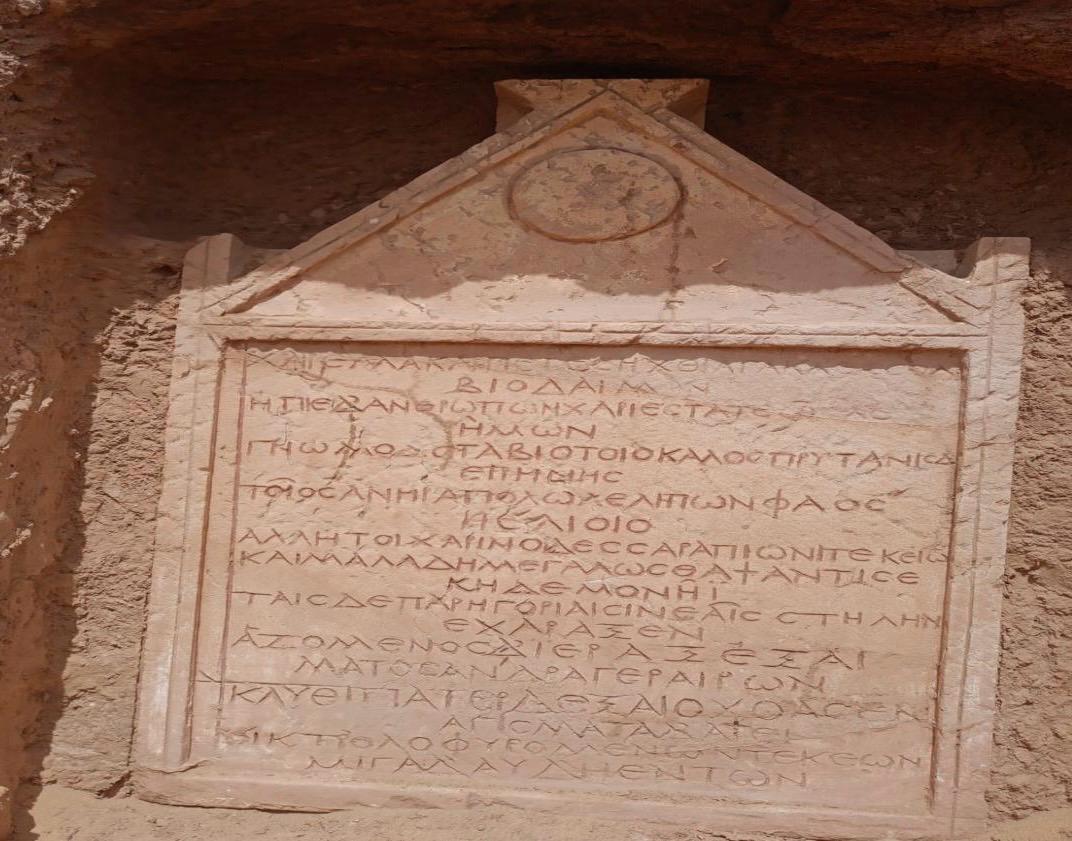
The excavations also uncovered a number of important artifacts, including a stone stela bearing a funerary elegy written in ancient Greek, an offering table and a sandstone purification basin, as well as a variety of pottery vessels and a bronze coin bearing a relief of the Roman Emperor Constantine.
Dr. Hisham El-Leithy, Secretary-General of the Supreme Council of Antiquities, said the importance of the new discovery lies in the tomb's architectural elements, inscriptions and funerary texts, which provide important information about funerary practices and cultural and religious life in Dakhla Oasis during the Roman era.
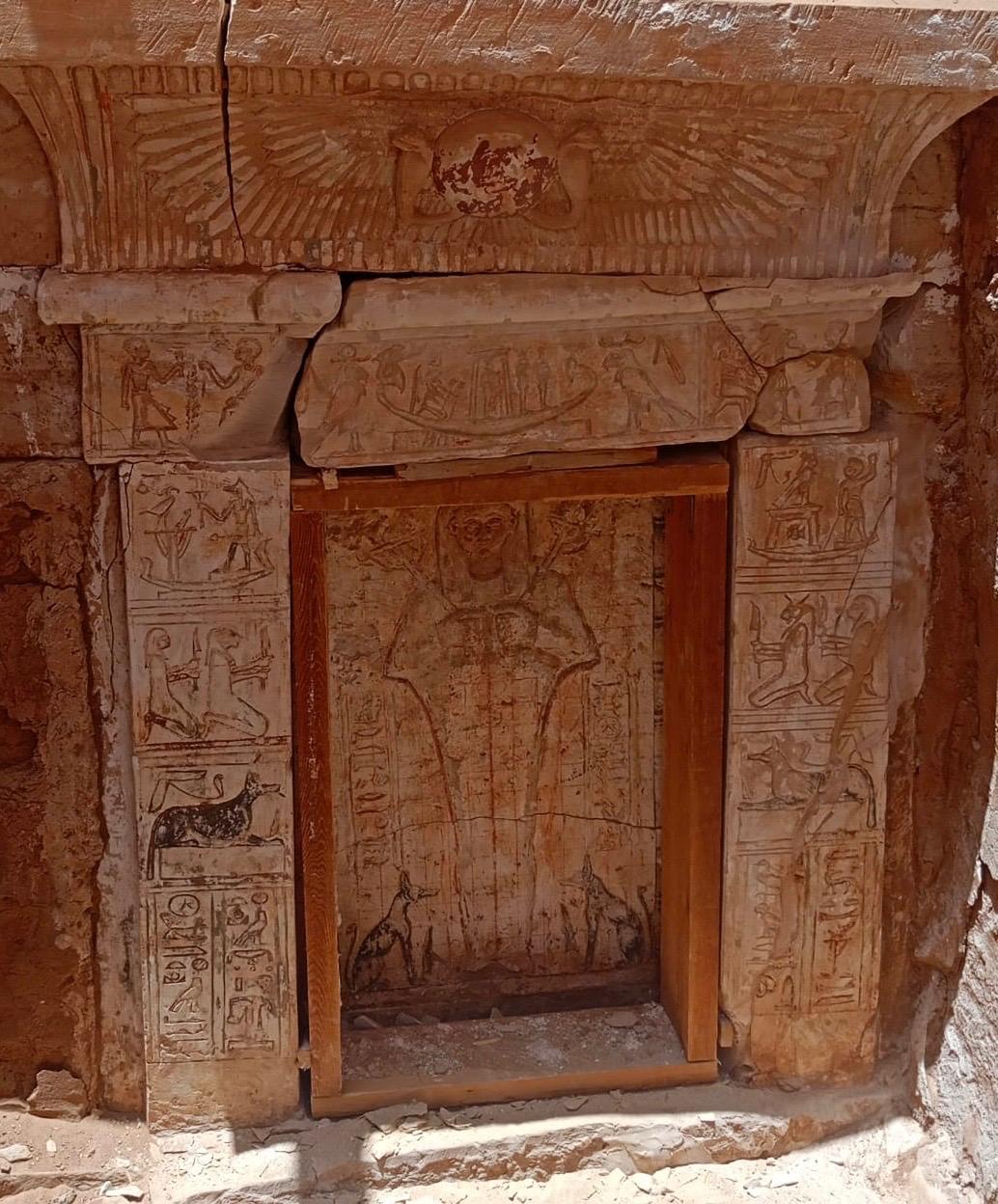
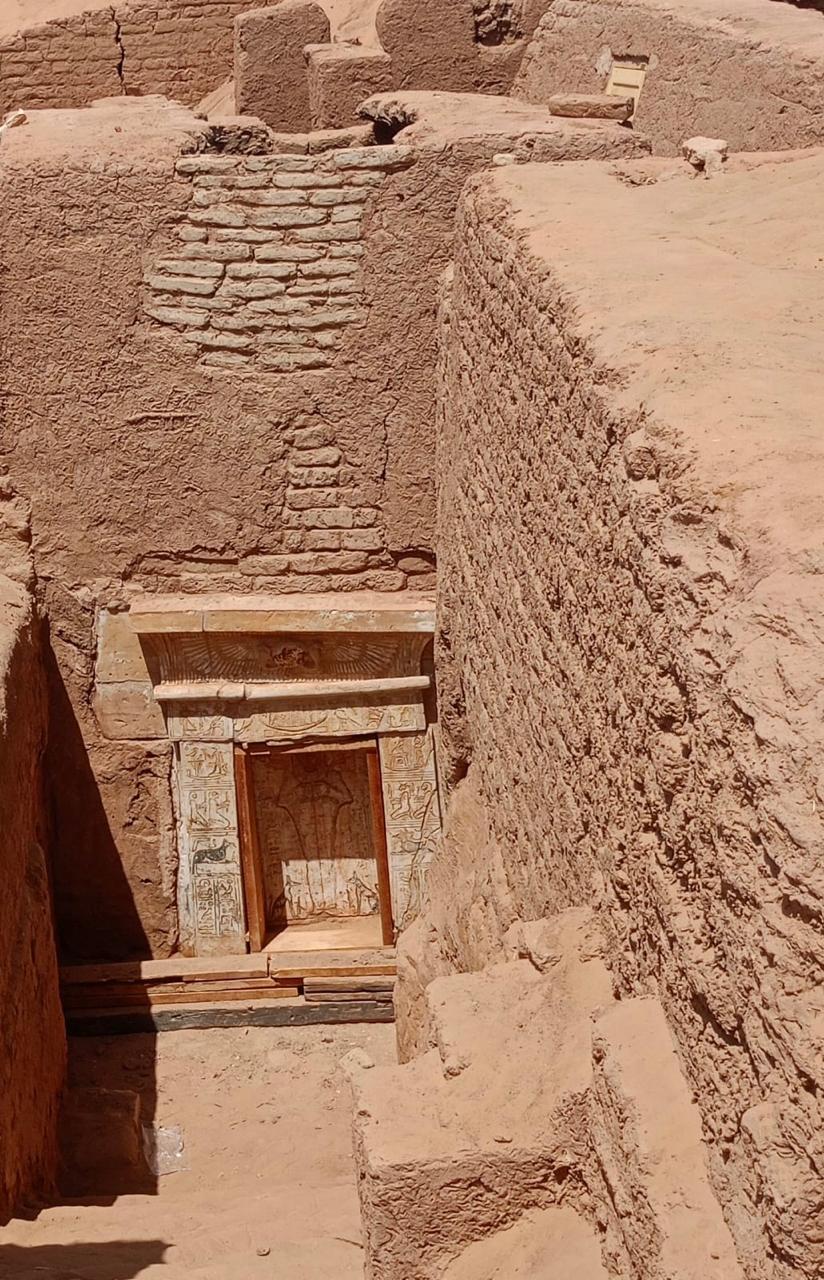
Mohamed Abdel Badie, head of the Egyptian Antiquities Sector at the Supreme Council of Antiquities, said the tomb begins with a staircase of 14 steps leading to its main entrance, built of sandstone in the Egyptian style and decorated with sunken-relief hieroglyphic inscriptions and texts, including a group of protective spells and funerary recitations. The stone entrance is one of the distinctive and unique architectural elements of the Bir El-Shaghala necropolis: it is crowned by an Egyptian cornice decorated with the winged sun disk and two cobras, followed by an architectural element in the form of a bundle of reeds.
The upper lintel of the entrance bears a rare funerary scene appearing for the first time in the necropolis's tombs, depicting the seventh hour of the Amduat, one of the ancient Egyptian books of the afterlife, while the inscriptions on both sides include texts and scenes related to the tomb's owners. The entrance was found sealed with a stone blocking slab bearing an Osiris figure surrounded by a group of spells.
The entrance leads to a transverse hall built of mudbrick with a vaulted ceiling, part of whose western side has collapsed. To the right of the hall are two burial chambers built of mudbrick and covered with a layer of plaster, topped by the tomb's pyramid shape.
Dr. Samy Dardiri, head of the Central Administration of Middle Egypt Antiquities, said one of the most notable finds of the excavations was a funerary stone stela (an elegy) fixed to the southern wall of the pyramid structure. The rectangular stela ends at the top in a gable centered on a sun disk carved in raised relief. It bears a text written in red ink in ancient Greek, a 19-line funerary lament dedicated to a man named "Besikhtis," who, according to the initial study, may have held the post of judge. The elegy dates to the late third and early fourth centuries AD and is important evidence of the flourishing literary and cultural life in the oases during the Roman era.
Mohamed Ibrahim, Director General of New Valley Antiquities, said the mission uncovered a sandstone offering table set above a purification basin of the same material, along with a group of pottery vessels and a bronze coin bearing a relief of the Roman Emperor Constantine. Archaeological evidence suggests the tomb may have been reused at a later period, as a mudbrick chapel was found in its upper part above the main entrance, fronted by a funerary shrine with 4 square mudbrick pillars.
Bir El-Shaghala is one of the most important archaeological sites in Dakhla Oasis and one of the necropolises of the city of Mut, the oasis capital during the Ptolemaic and Roman eras. The site's modern name comes from a water well known as "Bir El-Shaghala." The Supreme Council of Antiquities began excavations at the site in 2002, and successive seasons have uncovered many tombs of varied layouts and architectural styles.
The tombs found in the necropolis reveal an architectural style that combines ancient Egyptian elements with influences that emerged during the Ptolemaic and Roman eras. Among them is the Egyptian style with an open courtyard, which in some tombs becomes a staircase flanked by altars likely used for open-air funerary rituals. Some tombs also feature an upper level with a funerary shrine topped by a pyramid shape. The nature of these tombs and their architectural and artistic elements suggests that the necropolis may have been reserved for the burial of members of the elite among the residents of the oasis capital during the Roman era.
The interior of several of these tombs consists of a front hall leading to burial chambers, some of which contained stone and pottery coffins, while the chamber ceilings were usually vaulted and built of either sandstone or mudbrick made from local clay. The walls and ceilings of a number of these chambers are decorated with funerary scenes and texts drawn from the ancient Egyptian books of the afterlife, along with some Greek and Roman elements, in a blend that reflects the beliefs, customs and traditions of the people of the ancient city of Mothis, today's Mut, during that period.