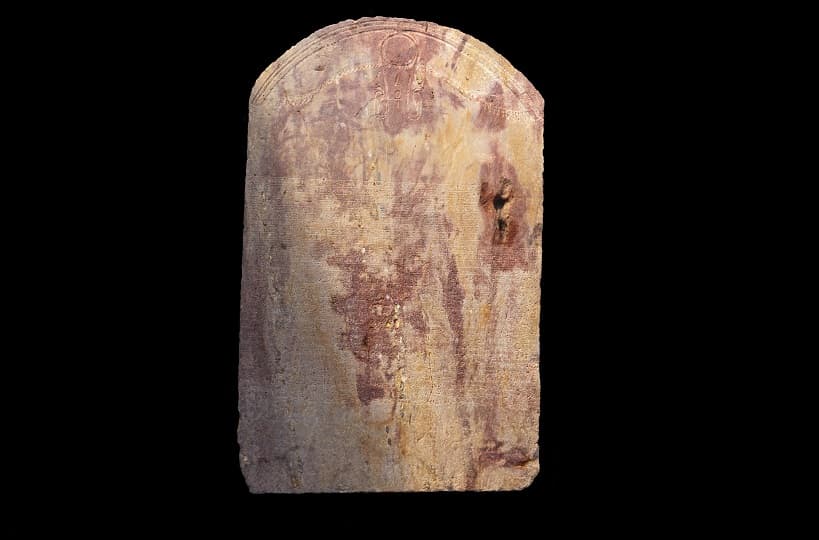
The Egyptian archaeological mission of the Supreme Council of Antiquities working at the Tell El-Faraun site in the city of Husseiniya, Sharqia Governorate, has uncovered a stone stela representing a new copy of the famous Canopus Decree, issued by King Ptolemy III in 238 BC, when senior priests gathered in the city of Canopus (east of Alexandria) to sanctify and venerate King Ptolemy III, his wife Berenice and their daughter, and to distribute the text of the decree to the major Egyptian temples.
Sherif Fathy, Minister of Tourism and Antiquities, affirmed that this discovery is the largest of its kind in more than 150 years, as no new and complete copy of the decree has been found since then, adding that the continuous achievements of Egyptian archaeological missions add new pages to the history of Egypt's ancient civilization. He noted that the discovery sheds light on the archaeological importance of Sharqia Governorate and the treasures it holds, which continue to amaze the world, and stressed that the ministry will continue its full support for all missions working in Egypt, ensuring a suitable environment for more outstanding discoveries.
Dr. Mohamed Ismail Khaled, Secretary General of the Supreme Council of Antiquities, explained that the importance of this discovery lies in its being a new complete copy of the Canopus Decree found after more than a century and a half, a significant addition that helps deepen knowledge of royal and religious texts in the Ptolemaic era and enriches understanding of ancient Egyptian history and language.
He added that this copy joins six previously known copies, some complete and others incomplete, which were discovered at sites such as Kom El-Hisn, San El-Hagar and Tell Basta, noting that the discovered stela is inscribed entirely in hieroglyphic script only, unlike the other copies, which were trilingual, written in hieroglyphic, Demotic and Greek, which opens new horizons for understanding the ancient Egyptian language and provides additional information on Ptolemaic decrees and the systems of royal and religious celebrations.
Mohamed Abdel-Badie, Head of the Egyptian Antiquities Sector at the Supreme Council of Antiquities, noted that the discovered stela is made of sandstone, with an arched top, measuring 127.5 cm in height, 83 cm in width and about 48 cm in thickness. It is topped by a winged sun disk from which hang two royal cobras wearing the White and Red Crowns, with the inscription “di ankh,” meaning “given life,” between them. The middle section contains 30 lines of hieroglyphic text, carved with medium quality.
Dr. Hisham Hussein, Head of the Central Administration of Lower Egypt Antiquities, added that the inscribed texts include precise details of the deeds of King Ptolemy III and his wife Berenice (the Benefactor Gods), including making donations to Egyptian temples, maintaining internal peace, reducing taxes during periods of low Nile levels, increasing their veneration in temples and adding a new priestly rank in their name, adding a new religious festival on the day of the rising of the star Sirius, introducing a system of adding a day every 4 years (the leap-year system) dedicated to the worship of the Benefactor Gods, and deifying their daughter Berenice in Egyptian temples. The decree also stipulated that these stelae be copied in hieroglyphic, Demotic and Greek and placed in the most important major temples.
It is worth noting that the Tell El-Faraun site (the ancient Egyptian city of Imet) in the eastern Nile Delta was an important urban center from the Middle Kingdom onward, as previous excavations uncovered temples and luxurious residential buildings from the Ptolemaic era, including a temple dedicated to the worship of the goddess Wadjet.