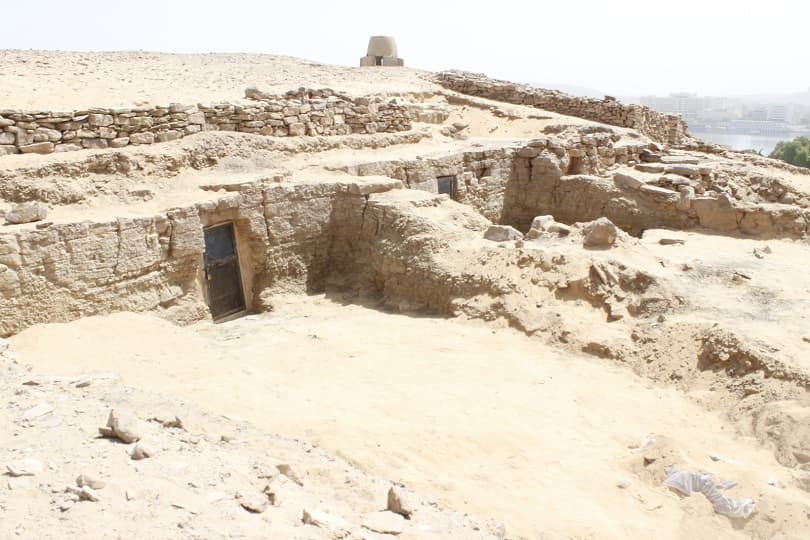
As part of ongoing archaeological excavation work, the Egyptian archaeological mission working at the Qubbet el-Hawa necropolis in Aswan has uncovered 3 rock-cut tombs from the Old Kingdom during the current excavation season.
Dr. Mohamed Ismail Khaled, Secretary General of the Supreme Council of Antiquities, stated that preliminary results indicate that some of these tombs were reused during the Middle Kingdom, reflecting the historical continuity of the Qubbet el-Hawa necropolis's importance as a burial site across different eras.
He explained that the discovery is an important scientific addition, as it sheds light on a critical transitional period between the end of the Old Kingdom and the beginning of the First Intermediate Period. Studies also show that some of the tombs dug in that period were devoid of inscriptions but retained the traditional architectural character and burial rites, indicating the limited economic means at the time.
For his part, Mohamed Abdel Badie, Head of the Egyptian Antiquities Sector at the Supreme Council of Antiquities, explained the details of the three tombs. The first tomb is devoid of inscriptions and writings and has an outer courtyard, inside which two false doors, two offering tables, pottery vessels and poorly preserved coffins were found, in addition to skeletons. Inside the courtyard, the mission found a burial shaft containing dilapidated wooden coffins with skeletons inside, as well as pottery vessels, some bearing hieratic inscriptions dating back to the Old Kingdom.
The second tomb is located west of the first tomb and is also devoid of inscriptions. Two offering tables and pottery vessels dating back to the Middle Kingdom were found inside it. Its architectural design suggests that it dates to the end of the Old Kingdom or the beginning of the First Intermediate Period, and it was reused in the Middle Kingdom.
The third tomb differs in design from the two previous tombs and is located west of the tomb of "Ka-kem" from the New Kingdom. The tomb is devoid of inscriptions, and a large quantity of well-preserved pottery was found inside it, in addition to skeletons, some of them of children. Evidence indicates that the tomb dates back to the Old Kingdom.
The archaeological discovery confirms the importance of the Qubbet el-Hawa necropolis as one of the most important archaeological sites in southern Egypt, and supports understanding of the chronological and architectural sequence and burial rites during the transitional periods of ancient Egyptian history.