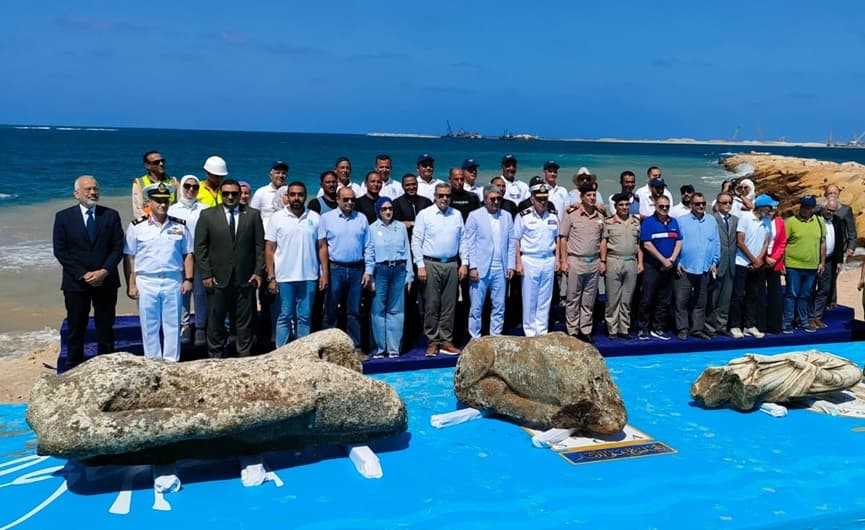
Sherif Fathy, Minister of Tourism and Antiquities, this morning, Thursday, witnessed the recovery of 5 massive sunken artifacts from Abu Qir Harbor in Alexandria. "We were able to recover 5 heavy artifacts from under the sea," he said, adding that several proposals are being studied, including establishing a dedicated museum for sunken antiquities or an underwater museum, but that all of them are still proposals under study and whatever is decided will be announced.
The Minister of Tourism and Antiquities explained in his speech that the ministry is unable to recover all the antiquities from under the water, as it is bound by laws and an agreement with UNESCO that prevent the recovery of all antiquities from the waters of the Mediterranean, out of concern about damaging the artifacts and in order to preserve them, since they are made of certain materials that prevent their recovery, while pieces that face no risk are recovered from the Mediterranean.


The Minister of Tourism and Antiquities expressed his thanks and appreciation to everyone who contributed to accomplishing this exceptional work, praising the efforts made to bring these unique artifacts from the depths of the Mediterranean to light. He also commended the great support that antiquities receive from the political leadership, stressing that the attention and care the state devotes to Egyptian antiquities and heritage have contributed substantially to safeguarding Egypt's civilizational identity and protecting its unique human legacy.
The minister thanked the Armed Forces, the Naval Forces and the Engineering Authority for their fruitful cooperation and continuous support in the success of the discovery and recovery of these rare artifacts from the bottom of the Mediterranean.


Dr. Mohamed Ismail Khaled, Secretary General of the Supreme Council of Antiquities, stressed the exceptional importance of the Abu Qir archaeological site, which stands as living testimony to the greatness, history and civilization of ancient Egypt. He explained that today's recovery of artifacts from the Mediterranean comes 25 years after the last similar operation in Egypt, since it signed the UNESCO Convention on the Protection of the Underwater Cultural Heritage in 2001, and that certain procedures must be followed when recovering some pieces. Work on this project proceeded, and in 2023 a large group of antiquities was discovered on land, and excavation and documentation work began through inspectors of the Supreme Council of Antiquities.

Closer to the sea, extensions of these buildings and antiquities were discovered submerged underwater. The General Department of Underwater Antiquities carried out underwater work through divers and trained antiquities inspectors, who found large numbers of artifacts and fixed structures underwater, indicating that the area was hit by an earthquake or geological changes that led to part of ancient Alexandria being submerged. Most of the recovered pieces are missing their heads and feet, which indicates that an earthquake occurred or that they broke when they fell into the water. He revealed that among the anticipated discoveries is an ancient ship that will be announced in the coming period, once the excavation work and its comprehensive scientific study are completed.
Travel Yalla News provided special live coverage of the event, covering all stages of the recovery of the massive artifacts and the smaller pieces recovered earlier, in the presence of Lt. Gen. Ahmed Khaled, Governor of Alexandria; Maj. Gen. Mahmoud Fawzy, Commander of the Naval Forces; Maj. Gen. Yasser El-Khatib, Commander of the Northern Military Zone; and a number of ambassadors and consuls of foreign countries in Egypt.


The recovered pieces included a massive quartzite statue in the form of a sphinx bearing the cartouche of King Ramses II, a granite statue of an unknown person from the late Ptolemaic period broken at the neck and knees, and a white marble statue of a Roman man of the noble class.


Survey and study work confirmed that the site represents a fully equipped city dating back to the Roman era, including buildings, temples, water cisterns and fish-farming basins, as well as an ancient port and docks, suggesting that it is an extension of the western side of the famous city of Canopus, part of which was previously discovered east of the area. The evidence also reveals civilizational continuity across multiple eras, including the ancient Egyptian, Ptolemaic, Roman, Byzantine and Islamic periods.
The search work also led to the discovery of a large group of important archaeological evidence, most notably amphorae bearing seals for goods and their dates of manufacture, and the remains of a merchant ship loaded with walnuts, almonds and other nuts and containing a copper scale used for weighing, in addition to royal statues and sphinx statues, a group of ushabti figurines, stone anchors, and coins from the Ptolemaic, Roman, Byzantine and Islamic eras, as well as pottery vessels and plates, fish-farming basins and a marine pier stretching 125 meters.