El-Enany: An exhibition of photos on the history of Heliopolis and a display of the first tram in the palace courtyard
Assistant Antiquities Minister for Engineering Affairs: 85% of restoration work completed, with opening at the end of this year
Dr. Khaled El-Enany, Minister of Antiquities, revealed that the Baron Empain Palace in Heliopolis, once its restoration is complete, will become an archaeological and tourist attraction as well as a social and cultural one, drawing everyone, both foreign tourists and Egyptians. A photo exhibition depicting the history of the Masr El-Gedida (Heliopolis) district through the ages is planned in cooperation with the Belgian Embassy in Cairo and Egyptian civil society organizations, in addition to displaying the first tram car of the Heliopolis area in the palace courtyard. He noted that service centers will also be provided.
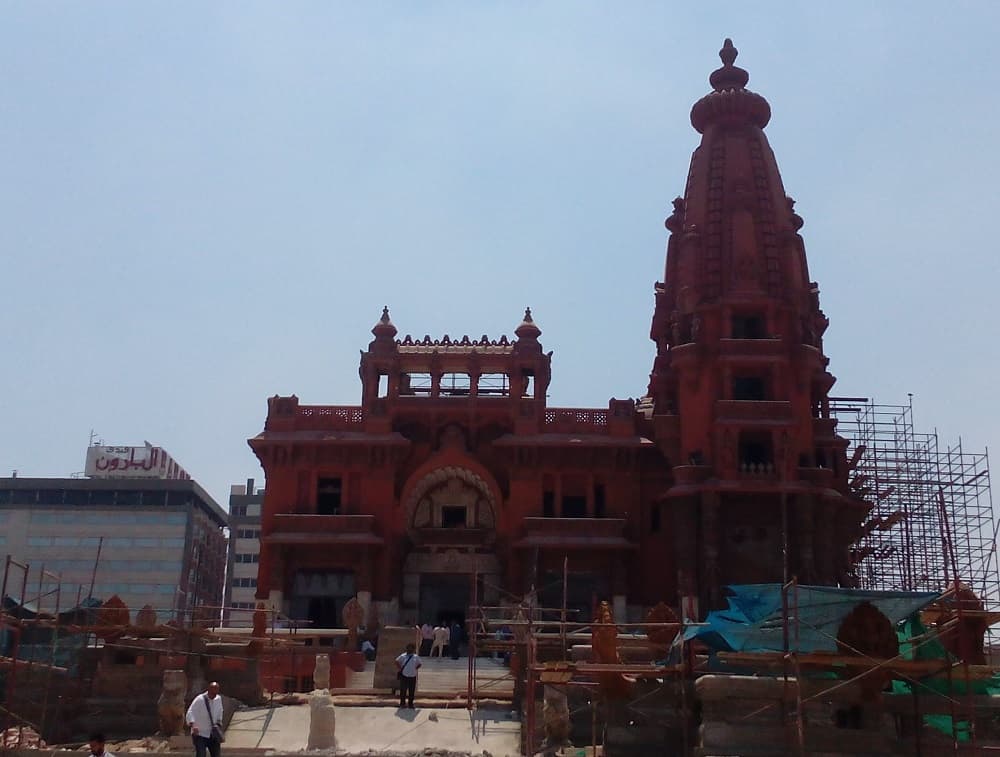
During an inspection tour of the latest restoration works at the palace, El-Enany stressed that the colors of the Baron Empain Palace facades are original, contrary to claims that a specific color had been chosen for it that alters its original historic character. “If that were the case, the palace would have been fully finished months ago,” he said.
El-Enany added that those in charge of the restoration took all the necessary measures, including tests, analyses, and photographic and architectural documentation of the signs of damage, in order to draw up the necessary plans and take the required samples using established scientific restoration methods. These revealed the original colors of all the facades, and accordingly the facades were restored by preserving and consolidating the original colors uncovered, which had been adversely affected by weather conditions.
During the tour, El-Enany inspected the palace’s original and newly built fences, the arrangement of the statues surrounding the palace, the details of the restoration process, and the materials used to preserve the original colors and form of every part of the palace and its surroundings.
For his part, Brig. Gen. Hesham Samir, Assistant Minister of Antiquities for Engineering Affairs and general supervisor of Historic Cairo, explained that 85% of the restoration work on the Baron Empain Palace in Heliopolis has been completed. The palace is scheduled to open at the end of this year, the project’s total cost is 100 million pounds, and restoration work is proceeding apace under the supervision of the Armed Forces Engineering Authority.
He said that the structural reinforcement and restoration of the palace’s ceilings have been completed, along with finishing the facades, cleaning and restoring its decorative elements, completing missing doors and windows, removing all the plaster ceilings and cornices, and restoring the marble columns, the wooden doors, the decorated metal and iron windows on the main facades, the mural above the main entrance, and the marble statues on the grounds. He noted that work has begun on upgrading the palace grounds and landscaping its garden.
Samir added that, to preserve standards of authenticity during the restoration, the non-historic iron fences built around the palace in 2006 were removed because of their poor condition and because they were incompatible with the palace’s archaeological and architectural value. He stressed that no stone wall will be built in their place, and that the palace’s original drawings by the architect Alexandre Marcel were used to build fences with the same design as the old historic fences: a longitudinal concrete base below ground level, topped by iron panels running the length of the facades, with small-section stone columns spaced at intervals to hold the iron fence panels in place. He stressed that the view of the palace will in no way be obstructed or blocked, so that passers-by can enjoy seeing the palace and its magnificent design.
In a related context, Mahmoud Abdel Basset, Director General of Historic Cairo, said the restoration work is planned to be completed within 3 months, followed by landscaping and other work on the square surrounding the palace.
It is worth noting that the studies carried out to determine the original colors of the facades included references to the color in historical documents related to the Baron Palace. Amélie d’Arschot wrote in her book Le Roman d’Héliopolis that the facades were covered in white with a burnt brick color inspired by 12th-century temples in northern India (page 178).
Anne Van Loo also explained in her book Heliopolis (page 135) that Baron Empain wanted to distinguish his palace from the rest of the buildings of Heliopolis, which were characterized by the color of the desert, “the earthy color,” and chose burnt brick, burnt Sienna.
A historical French document dating back to the palace’s construction in 1911 also states that the palace was painted in burnt Sienna, the burnt brick color. In addition, the photographic documentation made before the restoration shows the white color of the underside of the recessed vault of the entrance, which is made of gypsum, as well as the color of the facades before the restoration work, a burnt brick color, which is what emerged after the cleaning work.
History of the Baron Palace
The construction of the Baron Empain Palace marks the birth of the Heliopolis district. It was built by the Belgian Édouard Empain in 1907 AD on an area of about 12,000 square meters, and construction was completed in 1911.

The Belgian millionaire Édouard Empain arrived in Cairo at the end of the 19th century, specifically several years after the opening of the Suez Canal. Édouard Empain held the title of “Baron,” which was granted to him by the King of France in recognition of his efforts in building the Paris Metro.
The idea of building the palace goes back to Baron Empain, who proposed to the Egyptian government the idea of establishing a district in the desert east of Cairo and chose for it the name “Heliopolis,” meaning city of the sun. The Baron bought the feddan for just one pound, as the area lacked utilities, transport and services. To attract people to his new suburb, the Baron came up with the idea of building a metro, which still operates today and took the city’s name, the “Heliopolis Metro,” to connect the new district or city with Cairo. He also began building houses in the classic Belgian style, in addition to large spaces with wonderful gardens, and built a huge hotel, the old Heliopolis Hotel, which was recently annexed to Egypt’s presidential palaces.
The Baron decided to build a palace, and it was a legendary one, designed so that the sun never leaves it, entering all its rooms and halls. It is one of the most luxurious palaces in Egypt ever, and was inspired by the Angkor Wat temple in Cambodia and the Hindu temples of Odisha.