The Supreme Council of Antiquities has announced the start of a project to restore and develop the Luxor and Karnak temples on the East Bank and the Hatshepsut and Seti I temples on the West Bank in Luxor. Sherif Fathy, Minister of Tourism and Antiquities, stated that the restoration and development works are being carried out according to a set timetable, ensuring they are completed as soon as possible before the start of the winter tourist season, noting that these efforts are part of improving the tourism experience and providing integrated services that allow visitors to enjoy the archaeological sites in the best way.
For his part, Dr. Hisham El-Leithy, Secretary-General of the Supreme Council of Antiquities, explained that the restoration works are carried out by a specialized team of restorers from the council's Projects Sector according to the latest scientific methods in this field, ensuring the preservation of the archaeological and architectural value of these sites, noting that a number of inspection tours of various archaeological sites took place recently to assess their needs and begin development works at them in succession.
The Karnak temples saw development works that included upgrading the control building for the electronic surveillance system, and an integrated study is currently being prepared to implement the second phase of this system, ensuring tight security control and covering all the walls surrounding the archaeological area with surveillance cameras.
As for the Luxor Temple development project, it includes expanding the entrance hall to about 250 m², instead of the current area of about 110 m², along with adding 6 new entrance gates, helping organize visitor flows and reduce crowding at the entrance.
The development works also include increasing the number of X-ray scanners, along with strengthening the ticketing system with additional machines, helping improve operational efficiency and speed up the reception of visitors.


Moamen Othman, Head of the Restoration and Archaeological Projects Sector at the Supreme Council of Antiquities, explained that the final concept for the expansion and development works is currently being prepared by the Central Department of Archaeological Projects, with the works to be carried out during the summer months, from May to August, given the lower visitor numbers during this period. The temple's current exit gate will be used as a temporary entrance and exit gate until the works are completed.
As part of developing and upgrading the services provided to visitors, the works include enlarging the visitors' waiting shade in front of the ticket office to accommodate the growing numbers and provide protection from the sun, as well as developing the facade and the area in front of the entrance in line with the site's archaeological character, helping improve the tourist experience for visitors.
He added that the development works at the Temple of Hatshepsut include upgrading the visitor center building and equipping it with two X-ray baggage scanners, building 4 entrance gates equipped with sterilization systems, and allocating a space with 11 electronic ticket gates.
The works also include building a modern display hall equipped with seats and an interactive screen showing the history of the temple and the surrounding area, along with upgrading the surveillance, sound and fire alarm systems. As part of improving services, shades have been built in front of and behind the visitor center.
For his part, Mohamed Abdel Badie, Head of the Egyptian Antiquities Sector, noted that an integrated project is to be carried out in the coming period to develop the site's general services, including renovating the bazaars at the site entrance, replacing and renewing the floors of the general entrance, and restoring the wooden coverings of the entrance path.
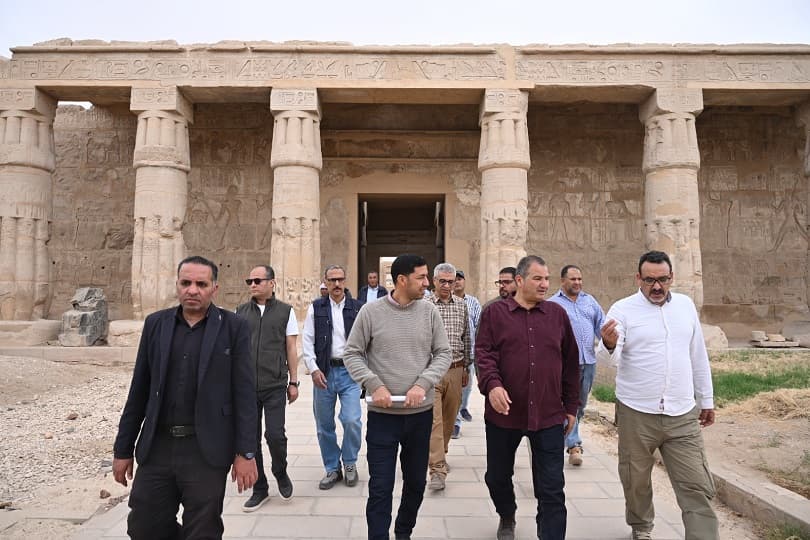
As for the restoration project of the Temple of Seti I, Moamen Othman, Head of the Restoration, Archaeological Projects and Museums Sector at the Supreme Council of Antiquities, explained that it includes removing dirt and soot layers and cleaning bird droppings, helping reveal the original colors of the inscriptions and decorations in the best way, as well as building main visit paths using sandstone, removing harmful plants and weeds, and reinforcing some weak parts of the walls of the temple's outer enclosure. The development works also included installing an information panel on the history of the temple and its components, building an entrance hall and upgrading the general entrance.