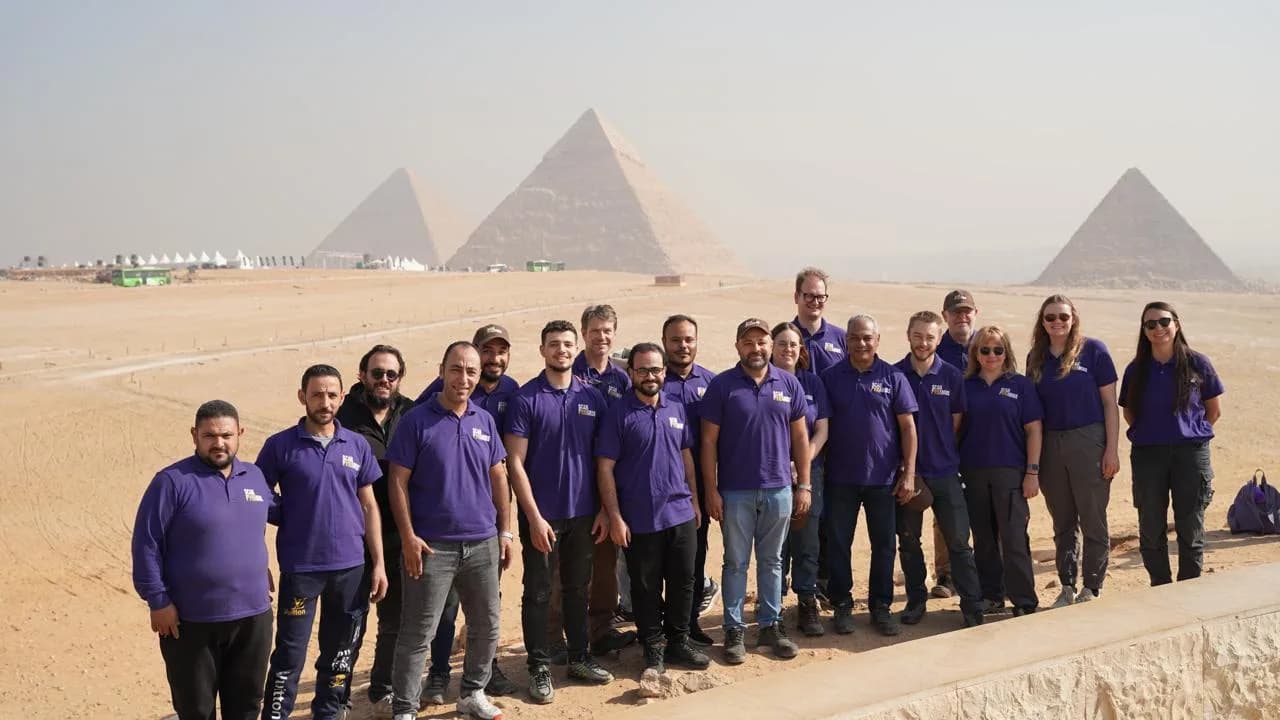
The “ScanPyramids” project continues its scientific research inside the Pyramid of King Khufu at the Giza Pyramids archaeological site, using the latest advanced acoustic imaging technologies to further study the Big Void, which was discovered above the Grand Gallery inside the pyramid in 2017. The research aims to determine its location, dimensions, and spatial extent with greater precision, as part of ongoing scientific efforts to uncover the secrets of the Giza Pyramids and study their architectural structure using modern technologies that are entirely safe for antiquities, non-destructive, and non-invasive.
The project is led by the Faculty of Engineering at Cairo University, under the leadership of Dr. Hany Helal, former Minister of Higher Education, in cooperation with several specialized international universities and research institutions in Germany, France, Canada, and Japan, and under the supervision of the Ministry of Tourism and Antiquities, represented by the Supreme Council of Antiquities.
Sherif Fathy, Minister of Tourism and Antiquities, said that the continuation of scientific research under the “ScanPyramids” project reflects the Egyptian state's commitment to leveraging technological advancements and modern scientific techniques to study and preserve its antiquities. He noted that the project represents a model of fruitful scientific cooperation between Egyptian academic and research institutions and their international counterparts, contributing to a deeper scientific understanding of ancient Egyptian civilization.
He added that the ministry attaches great importance to supporting scientific research projects that rely on non-destructive testing methods, ensuring the preservation of the integrity and authenticity of archaeological sites and structures. He stressed the importance of continuing specialized scientific studies that help uncover more secrets of ancient Egyptian civilization and highlight Egypt's unique cultural heritage.
For his part, Dr. Hisham El-Leithy, Secretary-General of the Supreme Council of Antiquities, explained that the project's current phase focuses on conducting advanced scientific measurements using acoustic imaging techniques to collect additional data on the Big Void, known as the “ScanPyramids Big Void.” The void was discovered above the Grand Gallery inside Khufu's Pyramid using three independent muon radiography techniques.
He noted that these measurements aim to improve the accuracy of determining the void's geometric location, dimensions, and extent within the pyramid, by employing scientific techniques that complement the findings of previous studies. He stressed that all work is being carried out in accordance with strict scientific and archaeological standards and under the supervision of the Supreme Council of Antiquities, ensuring that the pyramid and its architectural elements remain unaffected.
In this context, a joint research team from the Faculty of Engineering at Cairo University and the Technical University of Munich (TUM) in Germany is currently conducting a series of field measurements on the exterior faces of Khufu's Pyramid, using advanced acoustic imaging equipment and techniques as part of the new phase of scientific studies on the Big Void.
For his part, Ashraf Mohie El-Din, Director General of Giza Antiquities, said that the measurement work is being carried out in full coordination with officials at the archaeological site and under specialized archaeological supervision, with all necessary measures in place to protect the pyramid during the research. He explained that the research team has used advanced acoustic measuring devices on the pyramid's exterior faces to collect the scientific data needed to study the discovered void, without the need for excavation or any physical intervention in the ancient structure. He added that this phase builds on a series of studies conducted at the Giza Pyramids site over the past years, which have yielded important scientific findings about the internal structure of Khufu's Pyramid.
It is worth noting that since its launch, the “ScanPyramids” project has led to several significant scientific discoveries inside the Pyramid of King Khufu, most notably the Big Void above the pyramid's Grand Gallery. This discovery was made using muon imaging techniques, which allow researchers to study the internal density of massive structures without any physical intervention.
In 2023, a hidden passage behind the pyramid's northern entrance gable, known as the “North Face Corridor,” was discovered using radar scanning, acoustic wave, and muon imaging techniques. The team was able to capture images of the passage from the inside for the first time in approximately 4,500 years, using a small endoscope measuring no more than 8 millimeters in diameter, which was passed through narrow openings between the stones. This made it possible to document the passage and reveal details of its interior without causing any damage to the archaeological structure.
The current research builds on these efforts as part of an integrated scientific approach that employs multiple advanced technologies to study the internal structure of the pyramids. This contributes to expanding scientific knowledge of their construction methods and architectural development while preserving their structural integrity and archaeological and historical value.