The Ministry of Tourism and Antiquities receives the pieces from the Foreign Ministry and deposits them at the Egyptian Museum in Tahrir
The Ministry of Tourism and Antiquities, represented by the Supreme Council of Antiquities, has received 13 artifacts that arrived in the country from the United Kingdom and Germany, in coordination with the Ministry of Foreign Affairs, Emigration and Egyptian Expatriates and in cooperation with the relevant Egyptian, British and German authorities. This comes as part of the Egyptian state's continuous efforts to protect and preserve its cultural heritage and recover artifacts that left the country illegally.
In this context, Sherif Fathy, Minister of Tourism and Antiquities, affirmed that the recovery of this collection reflects the commitment of the Egyptian state, with all its institutions, to protecting its unique cultural heritage. He praised the fruitful cooperation with the Ministry of Foreign Affairs, Emigration and Egyptian Expatriates and commended the cooperation shown by the British and German authorities in returning these pieces to their original homeland, Egypt, which reflects the depth of cooperation and joint coordination in protecting cultural heritage and combating illicit trafficking in cultural property.
For his part, Dr. Mohamed Ismail Khaled, Secretary General of the Supreme Council of Antiquities, explained that the artifacts were recovered from the United Kingdom after the British authorities, represented by London's Metropolitan Police, seized and confiscated them once it was proven that they had left Egypt through an international network specializing in antiquities smuggling. As for the pieces recovered from Germany, the Egyptian Embassy in Berlin received a notification from the authorities of the city of Hamburg expressing their wish to return a number of artifacts kept at the city's museum, after confirming that they had left Egypt illegally.
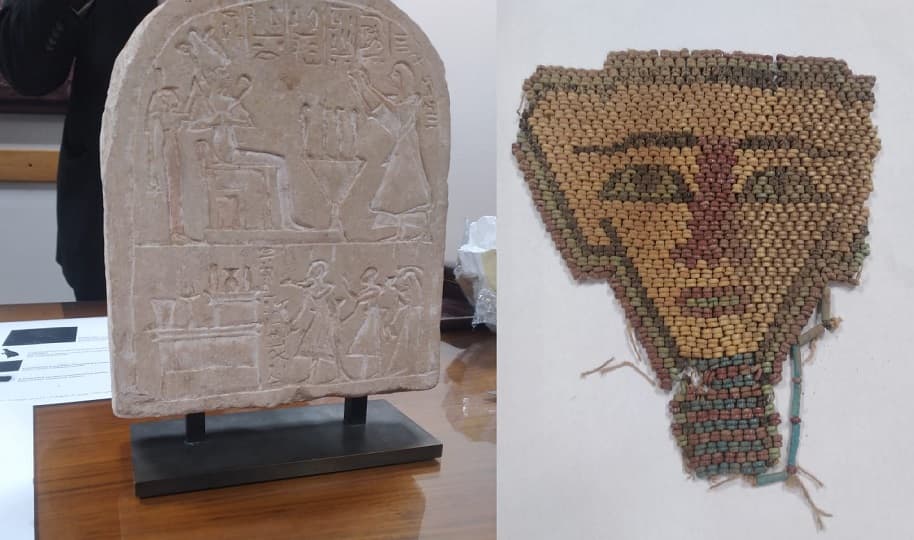
Shaaban Abdel Gawad, Director General of the General Department for Antiquities Repatriation and supervisor of the Central Administration of Archaeological Units at Ports, said the artifacts recovered from Britain date back to various eras of ancient Egyptian civilization. They include a limestone funerary stela from the New Kingdom showing the deceased "Paser", overseer of builders, in a scene of worship before the deities Osiris and Isis and the four sons of Horus, and a small red amulet in the form of a baboon, representing one of the symbolic forms associated with the gods in Egyptian funerary thought for protection.
They also include a footed vessel made of green faience and a small blue faience funerary flask, both from the 18th Dynasty, as well as part of a bronze crown consisting of a feather, a serpent and a ram that was part of a large statue of the god Osiris and can be dated to the period between the 22nd and 26th Dynasties, a beaded funerary mask from the 26th Dynasty, and a number of funerary amulets made of faience and black stone.
He further explained that the pieces recovered from Germany included a skull and a hand from an unidentified mummy, in addition to an ankh amulet, the symbol of life in ancient Egyptian civilization.
He noted that the recovered pieces have been deposited at the Egyptian Museum in Tahrir ahead of maintenance and restoration work and their display in a special exhibition at the museum featuring recently recovered artifacts.