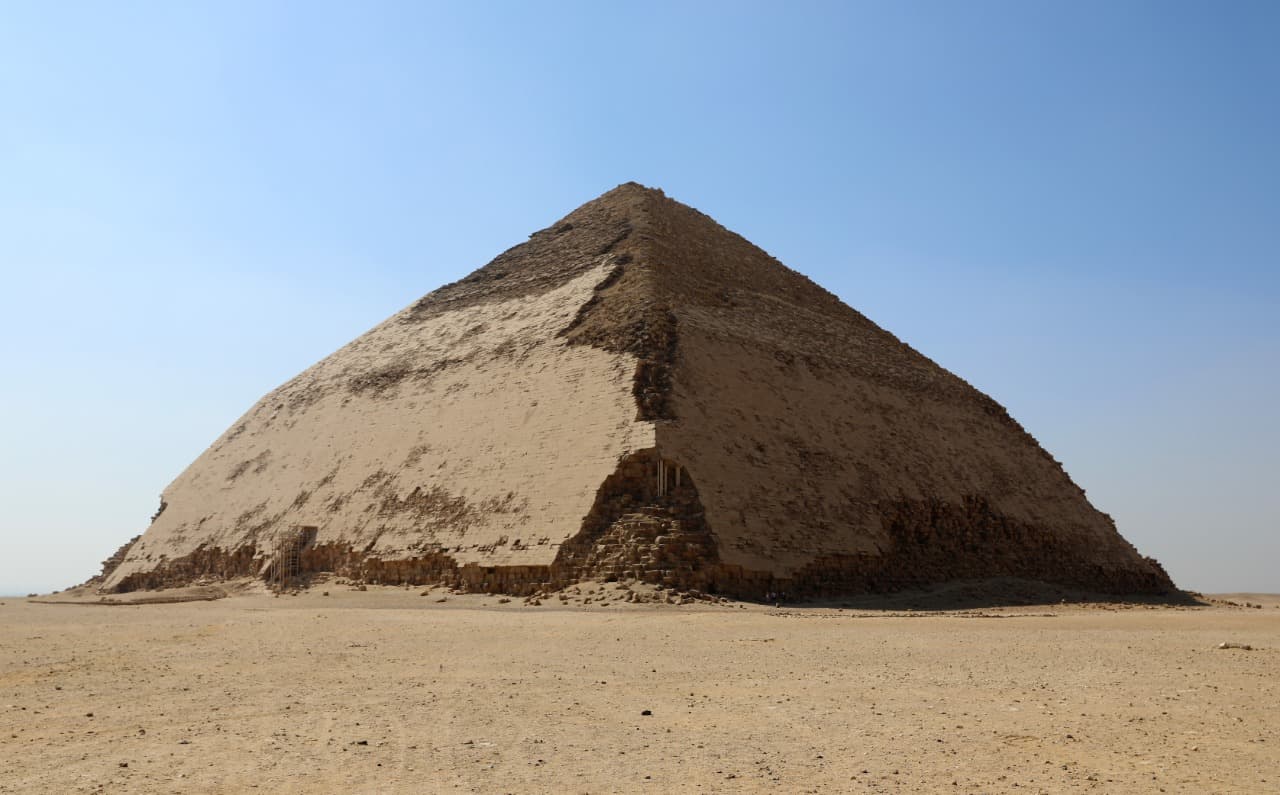
Minister of Antiquities Dr. Khaled El-Enany this morning, Saturday, opened King Sneferu's Bent Pyramid in the Dahshur archaeological area, along with the ritual Ka pyramid, to public visits after the completion of development and restoration work.

The opening was attended by Giza Governor Maj. Gen. Ahmed Rashed, Dr. Mostafa Waziri, Secretary General of the Supreme Council of Antiquities, and about 40 ambassadors of foreign and African countries in Egypt, namely the ambassadors of Britain, France, Italy, Germany, Denmark, the Netherlands, Cyprus, Finland, Japan, Colombia, Equatorial Guinea, Australia, Hungary, Thailand, Chile, Congo, Mexico, Jordan, Cameroon and Zambia, as well as representatives of the embassies of Cuba, Peru, Tajikistan and Niger, and UNESCO.

In his speech, Minister of Antiquities Dr. Khaled El-Enany stressed that this is the first time Sneferu's Bent Pyramid and its ritual Ka pyramid have been opened to the public since 1965, adding that the Bent Pyramid and the other pyramids in the Dahshur archaeological area are inscribed on UNESCO's World Heritage List as part of the Memphis necropolis. He explained that the Bent Pyramid represents a transitional stage in the development of pyramid building between Djoser's Step Pyramid, the Meidum Pyramid, and the Red Pyramid, which King Sneferu also built in Dahshur after discovering that the Bent Pyramid was inclined at an angle.

For his part, Dr. Mostafa Waziri, Secretary General of the Supreme Council of Antiquities, explained that the restoration and development of both the Bent Pyramid and the Ka pyramid were carried out by the ministry's Projects Sector and included installing internal and external stairs and walkways to facilitate visitors' movement inside them, as well as a lighting network inside and outside the two pyramids, in addition to completing all fine restoration work, including strengthening and consolidating some of the corridor stones and restoring the burial chamber of the Bent Pyramid.

Waziri noted that the Bent Pyramid, also known as the Southern Pyramid, reflects an important stage in the evolution of pyramid building, which the ancient Egyptians used as royal tombs, as it was the first attempt to build a complete pyramid after Djoser's Step Pyramid. It was built by King Sneferu, founder of the Fourth Dynasty, in 2600 BC in the Dahshur archaeological area, which is considered the southern extension of the Memphis necropolis.
The pyramid is about 101 metres high, and each side of its base is 188 metres long. It has two angles of inclination, the first 54 degrees up to a height of 49 metres and the second 43 degrees up to a height of 52 metres. The pyramid has two entrances, the first on the north side at a height of 12 metres, leading to a descending corridor 79.5 metres long, then to a transverse hall with a gabled ceiling, and from there to an irregular corridor whose right side leads to the western entrance of the pyramid, while its left side leads to the burial chamber with an unfinished ceiling, which contains wooden supports made of cedar imported from Lebanon.


Excavations at the Bent Pyramid
The pyramid has seen many excavations, the first in 1839 by the British Perring and Vyse, who cleaned the interior parts of the pyramid. Then, in 1894 and 1895, came the "de Morgan" mission, the first scientific mission to carry out excavations in the area.
In 1945, engineer Abdel Salam Hussein uncovered the name of King Sneferu written more than once, along with the marks that quarry workers wrote on the pyramid's stone blocks, especially those at the corners of the pyramid, while carrying out archaeological excavations around the pyramid.
In 1951, archaeologist Dr. Ahmed Fakhry discovered the western entrance of the pyramid while cleaning all its internal corridors, and he also cleaned part of the causeway leading to the valley temple.
The Ritual Ka Pyramid
It was discovered by Dr. Ahmed Fakhry in 1956 and lies about 55 m from the middle of the southern side of the Bent Pyramid. Its entrance, on the north side, is a descending corridor 25 m long leading to the burial chamber, which has a gabled ceiling. This pyramid had been closed since its discovery until it was opened to visitors today, and the restoration team installed a wooden staircase and a lighting system inside the pyramid.