3D screens and a comprehensive update of the museum's display scenario
The original mud seals of the tomb of King Tutankhamun displayed for the first time since its discovery in 1922
Fathy meets German and French tourists during his visit to the Ramesseum temple
He also visits the excavations of the Egyptian archaeological mission at Dra Abu el-Naga on Luxor's West Bank and reviews the new discoveries
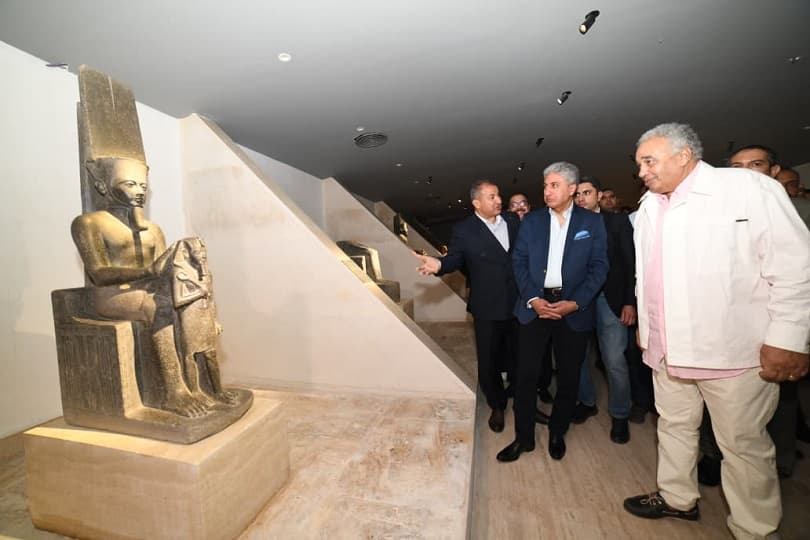
Minister of Tourism and Antiquities Sherif Fathy opened the Cachette Hall at Luxor Museum after the completion of its restoration and the development of its museum display scenario, allowing its contents to be displayed in full for the first time in the hall dedicated to them. He also toured the museum's various halls.
Fathy praised the efforts made in implementing the project, stressing that displaying the Luxor Temple cachette in full in a dedicated hall is a qualitative addition to Luxor Museum and helps provide an integrated museum experience that highlights the historical and artistic value of these unique artifacts.


For his part, Dr. Hisham El-Leithy, Secretary-General of the Supreme Council of Antiquities, explained that the hall contains 26 diverse artifacts, noting that the development work included updating museum display methods so the pieces are presented in a visual context that recreates the moment of their discovery and its historical circumstances, enhancing the visitor's educational and visual experience.
Dr. Ali Omar, Head of the Supreme Committee for the Museum Display Scenario, noted that the project also included developing the display across the museum, by preparing the largest showcase to display the original mud seals of the tomb of King Tutankhamun for the first time since its discovery in 1922, after the completion of their careful restoration by a specialized team of Luxor antiquities restorers.
In a related context, Dr. Mahmoud Mabrouk, the minister's advisor for museum display, explained that the development of the Cachette Hall aimed to provide an integrated museum display reflecting the context of the cachette's discovery, introducing artistic installations in the hall that recreate the scene of its finding, supporting the museum narrative and providing an integrated visual framework linking the pieces with their historical story.
He added that the project included architectural modifications to accommodate the new display scenario, as well as adding two showcases at the entrance area, designing suitable display bases and backgrounds and carrying out restoration and completion work on a number of artifacts.
Dr. Ahmed Hemida, Head of the Museums Sector, stressed that the development work included producing and installing graphic panels and modern explanatory labels, as well as introducing interactive and digital display screens, including 3D technologies to display the artifacts, in addition to applying a specialized museum lighting system that allows lighting levels to be controlled according to display and conservation requirements.
For his part, Dr. Moamen Othman, Head of the Restoration, Antiquities and Museums Projects Sector, noted that the structural development work included replacing the floors and marble skirting, building a new arched ceiling, removing part of the old staircase and replacing it with a ramp to ease movement, especially for people with special needs, as well as replacing wooden cladding with natural stone partitions and installing display bases of marble, granite and wood.
It is worth noting that the Luxor cachette was discovered in 1989 during soil testing in the courtyard of King Amenhotep III at Luxor Temple, when a pit was found containing a group of royal and divine statues dating from the 18th to the 25th Dynasty, which were carefully documented and restored before being moved to secure storage.
Accompanying the minister during the opening and tour were Dr. Hisham El-Leithy, Secretary-General of the Supreme Council of Antiquities; Dr. Moamen Othman, Head of the Restoration, Antiquities and Museums Projects Sector; Mohamed Abdel Badie, Head of the Egyptian Antiquities Sector; Dr. Ahmed Hemida, Head of the Museums Sector; Dr. Ali Omar, Head of the Supreme Committee for the Museum Display Scenario; Dr. Mahmoud Mabrouk, the minister's advisor for museum display; Said Shebl, Head of the Antiquities Conservation and Registration Sector; Dr. Abdel Ghaffar Wagdy, Director General of Luxor Antiquities; Bahaa El-Din Abdel Gaber, Director General of Qurna Antiquities; and Dr. Ayman Ashmawy, advisor to the Secretary-General for Egyptian, Greek and Roman Antiquities.
Visit to the Ramesseum Temple
On the sidelines of his current visit to Luxor to open the tombs of Amenhotep Rabuia and his son Samut after their restoration, Minister of Tourism and Antiquities Sherif Fathy and Luxor Governor Eng. Abdel Muttalib Emara, accompanied by Dr. Hisham El-Leithy, Secretary-General of the Supreme Council of Antiquities, went to the Ramesseum temple to inspect the project to dismantle and reassemble the temple's first pylon, carried out by a joint Egyptian-Korean archaeological mission including the Supreme Council of Antiquities' Antiquities Conservation and Registration Sector and the Korea National University of Cultural Heritage, funded by the Korea Heritage Service of the Republic of Korea.


Fathy met a group of German and French tourists, who were keen to talk to him and take souvenir photos with him, and said Egypt welcomes its guests from all over the world and opens its doors for them to enjoy its unmatched tourism diversity and richness and the distinctive and varied tourism experiences it offers.
For their part, the tourists expressed their delight at visiting Egypt, noting that they were keen to visit Luxor to enjoy its unique tourism and archaeological assets, and expressed their admiration for the monuments they saw, which reflect the greatness and depth of ancient Egyptian civilization. They also praised the warm welcome and generous hospitality they experienced, stressing that they would share their positive tourism experience in Egypt with their families and friends.


Dra Abu el-Naga Excavations and New Discoveries
Continuing his inspection tour of Luxor to review the latest work on a number of archaeological projects, Minister of Tourism and Antiquities Sherif Fathy visited the excavations of the Egyptian archaeological mission of the Supreme Council of Antiquities at Dra Abu el-Naga on Luxor's West Bank and the new archaeological discoveries they have yielded.
During the tour, the minister listened to a detailed explanation of the excavation work, which began in November 2025. Dr. Hisham El-Leithy, Secretary-General of the Supreme Council of Antiquities, explained that this is the mission's eighth season, with work carried out in the south-eastern part of the tomb of "Roy" (TT255), a site that was completely covered with debris from the work of other archaeological missions more than 150 years ago.
The mission's work resulted in a number of important archaeological discoveries:
The discovery of a group of wooden coffins dating to different periods. Inside the burial shaft in the courtyard of the tomb of “Baki”, 10 well-preserved wooden coffins bearing various scenes and texts were found.
Preliminary studies showed that 4 of these coffins date to the 18th Dynasty, including a coffin bearing the name of the chantress of Amun "Merit", as well as a Ramesside-era coffin bearing the name "Padi-Amun" and his title, priest at the Temple of Amun, while the rest of the coffins date to the Late Period.
Studies indicate that the shaft was used as a cache to store these coffins after they were moved from their original burial places to protect them, especially given the poor state of preservation of the mummies inside them.
The discovery of the tomb of the wab-priest of the Temple of Amun “Aa-shefi-nakhtu”. The tomb is located in the southern corner of the courtyard of the tomb of “Baki” and consists of a small courtyard fronted by a rectangular shaft and an entrance decorated with offering scenes and some funerary texts, ending in a rectangular hall leading to the burial chamber.
The tomb owner bears the title "wab-priest of the Temple of Amun", while his father "Padi-Amun" is mentioned with the same title. The facade texts also include the names of his two wives, "Isis" and "Ta-kaft", both of whom bear the title "chantress of the Temple of Amun".
The discovery of a sandstone pyramidion, found inside small tomb no. DP91, inscribed with a repeated scene of its owner in a worshipping pose. The pyramidion bears the name “Benji” and his title “scribe and noble”, while his original tomb has not yet been found.


Dr. Mohamed Abdel Badie, Head of the Egyptian Antiquities Sector at the Supreme Council of Antiquities, explained that this discovery points to the possible presence of his tomb near the excavation area, and confirms that the tomb was topped by a mudbrick pyramid that was destroyed over time.
The mission also succeeded in uncovering a burial of mummified animals. In the last layers of debris south of the tomb of "Baki", a large group of mummified animals was found, including wild and domestic cats, wrapped in linen casings and tied with linen strips, comprising more than 30 mummies of small and large cats.
This burial probably dates to the Ptolemaic period, when animal mummies were presented as symbolic offerings for protection, before being collected and buried in small pits after the end of religious rituals and celebrations. The discovery reflects the richness of the archaeological site and the diversity of the finds and the periods they belong to.
Dr. Abdel Ghaffar Wagdy, Director General of Luxor Antiquities, explained that the mission is currently continuing the scientific study and documentation of the finds, as well as the careful restoration and maintenance of the coffins, artifacts and tombs discovered, in preparation for presenting the results of the studies in a comprehensive scientific manner.
He added that the owners of the discovered tombs are figures who have not been mentioned before in any known historical sources, and the inscriptions found inside have documented new titles and positions mentioned for the first time.