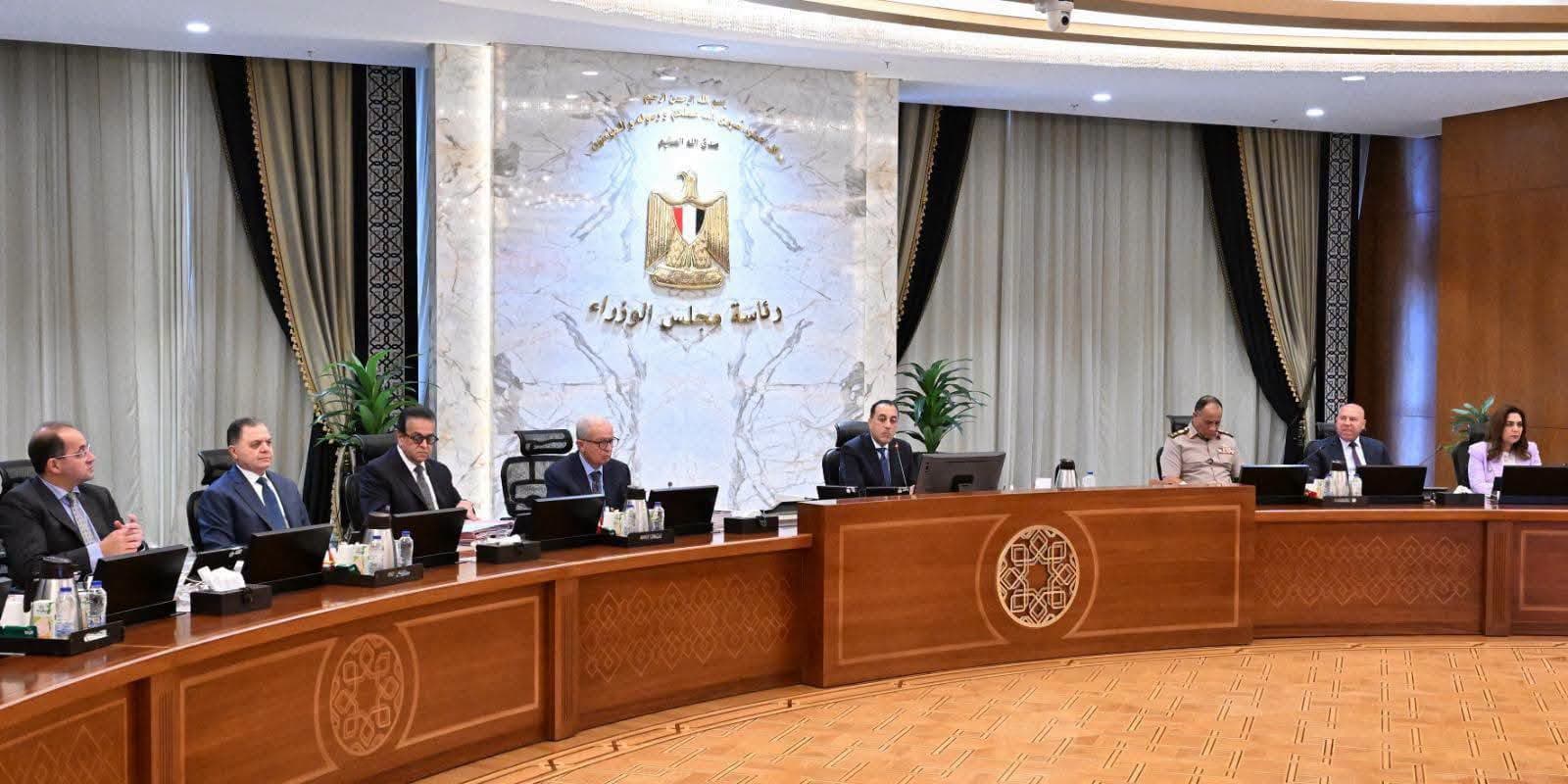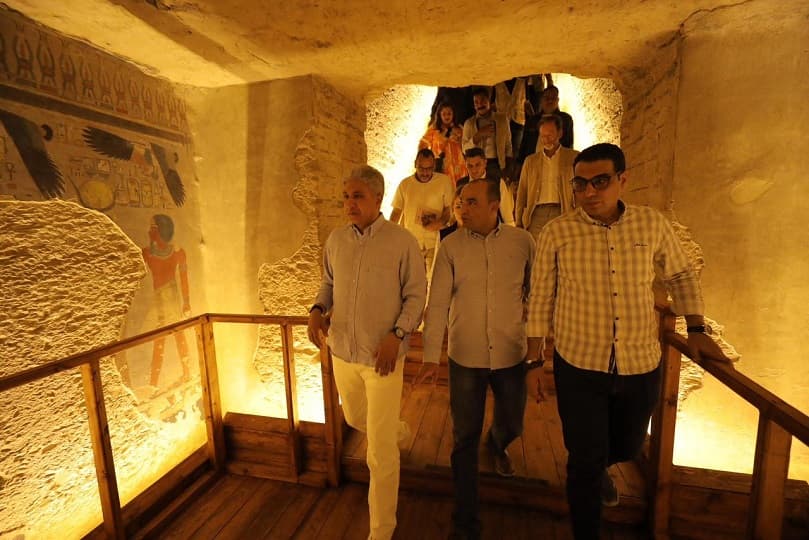
Sherif Fathy, Minister of Tourism and Antiquities, today opened the tomb of King Amenhotep III in the Valley of the Kings on the West Bank of Luxor, accompanied by Dr. Mohamed Ismail Khaled, Secretary General of the Supreme Council of Antiquities; Dr. Hisham Abu Zeid, Deputy Governor of Luxor; and Dr. Nuria Sanz, Director of the UNESCO Regional Office in Cairo, following the completion of a restoration project that lasted more than 20 years.
This came within the framework of the project "Conservation of the Wall Paintings of the Tomb of King Amenhotep III", implemented in cooperation between the Supreme Council of Antiquities and Japan's Waseda University and Higashi Nippon International University, under the auspices of the UNESCO/Japanese Funds-in-Trust.
In his speech, Fathy expressed his deep appreciation for the efforts made in implementing the tomb restoration project, extending his thanks and appreciation to the Japanese side and UNESCO for their support and fruitful cooperation in this project, which is an outstanding model of Egyptian-Japanese cooperation in the field of antiquities that has extended for decades and continues in many important archaeological projects.


He also commended the efforts of the Egyptian and Japanese restorers and experts who took part in the restoration work, stressing that their tireless effort and dedicated work over more than two decades is an exceptional and unparalleled achievement that helped restore the tomb to its original splendor and preserve it for future generations.

The Minister of Tourism and Antiquities made a point of inviting Egyptian restorer Mohamed Mahmoud, who had taken part in the tomb's restoration work since the beginning of the project and happened to be in the area, to the ceremony stage, where he expressed to the audience his overwhelming joy at seeing the fruit of his work crowned by the reopening of the tomb.

In this context, restorer Mohamed Mahmoud expressed his happiness on this historic day, noting that despite having reached the legal retirement age, he insisted on attending to witness the realization of the dream to which he had devoted more than 20 years of his professional life.

Dr. Mohamed Ismail Khaled noted that the tomb of King Amenhotep III is one of the most important and prominent tombs in the Valley of the Kings, expressing his great happiness at the completion of its restoration project and saying that today's celebration of its reopening makes it an outstanding addition to the tombs of the Valley of the Kings in particular, and to Egypt as a tourist destination in general, especially its cultural tourism product.
He praised the efforts of all the archaeologists and restorers of the Supreme Council of Antiquities who took part in the restoration work, and thanked the Japanese side and UNESCO for the fruitful partnership, stressing that this cooperation embodies a genuine passion for Egyptian antiquities and a keenness to preserve them and enhance their global standing.

For her part, Dr. Nuria Sanz reviewed the stages of work on the project, expressing her happiness that UNESCO was part of this achievement. She added that today is a celebration of many achievements, including the partnership between UNESCO, the Ministry of Tourism and Antiquities represented by the Supreme Council of Antiquities, and the Japanese side in this project, as well as the studies and research on the tomb and its inscriptions that helped reveal more about the tomb, and also a celebration of King Amenhotep III, one of the most important and greatest kings of ancient Egypt.

Restoration of the Tomb
It is worth noting that the project to conserve the wall paintings of the tomb of King Amenhotep III was carried out in three successive phases: the first phase ran from 2001 to 2004, followed by the second phase from 2010 to 2012, and then the third phase, which began in 2023 and continued until 2024.
The project was implemented by an international team of Egyptian, Italian and Japanese restoration experts, and this cooperation brought about a qualitative leap in conservation and restoration work inside the royal tomb.
Experts in stone restoration, wall painting conservation, architectural and civil engineering, rock monitoring and 3D scanning, as well as Egyptologists, also contributed to the restoration work.
Work during the first and second phases included the maintenance and restoration of the unique murals adorning the walls, pillars and ceilings of the tomb's chambers (E, I and J), in addition to significant progress in restoring the king's red granite sarcophagus lid. More than 200 fragments of the lid were successfully reassembled, its surface was cleaned, and it was then mounted on a metal base to present it in a manner befitting its historical status. The restoration work also included upgrading the stairways leading to the tomb and its lighting system.
The tomb's entrance has been equipped with informational and interpretive panels that allow visitors to learn about the history of the tomb and its owner, as well as an overview of the main restoration work carried out, in addition to a general plan of the tomb's interior to help guide visitors and provide a comprehensive learning experience.
This project is a pioneering model of international cooperation in the field of cultural heritage preservation, and an extension of the joint efforts that reflect the commitment of Egypt and its international partners to preserving the treasures of ancient Egyptian civilization for future generations, with appreciation for the efforts made to restore the tomb and its inscriptions, which have regained their original splendor.

Discovery of the Tomb
It is worth noting that the French engineers Prosper Jollois and Édouard de Villiers du Terrage discovered the tomb of King Amenhotep III during the French campaign in Egypt in 1799, although it had been known previously, as it was mentioned in the memoirs of British traveler William George Browne.
The tomb's contents were later fully uncovered by British archaeologist Howard Carter in 1915, a step that was an important addition to archaeological studies of the Valley of the Kings tombs. During the 19th century, the murals inside the tomb were damaged by the accumulation of salts on their surfaces, and the cracks in the pillars increased, affecting their structural and decorative integrity.
History of the Tomb
The tomb of King Amenhotep III is one of the largest royal tombs on the West Bank of Luxor and reflects the period of artistic and cultural prosperity in the New Kingdom era. It is distinguished by its unique decorations and colored inscriptions depicting religious and symbolic scenes of the king's journey in the afterlife, with the gods and with the spirit of his father. Its ceiling is decorated with yellow stars on a dark blue background representing the sky, and the walls of the burial chamber are adorned with texts from the Book of the Amduat.
Archaeological evidence indicates that work on the tomb began during the reign of King Thutmose IV, as his name was found inscribed in the foundation deposits, while his son King Amenhotep III completed its construction and decoration.
During the reign of King Smendes of the 21st Dynasty, the mummy of King Amenhotep III was moved, along with the other royal mummies, to the royal mummies cache later found in the tomb of King Amenhotep II (KV35), after the original tomb had been looted during periods of turmoil in ancient Egypt. Some archaeological evidence also indicates that the tomb was reused during the Third Intermediate Period.
The opening was attended by Eng. Ahmed Youssef, Assistant Minister of Tourism and Antiquities for Strategies and Acting CEO of the Egyptian Tourism Promotion Authority; Mohamed Ayoub, Chairman of the Chamber of Hotel Establishments; Dr. Hisham El-Leithy, Head of the Antiquities Documentation and Registration Sector at the Supreme Council of Antiquities; Mohamed Amer, Head of the Central Administration of Hotel Establishments, Shops and Tourist Activities; Mohamed Abdel Badie, Head of the Egyptian Antiquities Sector; Wagdy Abdel Ghaffar, Director General of Luxor Antiquities; and Rana Gohar, Advisor to the Minister for Communication and External Relations and General Supervisor of the Department of International Relations and Agreements.