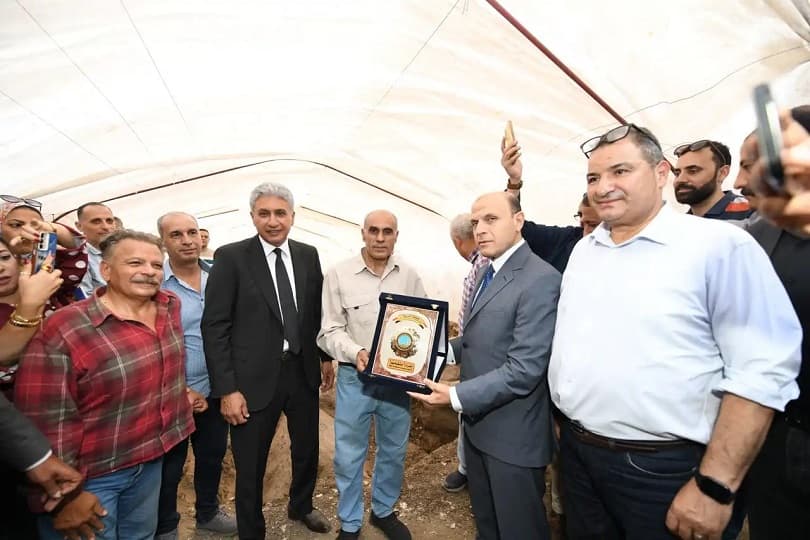
Tourism and Antiquities Minister Sherif Fathy visited Behbeit El-Hagar village in Gharbia Governorate, accompanied by Governor Major General Dr. Alaa Abdel Moaty, to inspect an archaeological discovery and honour resident Khaled El-Shahat Khalil. Khalil had reported an ancient stone block he found while working on land he owns in front of his home. The honour recognized his honesty, awareness and prompt action in reporting the discovery.
The minister thanked Khalil for reporting the artefact and handing it over to the competent authorities. He said this responsible action reflected citizens’ awareness of the importance of protecting Egyptian antiquities, their role in safeguarding the country’s cultural heritage and their willingness to cooperate with the state.
Fathy said Khalil’s report had enabled an Egyptian archaeological mission from the Supreme Council of Antiquities to make the important discovery during rescue excavations in the area. Prompt reporting allows specialists to handle finds according to established scientific and archaeological procedures, helping protect them for future generations.
The minister presented Khalil and his wife with a certificate of recognition and an Umrah trip in appreciation of his honesty, responsible conduct and initiative in reporting and handing over the archaeological stone block.
Fathy also inspected progress at the excavation site. The secretary general of the Supreme Council of Antiquities briefed him on the discovery and the results of the rescue excavations, which uncovered remains of two colossal royal statues. One depicts King Ramesses II, while the other is also believed to represent him. A pink granite block was also found, bearing hieroglyphic inscriptions that include several of his royal titles.
The minister said the archaeological area would receive greater attention in future excavations. Significant indications suggest that further important archaeological treasures may remain, potentially revealing more of the site’s historical and cultural secrets.
Fathy said he had wanted Khalil to be honoured in his own village, on his land and among his family and neighbours. This recognized his honesty, awareness and sense of responsibility, while highlighting an example of Egyptian citizens’ commitment to preserving their country’s heritage and setting a model for national responsibility.
Governor Alaa Abdel Moaty said the tribute recognized Khalil’s exemplary awareness, sense of belonging and commitment to protecting Egypt’s antiquities. He added that patriotic actions are measured not only by their scale, but also by the responsibility and appreciation of national history and civilization that they reflect.
The governor said Gharbia possessed diverse cultural and historical assets, including ancient Egyptian, Islamic and Coptic antiquities. Notable sites include Sa El-Hagar and Abusir Bana, alongside the collections of Tanta Museum and the historic city of Samannoud, strengthening the governorate’s cultural and religious tourism potential.
Visit to Behbeit El-Hagar Temple
Fathy and the governor also inspected Behbeit El-Hagar Temple in Samannoud district to assess the site’s current condition and examine options for its development and reconstruction, in keeping with its distinctive historical and archaeological value as an example of ancient Egyptian temples in Lower Egypt.
During the tour, Ihab Abdel Zaher, director general of antiquities affairs in the central Delta, and the temple’s archaeological team explained its history, the reasons for its destruction and the dispersal of its elements. They also outlined preliminary studies and work to inventory and document the ancient blocks and stones at the site. These indicate that the temple’s stones are complete, allowing the possibility of reconstruction and revival of its architectural elements to be studied.
Fathy emphasized the temple’s importance as one of Lower Egypt’s leading archaeological temples. He praised the team’s research, studies and documentation, as well as the preparatory steps taken to assess the project.
The minister directed officials to prepare a comprehensive proposal for the temple’s development and reconstruction as part of the ministry’s plans to develop and preserve archaeological sites and museums nationwide. The proposal should set out implementation phases, estimated costs and the necessary technical and scientific studies, ensuring that any work follows rigorous archaeological and scientific principles appropriate to the site’s historical value.
Behbeit El-Hagar Temple lies approximately 10 kilometres northwest of Samannoud in Gharbia Governorate. Dedicated to the goddess Isis, it covers around 20,000 square metres and is among the most prominent archaeological temples in Lower Egypt.
The temple dates to the Late Period, particularly the reign of King Nectanebo I, although archaeological evidence points to earlier origins. Discovered blocks and inscriptions confirm its religious and historical significance as a major centre of Isis worship in the Nile Delta.