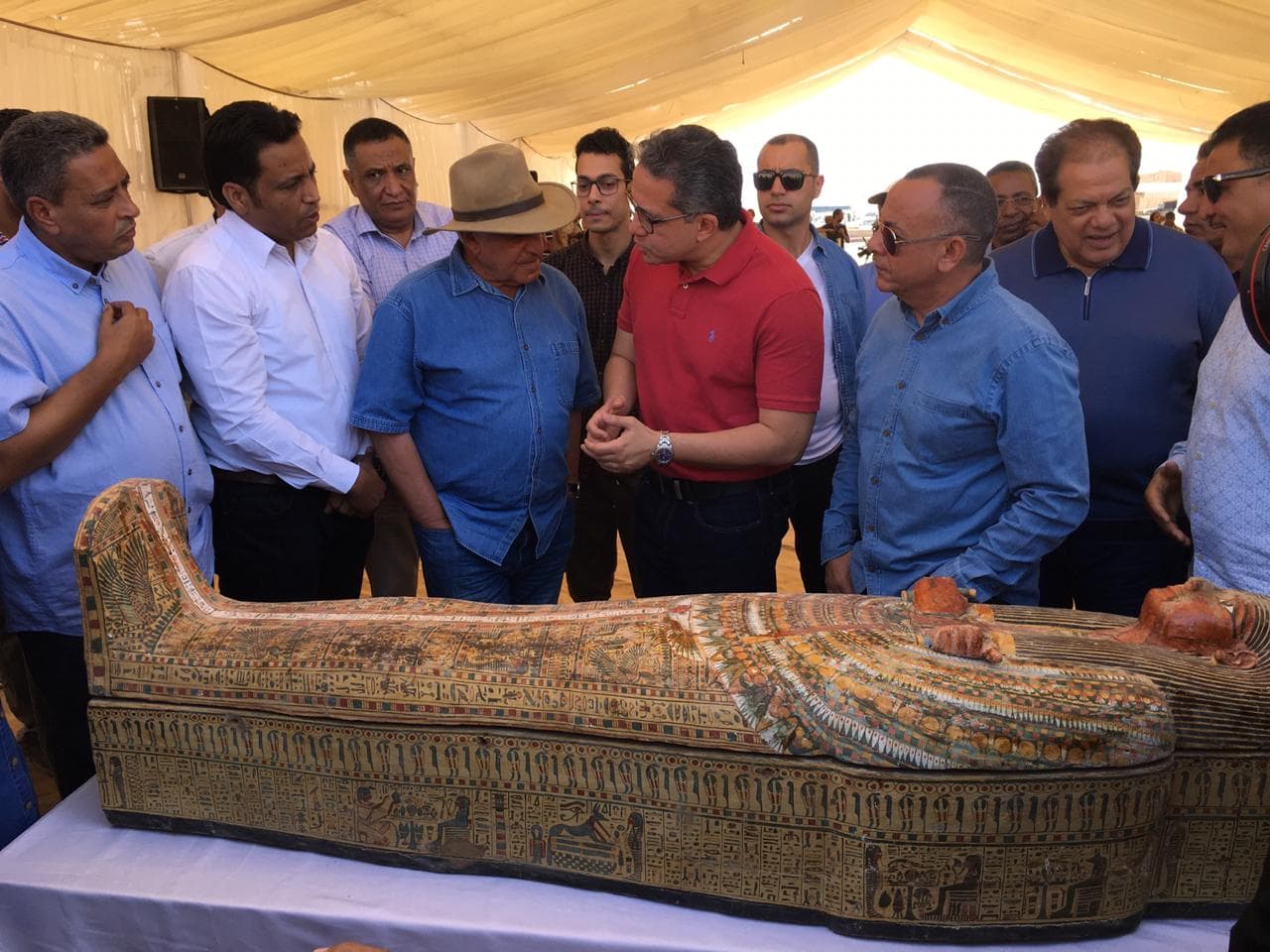
Amid global media coverage, Minister of Antiquities Dr. Khaled El-Enany officially announced this morning, Saturday, the success of the Egyptian archaeological mission headed by Dr. Mostafa Waziri, Secretary General of the Supreme Council of Antiquities, in uncovering the "Al-Assasif Cache" in Luxor, which includes a distinguished collection of 30 colored anthropoid wooden coffins of men, women and children, in a good state of preservation, with their colors and inscriptions complete. The announcement ceremony was attended by archaeologist Dr. Zahi Hawass and Luxor Governor Counselor Mostafa Elham.

El-Enany added that the coffins were found in the position in which the ancient Egyptians left them, sealed with the mummies inside, grouped together in a cache on two levels, one above the other; the first level held 18 coffins and the second 12. He described it as "the first large cache of anthropoid coffins to be discovered intact since the end of the 19th century, uncovered by Egyptian archaeologists in Luxor."

The Minister of Antiquities noted that among the most famous previous discoveries are two caches of royal mummies: the Deir El-Bahari cache, announced in 1881, and another cache found inside the tomb of King Amenhotep II in 1898, in addition to the Bab El-Gasus cache in 1891, inside which dozens of mummies of priests were found.
El-Enany praised the archaeologists in Luxor, as this is the first cache to be discovered by Egyptian archaeologists. He stressed that the claims raised by some, casting doubt on the discovery before it was announced by saying the coffins had been buried in 1967, do not deserve attention and are nothing more than malicious rumors with no basis in truth or evidence, aimed at undermining any success the ministry achieves that draws the world's attention to Egypt and its civilization.

For his part, Dr. Mostafa Waziri explained that the story of the cache's discovery began about two months ago, when excavation work for this season started, continuing the work of the previous season that began in 2018, which uncovered several tombs, including the original entrance of tomb TT 28 and two tombs of "Thaw-Irkhetef" and "Meryre" from the Ramesside era. This season, the excavation area was expanded to include the eastern part of the courtyard, where work began last season, resulting in the discovery of the "Al-Assasif" cache, which includes 30 wooden coffins of priests, priestesses and children from the 22nd Dynasty, in the 10th century BC, that is, some 3,000 years ago.


The cache includes a group of coffins of priests and priestesses of the Luxor deities Amun and Khonsu, numbering 30 so far, among them 3 coffins of children, and it lies above tomb TT 28. The coffins are distinguished by providing evidence of the different stages of coffin-making in that period: some have complete decoration and colors, some are in the early stages of manufacture, some were finished but the engraved scenes had not yet been added, and some were carved with parts decorated and other parts left blank without decoration.

The scenes engraved on the sides of the coffins depict various subjects, including offerings to deified kings such as King Amenhotep I, who was worshipped in the Deir El-Bahari area, scenes of gods, and scenes from the Book of the Dead, as well as a number of texts bearing the titles of the coffins' owners, such as Chantress of Amun, and texts of speeches by various gods.
Today, this cache stands as a witness to a historical period of instability in which tomb robberies spread and the building of huge tombs declined, and in which the coffin played an important role as a tomb to preserve the body. The scenes previously placed on tomb walls found their place on the sides of the coffin, and they show the cache's connection to the area, as they depict the goddess Hathor and King Amenhotep I, whose worship spread in the Deir El-Bahari area, of which the Al-Assasif necropolis is considered part.
As for the method of burial in groups, it was a previously known practice: the Bab El-Gasus cache of priests and priestesses of Amun from the 21st Dynasty was found near the Temple of Queen Hatshepsut, although it differed in number.
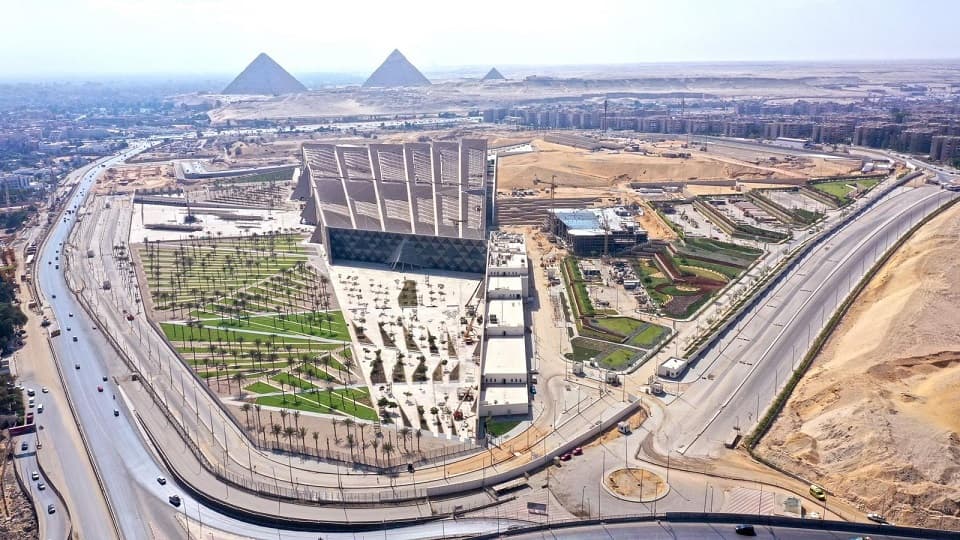
In a related context, Dr. El-Tayeb Abbas, Director General of Archaeological Affairs at the Grand Egyptian Museum, stated that the entire collection will be moved to the Grand Egyptian Museum, where a hall has been allocated to display the whole collection. It will be transferred after the completion of initial restoration work by a specialized team from the Egyptian Museum's restoration center, in cooperation with restorers from the Luxor antiquities area.