By Akram Medhat
Dr. Khaled El-Enany, Minister of Antiquities, announced this morning, Saturday, the discovery of a new tomb in the Dra Abu el-Naga area on the West Bank of Luxor and the rediscovery of another tomb.
El-Enany said that our Pharaonic ancestors are still playing their role in the country's advancement, as through these recent discoveries they are lending us a helping hand in reviving the Egyptian economy and restoring inbound tourism to Egypt, given their positive impact abroad.
El-Enany expressed his full appreciation for the great support the ministry receives from Luxor Governorate every time a new discovery is announced, especially as 2017 is considered the year of new discoveries, particularly in Luxor Governorate.
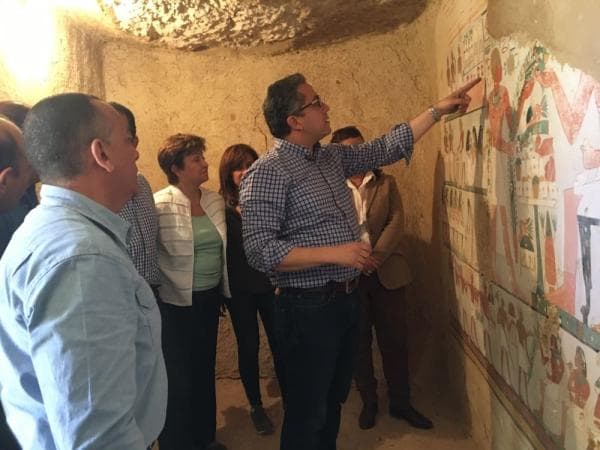
The new discovery was announced amid extensive local and international media coverage, and Dr. Ghada Wali, Minister of Social Solidarity, Sahar Talaat Moustafa, head of the Tourism and Aviation Committee of the House of Representatives, and a number of MPs visited the two tombs.

For his part, Dr. Mostafa Waziri, Secretary General of the Supreme Council of Antiquities and head of the Egyptian archaeological mission that made the discovery, explained that the tomb discovered for the first time bears the name Kampp 161, as German Egyptologist Friederike Kampp only numbered it in the 1990s and it was never worked on. The second tomb bears the number Kampp 150; Kampp numbered it and worked on it only as far as the entrance, and work on it was not completed until the Egyptian archaeological mission rediscovered it.
It is worth noting that tomb Kampp 161 lies north of tomb TT225 and tomb Kampp 157, which was discovered last April and belongs to the city judge Userhat.
Although the name or title of the tomb's owner was not found in any inscription inside it, it most likely dates to the period from the reign of King Amenhotep II to Thutmose IV, having been dated through the artistic style of the inscriptions and comparison with many private tombs in the Theban necropolis from the same period.
The tomb consists of a courtyard whose sides were reinforced with walls of stone and mud brick. It contains a shaft on the southern side reaching 6 meters deep and ending in four side chambers.
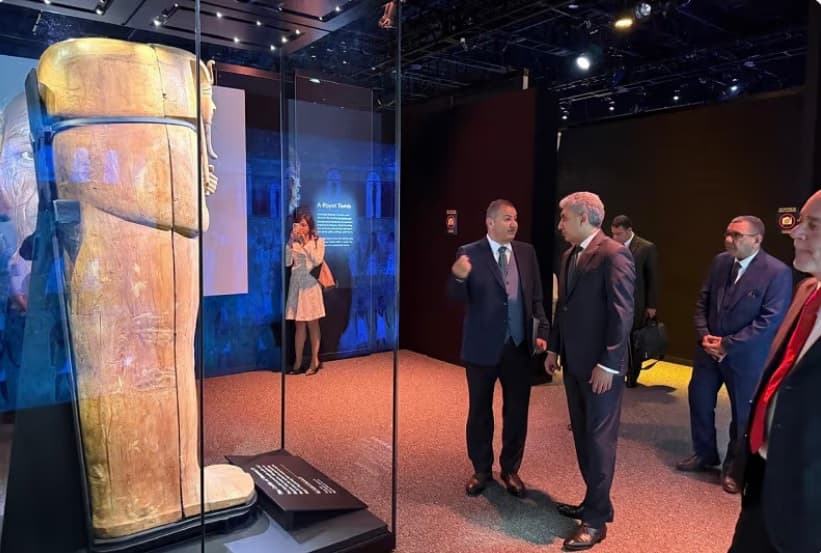
A number of artifacts were found inside the tomb, consisting of wooden parts of several coffins, most importantly a large wooden mask forming part of an Osiride-shaped coffin, and a small painted wooden mask.

Tomb Kampp 150 lies south of tomb Kampp 157 and next to tomb TT167, and dates to the end of the 17th Dynasty and the beginning of the 18th Dynasty, as a cartouche bearing the name of King Thutmose I was found on the ceiling of the tomb's longitudinal hall. However, there are no texts precisely identifying the tomb's owner, though there are several possibilities. The first is that it belongs to a person named Djehutymes, "true of voice", as the last part of the text carved on the facade of the entrance to the tomb's longitudinal hall ends with his name.
The second possibility is that it belongs to a person named Maati, who held the post of scribe, as more than 100 funerary cones were found in the courtyard and the transverse hall of the tomb, about 50 of which belong to Maati and his wife Mehi.
The tomb has five entrances on the eastern side opening onto a ruined transverse hall containing two shafts: the first, on the northern side, where excavation work has not yet been completed, and the second, on the southern side, which has been completed. This is followed by a longitudinal hall leading to another hall containing two shafts, one on the northern side 10 meters deep and the other on the southern side 7 meters deep.
The southern shaft contains a burial chamber of a woman named Isis Nefert, most likely the mother of the tomb's owner. Inside it were found parts of a wooden coffin, as well as 36 uninscribed wooden ushabti figurines, in addition to a 60 cm wooden ushabti of Isis Nefert in Osiride form.

Found inside the tomb were 100 funerary cones, painted wooden masks, 450 statuettes made of various materials including faience, wood and pottery, a collection of pottery vessels of different shapes and sizes, and a mummy embalmed and wrapped in linen which, according to an initial study, belongs to a person of high standing. Work is now under way to identify its owner.