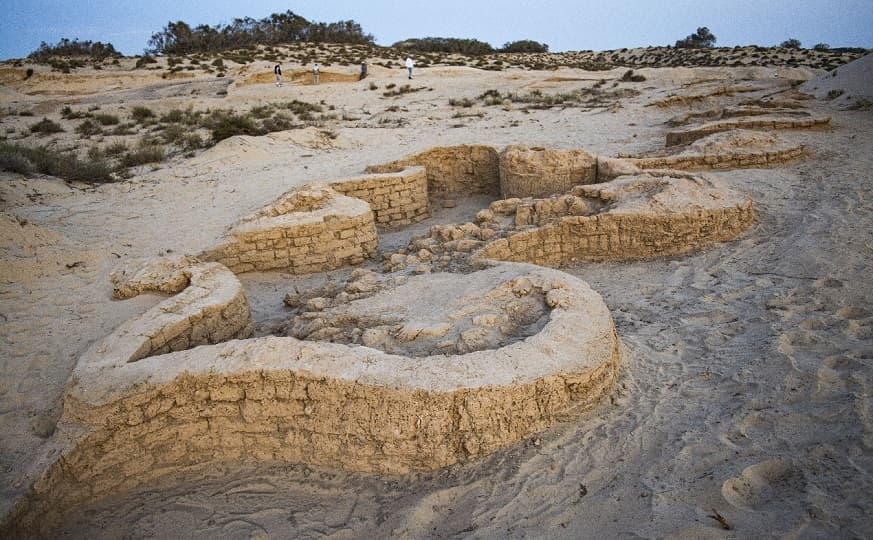
The Egyptian archaeological mission working at the Tell El-Kharouba archaeological site in the Sheikh Zuweid area of North Sinai has uncovered a military fortress from the New Kingdom era, one of the largest and most important fortresses discovered on the Horus Military Road, located near the Mediterranean coast.
This archaeological discovery is a new addition confirming the brilliance of the military planning of the New Kingdom kings, who built a series of fortresses and defensive fortifications to protect Egypt's eastern borders and secure the most important strategic routes that linked ancient Egypt with Palestine.
In this context, Sherif Fathy, Minister of Tourism and Antiquities, said this discovery is a tangible embodiment of the ancient Egyptians' genius in building an integrated defensive system to protect the land of Egypt, tells new chapters of the country's ancient military history, and enhances Sinai's standing as a land bearing unique evidence of civilization throughout the ages.
For his part, Dr. Mohamed Ismail Khaled, Secretary General of the Supreme Council of Antiquities, explained that the discovery of this massive fortress is an important step in reconstructing the complete picture of the network of Egyptian fortifications on the eastern border during the New Kingdom, adding that every fortress discovered adds a new building block to the understanding of the military and defensive organization of Pharaonic Egypt, and confirms that Egyptian civilization was not limited to temples and tombs, but was a state of strong institutions capable of protecting its land and borders.
He stated that the excavation work resulted in uncovering part of the fortress's southern wall, about 105 meters long and 2.5 meters wide, with a secondary entrance 2.20 meters wide in its middle, in addition to 11 defensive towers uncovered so far. The northwestern tower and parts of the northern and western walls were also uncovered, as the mission faced major challenges due to shifting sand dunes that covered large parts of the site.


In a related context, Mohamed Abdel-Badie, Head of the Egyptian Antiquities Sector, said the mission also uncovered a 75-meter-long zigzag wall on the western side of the fortress, dividing it from north to south and surrounding a residential area designated for soldiers, a distinctive architectural design of the New Kingdom era that reflects the ancient Egyptian architect's ability to adapt to the harsh environment.
Various pottery sherds and vessels were also found, including foundation deposits beneath one of the towers dating back to the first half of the 18th Dynasty, as well as a vessel handle stamped with the name of King Thutmose I. Quantities of volcanic stones, likely transported by sea from volcanoes on the Greek islands, were also found, along with a large oven for baking bread and, next to it, quantities of petrified dough, confirming that the fortress was an integrated center for the soldiers' daily life.


Dr. Hisham Hussein, Head of the Central Administration for Lower Egypt Antiquities, explained that preliminary studies have shown that the fortress underwent several phases of restoration and modification over the ages, including changes to the design of the southern entrance more than once, while the mission hopes to complete excavation work to uncover the rest of the walls and associated structures, and the military port that served the fortress is expected to be found in the area near the coast.
He added that the area of the new fortress is about 8,000 square meters, three times the size of the fortress discovered at the same site in the 1980s, which lies about 700 meters southwest of the current fortress. This fortress is a new addition to the series of military fortresses discovered on the Horus Military Road, most notably Tell Habua, Tell El-Borg and Tell El-Abyad, all dating back to the New Kingdom era.