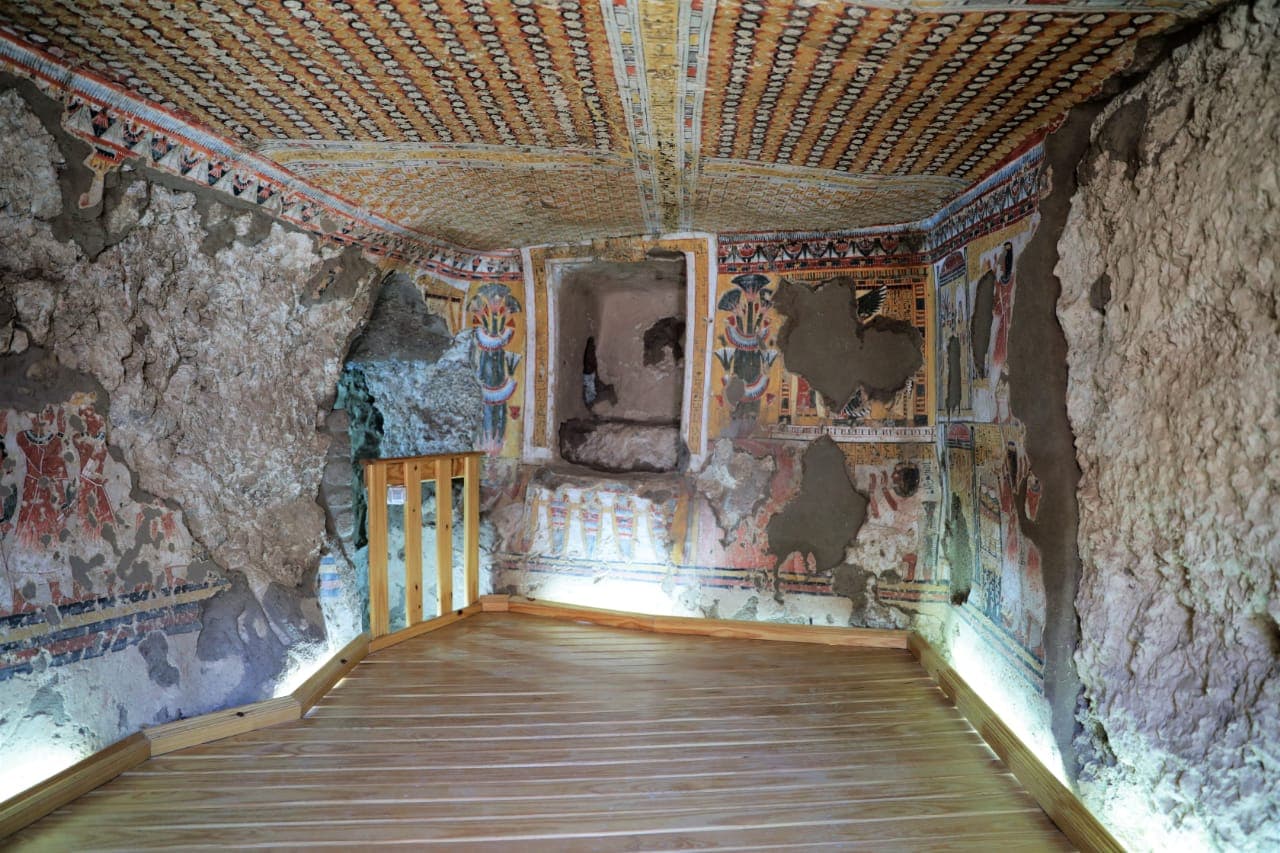
Dr. Khaled El-Enany, Minister of Antiquities, announced the completion of restoration work on tombs No. (TT159) and (TT286) in the Dra Abu El-Naga necropolis on the West Bank of Luxor, and the restoration of 4 chapels at the Temple of Khonsu in Karnak, in the presence of Thomas Goldberger, Chargé d’Affaires of the US Embassy in Cairo, Counselor Mostafa Elham, Governor of Luxor, and Louise Bertini, Director of the American Research Center in Egypt.

The restoration work was carried out by an Egyptian-American mission from the American Research Center in Egypt (ARCE) and the Ministry of Antiquities, with a grant of 35 million pounds from the United States Agency for International Development (USAID), to restore two tombs of nobles in the Dra Abu El-Naga area and 4 chapels at the Temple of Khonsu in Karnak, through field conservation schools that held a series of practical training sessions for more than 300 archaeologists and conservators at the Ministry of Antiquities.

Tomb (TT159) dates back to the 19th Dynasty and belongs to a man named “Raya” and his wife “Mutemwia.” He held the position of Fourth Priest of Amun, and among the most important scenes in the tomb are those depicting the Book of Gates and funerary scenes.
Tomb (TT286) belongs to a man named “Niay,” who held the position of scribe of the table in the 20th Dynasty. The walls of this tomb are decorated with colorful scenes depicting daily life and funerary scenes.
In his speech, Dr. Khaled El-Enany, Minister of Antiquities, stressed the continuous cooperation between Egypt and the United States in archaeological work, which has resulted in the completion and opening of many projects to lower the groundwater level, including at the Kom El-Shoqafa archaeological area in Alexandria and Kom Ombo in Aswan.
For his part, Thomas Goldberger, Chargé d’Affaires of the US Embassy in Cairo, said the United States is committed to its partnership with the Ministry of Antiquities to preserve Egypt’s cultural heritage, adding that such programs help create lasting jobs and achieve prosperity for Egypt.
In a related context, the Minister of Antiquities inspected the completed restoration of 4 chapels at the Temple of Khonsu, where their ceilings and walls were consolidated and restored, the columns and scenes were cleaned, and the old restoration carried out in the 1960s and 1970s was removed so that restoration work could be done according to modern scientific methods. In addition, the gate of Ptolemy III linking the Temple of Khonsu to the Avenue of Sphinxes was restored. The mission also installed wooden walkways to ease access to the temple and facilitate visits, and a laboratory equipped with the latest scientific means was set up to speed up and facilitate restoration work and train young conservators and archaeologists.

It is worth noting that Khonsu is the moon god in ancient Egyptian religion and the son of Amun and Mut in the Theban Triad. The Temple of Khonsu in Karnak is one of the distinctive temples and a complete model of the ancient Egyptian temple. Its construction was begun by King Ramesses III and continued after him by his son Ramesses IV, then Ramesses XI, and it was finally completed by “Herihor,” the high priest who became the last king of the 20th Dynasty.