A British television crew has finished filming a documentary titled "Egypt Lost City Drain" to shed light on Egypt's sunken antiquities. According to a statement issued by the Foreign Correspondents Center in Aswan, Egyptologist Bob Bianchi, who has studied Egyptian heritage for about 15 years, said the film will be broadcast on National Geographic next October, as reported by Egypt Independent.
For his part, Ahmed Ali, director of the center, explained that the documentary is part of a 10-episode series that sheds light on sunken antiquities and presents scientific facts and digital achievements that have helped uncover wrecks, treasures and sunken cities around the world, including in the Gulf of Mexico, the Nile River, the Indian Ocean, the Atlantic Ocean and the Baltic Sea.
It is worth mentioning that the documentary was filmed in several areas, including the temples of Abu Qir in Alexandria, and Kom Ombo and Edfu in Aswan, and the film also covers other sites, including the Nile islands and many fields along the banks of the Nile.
It is worth noting that the Egyptian-European archaeological mission of the European Institute for Underwater Archaeology has concluded its archaeological season at the site of the ruins of the sunken cities of Canopus and Heracleion in Abu Qir Bay in Alexandria, which lasted nearly two months.
Ehab Fahmy, head of the Central Administration of Underwater Antiquities, explained that all marine survey work this season was carried out using the SSPI sub-seabed tomographic scanner, the latest tomographic scanning device, which transmits images of archaeological evidence lying on the seabed or buried beneath it. He noted that the archaeological survey at the site of the ruins of Canopus uncovered the remains of a group of buildings that give the city of Canopus another extension of 1 km to the south, where the remains of a port were found along with a collection of pottery vessels from the Saite period, gold and metal coins, and gold jewelry including rings and earrings, in addition to bronze coins from the Ptolemaic period and gold coins from the Byzantine period, suggesting that the city was inhabited between the fourth century BC and the Islamic era.

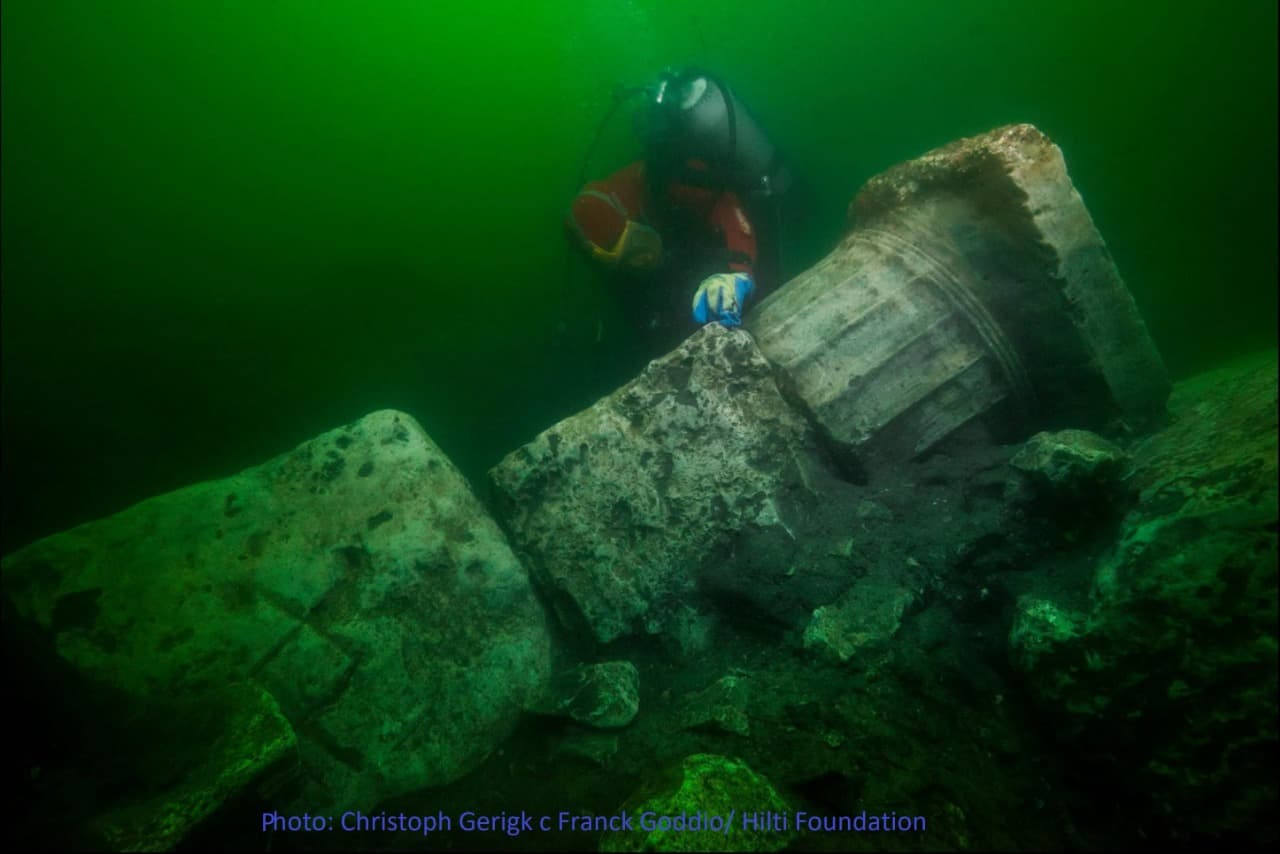
As for the site of the ruins of the sunken city of Heracleion, Franck Goddio, head of the mission, explained that the mission uncovered part of a completely destroyed temple inside the southern canal, which is the city's main temple (Amun-Gereb), in addition to many storage pottery vessels and tableware from the third and second centuries BC, bronze coins from the reign of King Ptolemy II, and parts of Doric columns, which had been preserved under 3 meters of silt on the seabed, as well as the remains of a smaller Greek temple within the silt of the canal.
Goddio noted that survey work at the site using the SSPI device revealed another extension of the port of Heracleion, consisting of a group of previously unknown harbors.
Fahmy added that some of the previously discovered ancient shipwrecks, numbering 75, were also studied, including a ship in the ancient Egyptian style from the end of the fifth century BC, which Herodotus described as being of the Baris type, such as shipwreck No. 6 and shipwreck No. 17, in addition to ritual procession boats such as shipwreck No. 11.
In the same context, Fahmy explained that shipwreck No. 61, on which a specialized Egyptian team had been working over four seasons, has been fully uncovered. The team found that the ship is 13 meters long and 5 meters wide, and was buried in silt at a depth ranging from one to three meters, and many pottery and metal vessels, coins and jewelry were found in it. The wreck can tentatively be dated to the fourth century BC, and it is currently being studied in preparation for its scientific publication jointly with the mission.