By Akram Medhat
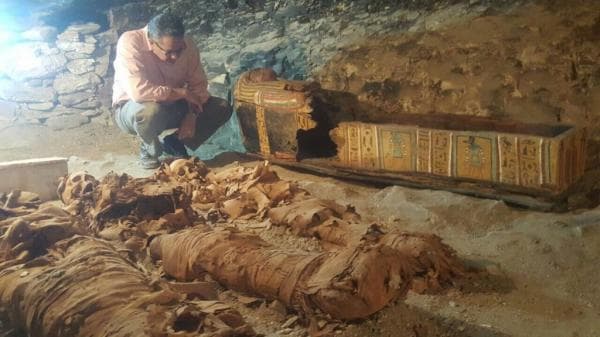
Minister of Antiquities Dr. Khaled El-Enany today announced a new archaeological discovery of the contents of the tomb of the "goldsmith of the god Amun", named "Amenemhat", made during excavation work by the Egyptian archaeological mission in the Dra Abu el-Naga area on Luxor's West Bank. The mission also uncovered a burial shaft in the outer courtyard, inside which three mummies of a woman and her two sons were found, along with a number of pottery vessels. The event received wide local and international media coverage.

The announcement of the discovery was attended by Luxor Governor Mohamed Badr, a number of members of the House of Representatives, ambassadors of foreign countries, cultural attachés and directors of foreign archaeological institutes in Egypt.
For his part, Dr. Mostafa Waziri, Director General of Luxor Antiquities, explained that the discovered tomb dates back to the New Kingdom, 18th Dynasty, and consists of an entrance leading to a semi-square chamber ending in a stela bearing a text with the name of the tomb's owner. It contains a mudbrick base on which stands a dual statue of the tomb's owner and his wife, and between them the remains of a small statue of their son, named "Nebnefer".

He continued: "To the right of the entrance is the tomb's main shaft, most likely dug for the tomb's owner and his wife. It is about 7 meters deep and leads to an opening with several burials, inside which a collection of coffins, mummies, wooden masks and some small statues were found."
To the left of the tomb's entrance is an opening leading to a shaft in which a collection of coffins dating to the 21st and 22nd Dynasties was found, some of which had been deliberately burned in the Late Period.

Waziri stressed that the importance of this tomb lies in what was found inside it: parts of a limestone "offering" stela of the tomb's owner; a sandstone dual statue of a person named "Mehu", who worked as a merchant at the temple of Thutmose III; the remains of 4 wooden coffins decorated with hieroglyphic inscriptions and scenes of various deities, dating to the 21st and 22nd Dynasties; and 150 ushabti figurines made of faience, wood, fired clay and limestone, some of which bear the names "Pakhonsu" and "Ankhkhonsu".

The mission also succeeded in uncovering 50 funerary seals, 40 of which indicate the existence of tombs of four individuals not yet discovered in the area: the scribe "Maati", a person named "Pengy", another named "Ruru" and the vizier "Ptahmes".
The mission found a number of pottery vessels, in addition to two faience amulets bearing offering scenes, two headrests, 7 ostraca of pottery and limestone, and a model of a pottery coffin with inscriptions in black ink.

As for the shaft discovered in the outer courtyard, Mohamed Baabish, a member of the Egyptian mission working at the site, said that the two coffins found inside it are made of cedar wood and are rectangular. One contains the mummy of a woman, while the other holds two mummies of children, which suggests that the shaft served as a family burial.
Shereen Ahmed Shawky, a member of the mission specializing in the study of human bones, confirmed that a study of the woman's mummy showed she was in the fifth decade of her life, while of the other two mummies, one belongs to a young man in the third decade of his life, and the other, poorly mummified with its bones left bare, belongs to a young man in the second decade of his life, noting that work in the tomb has not yet been completed.