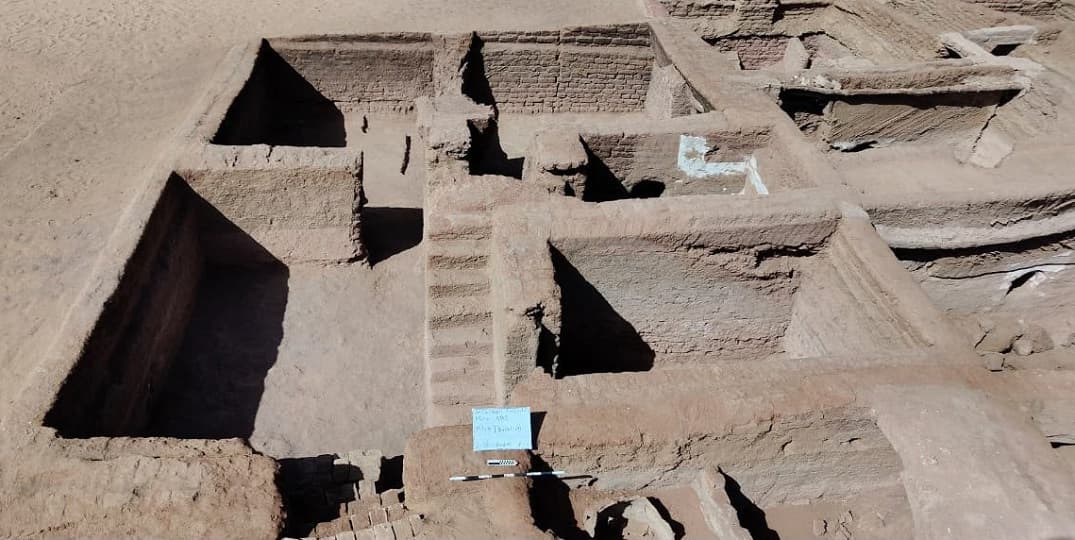
The Egyptian archaeological mission of the Supreme Council of Antiquities working at the Ain El-Sabil archaeological site in Dakhla Oasis in New Valley governorate has uncovered an integrated residential city dating back to the Byzantine period, with all its buildings constructed of mudbrick, as part of ongoing excavations at the site.
Minister of Tourism and Antiquities Sherif Fathy said the discovery is an important addition to the record of Egyptian archaeological discoveries, helping to highlight the civilizational diversity Egypt's oases have witnessed through the ages, noting that such discoveries enrich the tourist and archaeological destinations of New Valley governorate and support the state's efforts to develop the region and strengthen its position on the cultural tourism map.
For his part, Dr. Hisham El-Leithy, Secretary-General of the Supreme Council of Antiquities, explained that the importance of the discovery lies in the new and precise information it provides about the daily life of Egyptian society in Dakhla Oasis during the Byzantine period, noting that the results of the excavations have helped document many urban, social and economic aspects of the region during that period.
Dr. Diaa Zahran, Head of the Islamic, Coptic and Jewish Antiquities Sector at the Supreme Council of Antiquities, noted that the discovered city followed an organized urban plan, with main streets running from north to south intersected by cross streets from east to west, forming squares and open spaces, with a basilica church at its center overlooking one of the main streets.
Dr. Mahmoud Masoud, Director General of Dakhla Antiquities and head of the mission, added that the city included all the architectural elements needed for an integrated residential community, including the basilica church dating back to the mid-4th century AD, the remains of two watchtowers at the edges of the city, a fortress with thick walls and a group of houses with large halls and vaulted ceilings, as well as bread ovens, kitchens and grain-grinding tools.
The most notable buildings uncovered include the house of Tisos, a deacon of the church, dating back to the second half of the 4th century AD, and the house of Tabibos, dating back to the early 4th century AD, which was likely used as a house church before the basilica church was built in the city.


The excavations also yielded a distinctive collection of artifacts reflecting many aspects of the daily life and economic activities of the city's inhabitants, including pottery vessels for household use, bottles for storing oils and perfumes, oil lamps for lighting and the remains of stone tools used for grinding grain.


Dr. Zahran, Director of the Excavations Department at the Islamic and Coptic Antiquities Sector, added that among the most important finds is a large collection of written documents, around 200 ostraca inscribed in Coptic and Greek, documenting sales and purchases, correspondence and other details of the inhabitants' daily life.
The mission also found a large number of well-preserved bronze coins bearing images of Byzantine emperors, Latin inscriptions and Christian symbols, as well as a group of gold coins dating back to the reign of the Byzantine Emperor Constantius II, who ruled the empire from 337 to 361 AD.