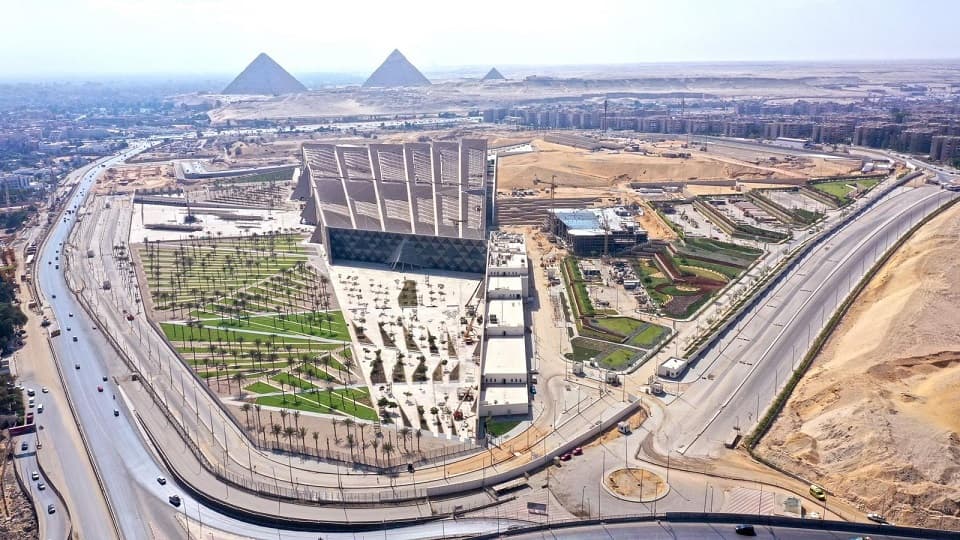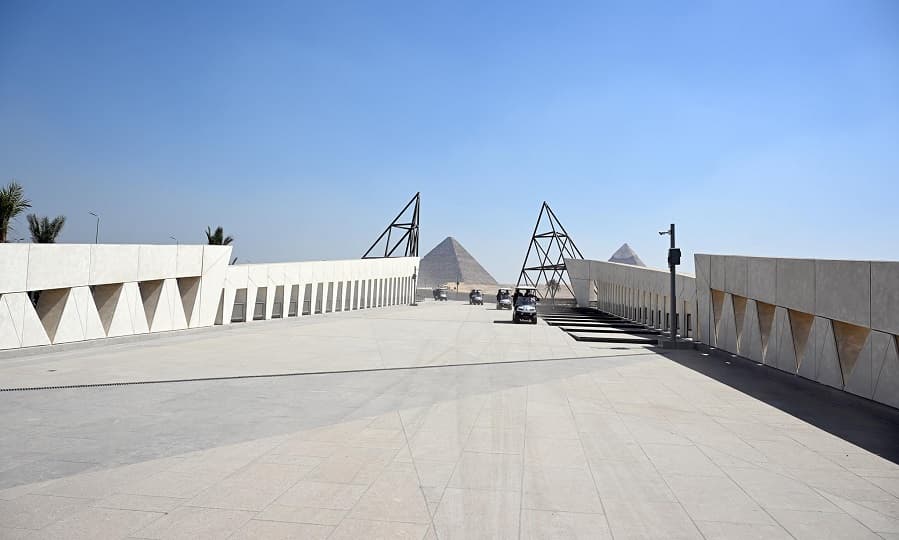
Prime Minister Dr. Mostafa Madbouly and his accompanying delegation inspected the “Tourist Walkway” linking the Grand Egyptian Museum and the Pyramids area, as part of preparations for the museum's upcoming opening on November 1.
During his inspection tour of the Tourist Walkway, the Prime Minister was briefed by Sherif Fathy, Minister of Tourism and Antiquities, who said the state is preparing to open the Grand Egyptian Museum in a way that strengthens Egypt's position as a leading global tourist destination, noting that the museum's opening is one of the important events eagerly awaited worldwide, and praising the great efforts made by the state through its various agencies to complete all arrangements for the opening and to develop the area surrounding the museum.
In this context, the minister explained that the Tourist Walkway links the Grand Egyptian Museum and the Pyramids area, noting that it has a distinctive civilizational and architectural character and reaches the Pyramids archaeological site while preserving the area's visual identity.
The Prime Minister was also briefed by Major General Atef Meftah, General Engineering Supervisor of the Grand Egyptian Museum and Surrounding Area project, who said the walkway extends for about 1.27 km, with an average width ranging from 13.5 meters to 27.5 meters.
He explained that the Tourist Walkway starts from the Grand Egyptian Museum's parking area, passing along the Fayoum Road, where the visual identity of the Grand Egyptian Museum is applied, and reaches inside the archaeological site with its historical and civilizational identity and fabric.
He noted that the walkway was designed and built to a world-class standard befitting the importance and value of the area, as part of the state's comprehensive tourism plan to upgrade the Pyramids archaeological site and the museum's surroundings, providing a direct and comfortable route between the museum and the Pyramids area that can be traveled on foot or by eco-friendly electric vehicles.
Meftah pointed out that the Tourist Walkway has contributed significantly to improving the aesthetic appearance of the Pyramids area and offering an integrated and distinctive tourist experience to visitors from around the world, according to the official Facebook page of the Egyptian Cabinet.
In a related context, Prime Minister Dr. Mostafa Madbouly followed up on the development work under way in the area surrounding the Grand Egyptian Museum and the roads leading to it, and stressed the need to complete the ongoing development work in the area surrounding the museum in a manner befitting the importance of the museum as the largest edifice for displaying antiquities in the world and in line with its civilizational and cultural value. He affirmed the state's interest in developing and upgrading this area to the highest level, as a civilizational and tourist facade for Egypt, in a way that contributes to improving the area's visual appearance, attracting more tourist traffic to it and providing a unique experience for visitors.
Madbouly stressed that the government has upgraded and developed all roads leading to the Grand Egyptian Museum and the Pyramids area, noting that a huge road network was designed and built to facilitate access to the area, taking into account integration between the Grand Egyptian Museum and all surrounding sites through the network of roads and axes leading to it, contributing to an integrated civilized appearance befitting the archaeological and historical value of the area and providing various services to visitors and tourists.


For her part, Hend Abdel Halim, Deputy Governor of Giza, said the work is being carried out according to the highest quality standards to ensure the area appears in its finest civilized form, reflecting Egypt's standing before the world. She explained that the development work included roads, squares, sidewalks, lighting, tree planting and landscaping, site coordination and the coordination of advertising signs, adding that it also included upgrading infrastructure and improving traffic flow on the axes leading to the museum.
Dr. Mostafa Madbouly began his tour by stopping at the “New Statue” area at the entrance of the Cairo-Alexandria road leading to the Grand Egyptian Museum, near the toll gate, where it was pointed out that the statue was designed and executed under the supervision of Dr. Tarek Sobhy, the project consultant, as part of efforts to develop the area surrounding the museum, and that it is a “work of art” expressing the surrounding environment, as it is inspired by ancient Egyptian civilization and was skillfully designed to blend ancient Egyptian art with modern contemporary art.


Concrete pouring and the installation of the statue on its base have been completed, while welding and marble installation are nearing completion. Palm planting has been 100% completed, and “electrical works” are about to begin, with 100% of the palm floodlights supplied. In this context, the Prime Minister directed the swift completion of lighting works and the provision of the necessary illumination for the statue, as well as the leveling and paving of the area where the statue is located.
Dr. Mostafa Madbouly then moved on to inspect the “Hazem Hassan Tunnel” area at Remaya Square, passing through El-Rakab and the area in front of the Giza Security Directorate up to the Hazem Hassan Tunnel. He then inspected the “Remaya Square” area, before heading to inspect the Fayoum Road from Remaya Square to the Tourist Road, passing through El-Rakab and the area behind the museum next to the Ring Road expansions, as well as development work on the Cairo-Alexandria Desert Road, according to the official Facebook page of the Egyptian Cabinet.