The two domes added to the map of archaeological sites open to visitors
Sherif Fathy, Minister of Tourism and Antiquities, and Dr. Ibrahim Saber, Governor of Cairo, accompanied by Dr. Mohamed Ismail Khaled, Secretary General of the Supreme Council of Antiquities, and Ambassador Gareth Bayley, the United Kingdom's Ambassador in Cairo, today opened the Fatimid dome of Yahya al-Shabih and the Mamluk dome of Safi al-Din Jawhar following the completion of their restoration project.
Also attending the opening were Moamen Othman, Head of the Museums Sector at the Supreme Council of Antiquities; Mark Howard, Director of the British Council in Cairo; and Dr. Khaled Salah, First Undersecretary of the Ministry of Awqaf in Cairo.
The project was carried out by the Athar Lina initiative of Megawra – Built Environment Collective, under the supervision of the Ministry of Tourism and Antiquities, represented by the Supreme Council of Antiquities, and funded by the British Council's Cultural Protection Fund in partnership with the UK Department for Digital, Culture, Media and Sport. It is part of the “Irth – Heritage and Climate” programme, launched in 2023 and successfully completed at the end of 2024, which aimed to integrate the conservation of historic and archaeological architectural heritage with tackling the effects of climate change through a series of technical, community and educational interventions.
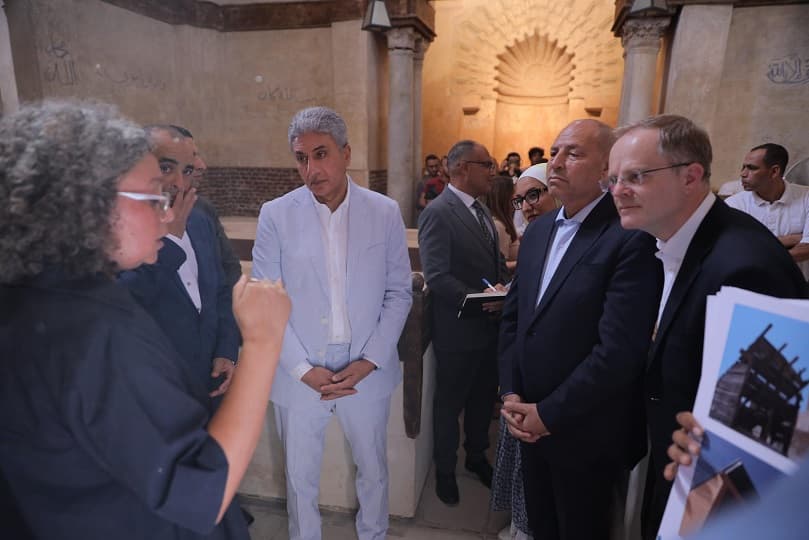
After the opening ceremony, the minister, the governor and their delegation toured the two domes, where they heard a detailed explanation from Dr. May al-Ibrashy, Chair of the Board of the Built Environment Collective – Megawra and coordinator of the Irth project, on the restoration and upgrading works carried out and on the historical and archaeological significance of the two domes. They also watched a documentary highlighting the condition of the domes before the restoration project and the various stages carried out to restore their splendor, which also sheds light on the efforts made to raise tourism and archaeological awareness among the communities surrounding the monument and to involve them in developing the area.
In his speech at the opening, Sherif Fathy expressed his deep appreciation for the fruitful cooperation in implementing the project to restore the domes of Yahya al-Shabih and Safi al-Din Jawhar, describing it as a model of constructive cooperation with supporting bodies. He thanked the Supreme Council of Antiquities and the Megawra Built Environment Collective for their great efforts in implementing the project, as well as the British Embassy and the British Council in Cairo for the financial and technical support they provided, noting that this cooperation is one of the ongoing and effective partnerships in the field of heritage conservation.

The minister stated that the state is fully committed to preserving Egyptian heritage and history, noting the ministry's keenness to strike a balance between protecting antiquities and studying ways to maximize their economic benefit, without compromising their archaeological value or harming their surrounding environment.
He added that what has been achieved in this project, both technically and financially, clearly reflects the great care taken to protect these heritage sites, noting that the domes' restoration project will be included on the online training platform that the ministry intends to launch next week, in order to make this model available as a training reference and to benefit from the lessons learned from it in future restoration projects.
He also announced that the two domes will be added to the map of archaeological sites open to visitors, as part of the ministry's policy of opening more sites to Egyptian visitors and tourists and enhancing diversity in tourism programs.
On the sidelines of the opening, the Minister of Tourism and Antiquities made a point of inspecting a collection of handmade products made by residents of the area surrounding the dome of Safi al-Din Jawhar and inspired by authentic Egyptian heritage. He praised the quality and distinctiveness of these products, highlighting the local creativity they showcase, which reflects the cultural identity of Egyptian society.
Sherif Fathy stressed the importance of supporting such community initiatives, which empower residents around archaeological and tourist sites, help integrate them into heritage conservation efforts and strengthen the concept of tourism economic security as one of the pillars of the ministry's strategy. He underlined the role of these activities in supporting the sustainable development of the areas surrounding archaeological sites, ensuring that local communities benefit from the heritage and tourism value of their areas.
The minister directed that these handicraft products be promoted and utilized within the cultural tourism promotion system, helping to highlight the unique civilizational assets of Egyptian society.

For his part, Dr. Mohamed Ismail Khaled stressed that the restoration works were carried out under the full supervision of the Supreme Council of Antiquities, which always ensures that all restoration projects are implemented according to the highest scientific and international standards, being first and foremost a scientific institution. He explained that before the restoration works began, detailed studies and comprehensive scientific documentation of the two domes were carried out to achieve the highest level of preservation of the monuments' authenticity and integrity.
He noted that during the restoration works, the team uncovered a number of architectural and decorative elements, which were precisely documented scientifically in preparation for displaying them in a separate exhibition in the coming period, helping to shed light on the artistic and historical value of these two important monuments.
In a related context, the British Ambassador in Cairo expressed his great pride in taking part in this important project, noting that the fund's financing of these two projects came as part of initiatives created specifically to support heritage protection efforts and strengthen the role of the local community in safeguarding it.
The ambassador expressed his love and deep appreciation for Egypt, particularly Historic Cairo, which he described as the “beating heart” of the capital, for its unique architectural and cultural heritage that reflects the depth of Islamic civilization in Egypt.
The Domes Restoration Project
The project included three main components, the first of which was the restoration of the dome of Yahya al-Shabih (Fatimid) in the Imam al-Shafi'i Cemetery and the dome of Safi al-Din Jawhar (Mamluk) on al-Khalifa Street.
The works included documentation, structural reinforcement, treatment of cracks, precise restoration of marble, wooden and stucco elements, and installation of a drainage system to lower the groundwater level, in addition to installing surveillance cameras and monitors, as well as informational and directional signs.
A technical guide was also prepared explaining restoration methods related to the impact of climate change, accompanied by educational videos and digital and field training materials, in addition to organizing a number of community awareness and education activities on the relationship between heritage and climate change, while using the groundwater extracted from the two sites for urban agriculture, cleaning and firefighting, as well as developing green spaces.
The Dome of Yahya al-Shabih
It is worth noting that the dome of Yahya al-Shabih was built by the Fatimid Caliph al-Zafir bi-Amr Allah Ismail Abu Mansur in 549-555 AH / 1154-1160 AD. It is attributed to Yahya ibn al-Qasim ibn Muhammad al-Ma'mun ibn Ja'far al-Sadiq ibn Muhammad al-Baqir ibn Ali Zayn al-Abidin ibn Ali ibn Abi Talib, who came to Egypt with his brother Abdullah Ahmed in the days of Ahmad ibn Tulun. When he arrived in Egypt and its people heard of his coming, they went out to meet him. He died in Egypt and was buried at the shrine in the month of Rajab 263 AH / 877 AD, and his brother Abdullah was buried beside him. Also buried in the dome were Sayyida Umm al-Dhurriya, wife of al-Qasim al-Tayyib, as well as Sayyid Yahya ibn al-Hasan al-Anwar, brother of Sayyida Nafisa, and her son, who was also buried in the dome.
The Dome of Safi al-Din Jawhar
The dome of Safi al-Din Jawhar dates back to 714 AH / 1314 AD. It was built by Safi al-Din Jawhar al-Nasiri al-Maliki, sometimes known as Jawhar al-Mudun, one of the Mamluks of Sultan al-Nasir Muhammad ibn Qalawun. He rose through the ranks until he held the post of jashnakir (royal taster) during the reign of al-Malik al-Muzaffar Baybars. He built this dome in 714 AH / 1314 AD to serve as his tomb.
The dome is distinguished by its architectural beauty and unique artistic treatment, featuring triangular openings made of stucco inlaid with glass, one of the distinctive features of 14th-century architecture.