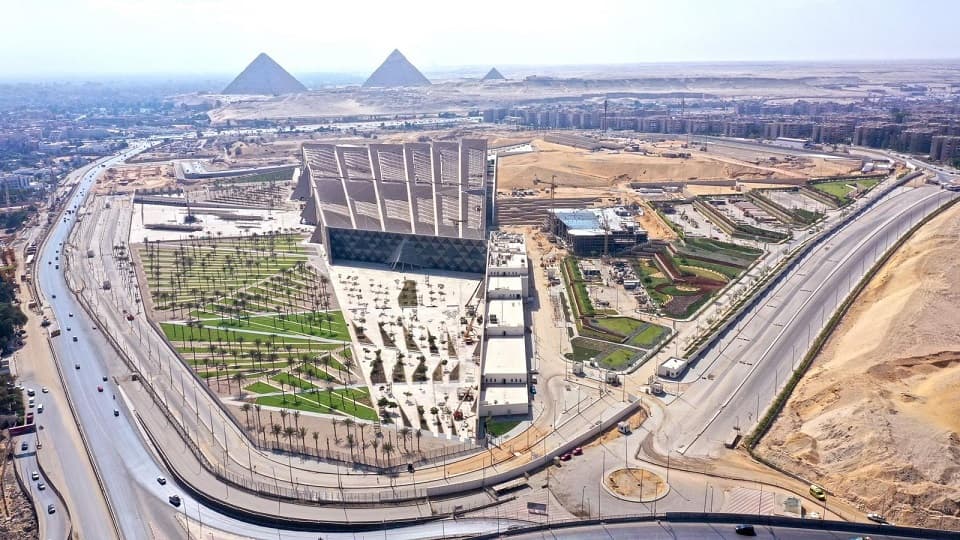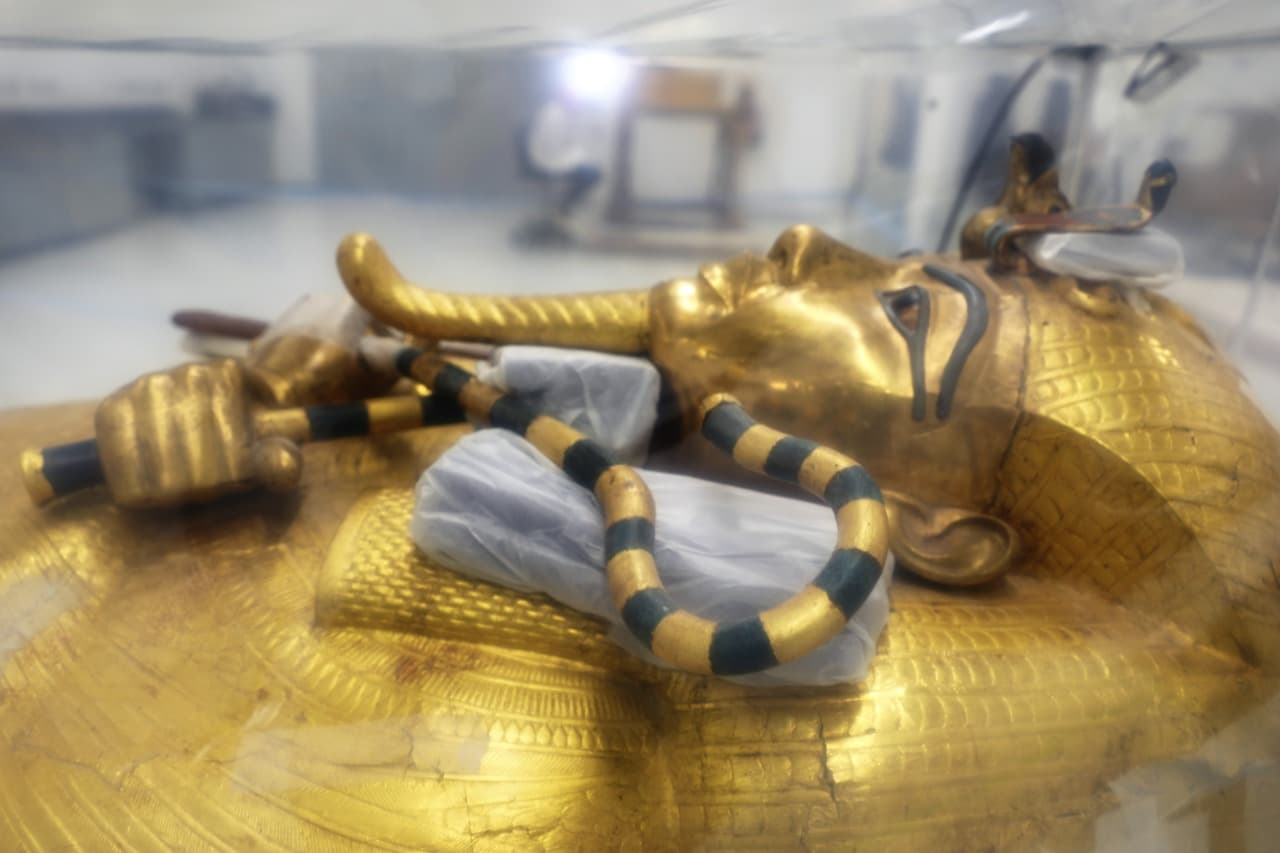
Minister of Antiquities Dr. Khaled El-Enany this morning witnessed the sterilization of the golden coffin of King Tutankhamun, which was recently moved to the conservation center at the Grand Egyptian Museum in preparation for placing it in the display hall dedicated to the boy pharaoh at the museum, which is scheduled to open by 2020. The event received wide international and local coverage from various media outlets and news agencies.

The large outer gilded coffin is made of gilded wood and depicts the king in the form of the god Osiris, with the hands covered in gold leaf and crossed over the chest, holding the royal insignia inlaid with blue and red glass paste. The coffin has silver handles that were used to move the lid, and it is 223 cm long, 84 cm wide and 105 cm high.

After the middle and inner coffins of the golden pharaoh were moved to be displayed at the Egyptian Museum in Tahrir, the outer gilded coffin was left in the tomb from its discovery in 1922 until it was moved to the Grand Egyptian Museum on July 12, to be restored in a suitable environment and protected from the factors of deterioration it was exposed to in the tomb, as well as to be displayed with the other two coffins in a coherent display scenario at the Grand Egyptian Museum when it opens.
The sterilization phase of the coffin began in the isolation hall at the Grand Egyptian Museum, in order to complete the restoration work, fix the fallen gilded layers back in their correct places and carry out the comprehensive consolidation of the coffin, which is expected to take about 8 months.

It is worth noting that King Tutankhamun, or the Golden Pharaoh as he is known worldwide, was one of the kings of the 18th Dynasty of the New Kingdom, and is one of the most famous ancient Egyptian kings or pharaohs because his tomb and treasures were discovered intact, as well as because of his death at a young age, which has become a mystery that arouses many people's curiosity about its causes. He was buried in his famous tomb in the Valley of the Kings in Luxor, which was discovered in November 1922 by British archaeologist Howard Carter.