Tourism and Antiquities Minister praises the resident who promptly reported an ancient stone block found on his land.
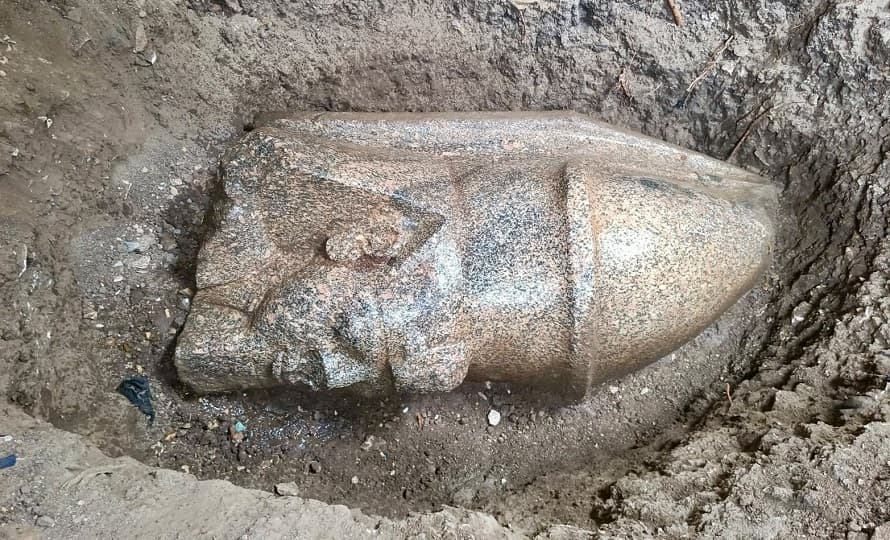
An Egyptian archaeological mission from the Supreme Council of Antiquities has uncovered the remains of two colossal royal statues during rescue excavations at Behbeit El-Hagar village in Gharbia Governorate. One depicts King Ramesses II, while the other is also believed to represent him. A pink granite block bearing hieroglyphic inscriptions containing several of his royal titles was also discovered.
The discovery followed a local resident’s finding of an inscribed stone block while working on land he owns in front of his home. He immediately notified the relevant antiquities inspectorate, whose officials visited the site and conducted a preliminary assessment indicating that the block was ancient.
The Behbeit El-Hagar Antiquities Inspectorate completed the necessary legal procedures and documented the incident. An archaeological committee and specialist team from the Supreme Council of Antiquities were then formed to begin rescue excavations, which revealed the statue remains and granite block.
Tourism and Antiquities Minister Sherif Fathy welcomed the discovery as an important addition to Egypt’s archaeological finds, shedding further light on the history of Behbeit El-Hagar and its archaeological and cultural significance.
He affirmed the ministry’s commitment to continuing research and excavations nationwide alongside efforts to protect and preserve archaeological heritage. He also praised the resident’s prompt report, highlighting the community’s role in safeguarding Egypt’s cultural heritage for future generations.
Dr. Hisham El-Leithy, secretary general of the Supreme Council of Antiquities, said the first find was a colossal head from a statue of Ramesses II, approximately 1.60 metres high. The king wears the double crown symbolizing the unification of Upper and Lower Egypt. Remains of the upper section of the statue’s back pillar were also found, bearing the king’s Horus name, “Hor Ka-Nakht Mery-Maat”. The head’s size suggests that the statue’s original height, including its base, may have reached around 8.5 metres, reflecting its monumental scale and artistic importance.
The second discovery comprises most of a royal statue measuring about 2.40 metres, also believed to depict Ramesses II. Its legs and base are missing. The king wears the royal nemes headdress, part of whose upper section is lost. The statue’s head was also recovered, with its facial features still clearly visible and well preserved, resembling those of the first statue.
The pink granite block is approximately 1.30 metres long and lies about one metre north of the second statue. It retains hieroglyphic inscriptions containing two of Ramesses II’s titles: “Nesu-Bity” (King of Upper and Lower Egypt) and “Sa-Ra” (Son of Ra).
El-Leithy said excavations and archaeological studies were continuing to uncover further elements and examine the finds’ characteristics and their relationships with one another and the site. This will help establish a clearer understanding of the statues, the area’s history and its architectural development in ancient Egypt.
Behbeit El-Hagar is an important archaeological site in the Nile Delta, known for the remains of a large temple dedicated to the goddess Isis. Its granite blocks and architectural elements reflect the area’s religious and architectural importance in ancient Egypt.