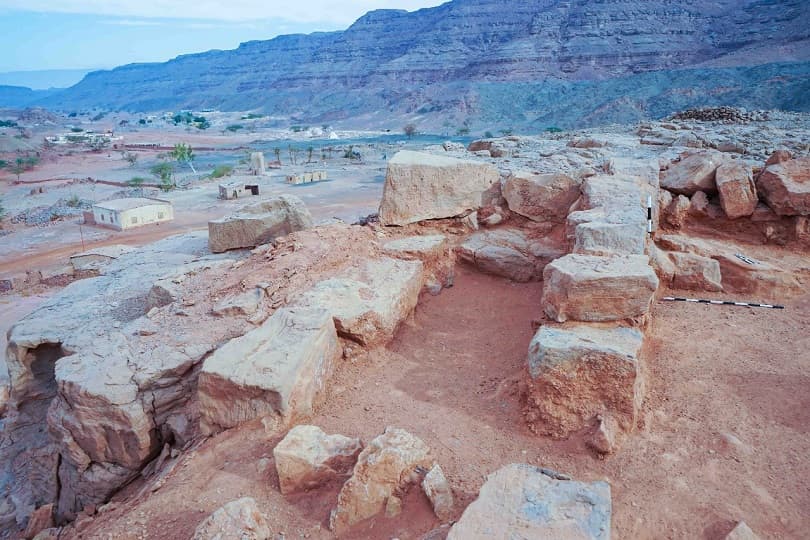
The Egyptian archaeological mission working at the Wadi al-Nasb site in South Sinai has uncovered a copper smelting workshop and a number of administrative buildings and observation posts, as part of ongoing excavation work at the site.
The discovery comes as part of the Ministry of Tourism and Antiquities' keenness to promote archaeological research in Sinai and highlight ancient Egypt's pioneering role in managing and exploiting its mineral wealth, opening new horizons for cultural tourism in areas that still hold many secrets.
Sherif Fathy, Minister of Tourism and Antiquities, noted that the discovery reflects Sinai's strategic importance in ancient Egyptian times as a main source of copper and turquoise, and confirms the depth of the Egyptian presence in the region. He stressed that the ministry, represented by the Supreme Council of Antiquities, will continue to support archaeological missions for the scientific and cultural value they add and for linking the achievements of the ancient Egyptians with contemporary concepts of sustainable development.
Dr. Mohamed Ismail Khaled, Secretary General of the Supreme Council of Antiquities, explained that the excavation results reveal architectural and industrial evidence confirming the continuity of Egyptian mining activity in Wadi al-Nasb from the Old Kingdom until the Late Period, with notable flourishing during the New Kingdom, which adds a new dimension to understanding the history of industrial and metallurgical activity in ancient Egypt.
He stressed that the copper smelting workshops, copper ingots of various shapes and sizes, and bellows tips that were found are clear evidence of an advanced industrial system for producing and casting copper before it was transported to the Nile Valley for use in craft, military and administrative purposes.
In a related context, Mohamed Abdel-Badie, Head of the Egyptian, Greek and Roman Antiquities Sector at the Supreme Council of Antiquities, said the finds include two buildings: one a rectangular sandstone structure at the western entrance of Wadi al-Nasb, and the other east of the point where Wadi al-Nasb meets Wadi Sur. Both were initially used as observation posts and were then turned into copper smelting workshops during the New Kingdom; several copper smelting furnaces were found inside them, along with lumps of copper slag, ingots, one of which weighs more than 1 kg, and clay bellows tips of various sizes.
For his part, Dr. Hisham Hussein, Head of the Central Administration of Lower Egypt Antiquities and head of the mission, explained that cleaning and study work included a third building located atop the southern edge of Wadi Sur, which is believed to have served as a control and observation point during the work of Egyptian mining expeditions and may date back to before the New Kingdom.
The mission also succeeded in uncovering part of a huge central workshop containing several types of copper smelting furnaces, tools for preparing ore, pottery crucibles, and Egyptian amphorae and vessels, in addition to large quantities of charcoal prepared from local trees and blocks of pure clay for making bellows tips.
The Egyptian mission continues its work at the Wadi al-Nasb site, seeking to uncover further details documenting Sinai's strategic role throughout ancient Egyptian history and highlighting its importance as one of the most important mining centers in Egypt's history.