Fathy: The project marks a new milestone in cooperation between the Egyptian government and the United States
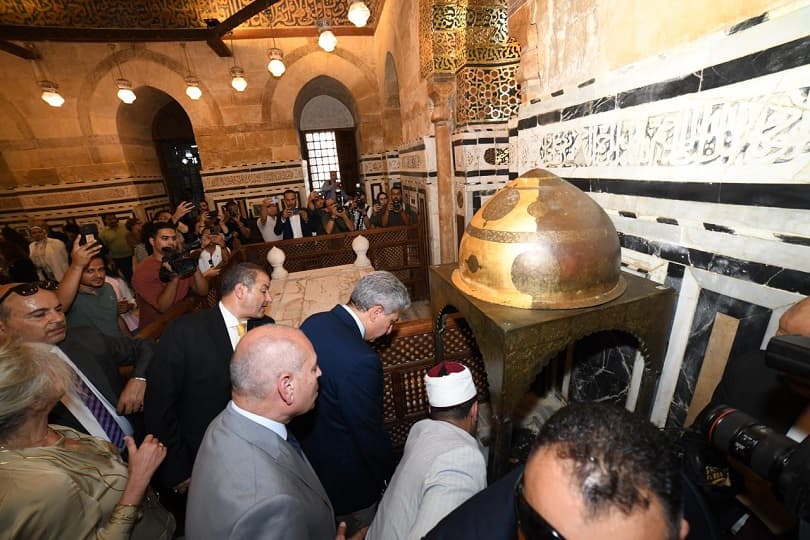
Minister of Tourism and Antiquities Sherif Fathy, Cairo Governor Dr. Ibrahim Saber and Robert Silverman, Chargé d'Affaires of the US Embassy in Cairo, accompanied by Dr. Hisham El-Leithy, Secretary-General of the Supreme Council of Antiquities, and Agnieszka Dobrowolska, Director of Archinos Architecture, yesterday evening inaugurated the dome of Sultan Al-Ashraf Qaitbay in the Mamluk Desert area of Cairo, following the completion of its restoration project. The project was carried out by Archinos Architecture under the full supervision of the Supreme Council of Antiquities, with funding from the US Ambassadors Fund for Cultural Preservation.
The minister and his companions toured the mausoleum dome to inspect the work carried out and heard a detailed explanation from Agnieszka Dobrowolska about the restoration project. She explained that it was implemented in two phases: the first included documentation and archaeological studies, including architectural surveys, technical studies and the precise restoration of the copper dome and the Quran reciter's chair, while the second included comprehensive restoration and maintenance of the architectural and decorative elements using the latest scientific methods and materials compatible with the historic nature of the building.

The project also included cleaning the stone elements, treating moisture and salts, reinforcing the walls and injecting cracks, revealing the Quranic inscriptions and decorations, restoring the stucco windows and completing the missing parts of the stained glass, maintaining the wooden elements, restoring the marble elements, and treating and re-gilding the decorations of the mihrab, preserving the dome's original artistic and archaeological character.
Fathy expressed his pleasure at the inauguration of the mausoleum dome and its restoration project, stressing that it marks a new milestone in the long-standing cooperation between the Egyptian government, represented by the Ministry of Tourism and Antiquities and the Supreme Council of Antiquities, and the United States, represented by its embassy in Cairo and the US government, a cooperation that spans decades and covers many fields and joint projects.


He explained that this cooperation is not limited to restoration and heritage preservation projects, but extends to the work of archaeological missions, with around 50 American archaeological missions working in Egypt, as well as capacity-building programs and support for local communities around archaeological sites. This is in line with the ministry's approach to implementing one of the pillars of its current strategy: strengthening archaeological and tourism economic security, maximizing the economic and social returns from cultural heritage and ensuring that local communities benefit from archaeological and tourism projects.
The minister also pointed to the close cooperation between Egypt and the United States in combating illicit trafficking in cultural property and recovering antiquities that left Egypt illegally, noting that last year alone Egypt, in cooperation with the US government, recovered around 60 artifacts that had left the country illegally. He added that during his recent visit to New York he saw a real commitment from the American side to this issue, expressing his pride in this cooperation, which helps return Egyptian heritage to its homeland as a legacy that belongs to Egypt and all of humanity.
Concluding his speech, the minister expressed his appreciation to everyone involved in the project, thanking the American side and the teams of the Supreme Council of Antiquities, including restorers, experts and technical staff, and stressing that their achievements in preserving cultural heritage are a source of pride and reflect the level of expertise and competence of the council's staff.
He added that the Ministry of Tourism and Antiquities continues to implement its strategy to preserve and protect Egypt's cultural heritage in line with the latest scientific standards, helping to highlight Egypt's unique civilizational assets and enhance the visitor experience.

In a related context, Robert Silverman of the US Embassy in Cairo said cultural heritage preservation efforts are not merely a documentation of the past but a bridge to the future, noting that US support for heritage preservation projects reflects its commitment to preserving shared history, empowering local communities and building a safer, stronger and more prosperous future for both countries.
He added that the United States affirms its commitment to preserving cultural heritage through the US Ambassadors Fund for Cultural Preservation, a program that uses American resources to protect historic buildings, monuments, archaeological sites, museum collections, ethnographic objects, paintings, manuscripts, indigenous languages and other forms of traditional cultural expression. In Egypt alone, the United States has invested more than $3.5 million in 17 projects through the fund, reflecting a long-term commitment to protecting Egypt's rich cultural heritage.
The restoration of Sultan Qaitbay's mausoleum has not only preserved its architectural and historical value but has also helped revitalize the surrounding area by attracting growing numbers of visitors.
For his part, Dr. Hisham El-Leithy, Secretary-General of the Supreme Council of Antiquities, said the restoration of the mausoleum dome of Sultan Al-Ashraf Qaitbay is a world-class model of what can be achieved by combining international cooperation with Egyptian expertise. He noted that the dome is one of the most prominent jewels of Mamluk architecture in historic Cairo and that the restoration work, which took 5 years, embodied the highest standards of scientific restoration and archaeological conservation, ensuring the protection and preservation of Egypt's archaeological and historic areas according to an integrated scientific approach.
He added that every restored monument is not merely a witness to the past but a living part of Egypt's national identity and cultural future, noting that preparing the dome to receive researchers, visitors and the local community enhances the civilizational value of the Mamluk Desert area.


The dome of Sultan Al-Ashraf Qaitbay
Dr. Diaa Zahran, Head of the Islamic, Coptic and Jewish Antiquities Sector at the Supreme Council of Antiquities, explained that the mausoleum dome of Sultan Al-Ashraf Qaitbay has exceptional historical and architectural value, as it is part of the Sultan's architectural complex, which includes the mosque, the sabil, the kuttab and the burial enclosure for freed slaves, as well as the Gulshani dome (the tomb of the Sultan's children), which the Sultan built before he came to power.


He added that the dome, adjoining the qibla iwan, is one of the finest examples of Mamluk architecture, with its intricate stone and floral decorations, colored marble floors and a mihrab rich in gilded decoration, as well as the famous stone dome whose drum is encircled by an inscription band in raised Thuluth script containing Quranic verses and ending with the date of its construction in 879 AH.


He noted that the dome contains the tomb of Sultan Al-Ashraf Qaitbay and the tomb of his son, Sultan Muhammad Qaitbay, and also houses a black basalt stone said to bear the footprints of the Prophet Muhammad (peace be upon him), which has been a place of visitation and blessing through the ages, giving the dome historical and spiritual value alongside its architectural and artistic value.
The inauguration of the dome of Sultan Al-Ashraf Qaitbay following the completion of its restoration is part of the Ministry of Tourism and Antiquities' efforts to preserve Egypt's cultural heritage and make better use of archaeological and historic sites, helping to highlight the richness of historic Cairo and support its position as one of the world's most important tourist and cultural destinations.