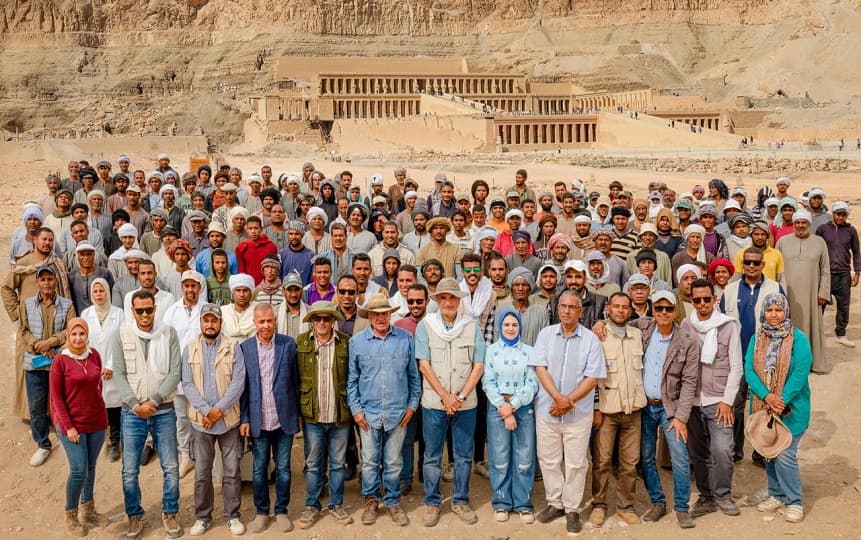
Egyptologist Zahi Hawass, head of the joint archaeological mission of the Zahi Hawass Foundation for Antiquities and Heritage and the Supreme Council of Antiquities, has announced numerous discoveries near Queen Hatshepsut’s temple at Deir El-Bahari in Luxor.
Hawass said that since scientific research and excavations began in September 2022, the mission has made important discoveries near the beginning of the causeway leading to Hatshepsut’s temple.


Hatshepsut’s valley temple, 1479–1458 BC
The mission uncovered part of the foundations of the valley temple, which stood at the edge of the valley and formed the main entrance to Hatshepsut’s mortuary temple, Djeser-Djeseru, renowned as one of ancient Egypt’s most beautiful temples.
Hawass said the team found numerous reliefs representing rare and beautiful examples of sculpture from the reigns of Hatshepsut and Thutmose III. Only a few comparable examples are held in the Luxor Museum and Metropolitan Museum. The newly discovered royal reliefs form the most complete group surviving from the valley temple, which was demolished in the Ramesside period during the Nineteenth Dynasty.
Mohamed Ismail, Secretary-General of the Supreme Council of Antiquities, said more than 100 limestone and sandstone tablets bearing Hatshepsut’s birth and throne names within cartouches were discovered. They form part of foundation deposits identifying the temple’s owner, known as name stones.

One unique limestone tablet bears, in raised relief, the name of Hatshepsut’s architect Senenmut and his title, overseer of the palace. The complete foundation deposits are among the mission’s most important discoveries, coming about a century after American archaeologist Herbert Winlock uncovered the last complete group of Hatshepsut’s deposits at the mortuary temple between 1923 and 1931.
Hawass said rock-cut Middle Kingdom tombs, dating to approximately 2050–1710 BC, revealed the site’s historical sequence. The area was occupied from the Middle Kingdom until the early Eighteenth Dynasty, when Senenmut ordered burials to stop and selected it for the valley temple and part of the causeway connecting it to the mortuary temple. He buried the cemetery beneath large quantities of sand while preparing the construction site.
Middle Kingdom tombs contained important artifacts, including pottery offering tables with models of bread, wine, and a bull’s head and thigh, characteristic of the period.
The mission also uncovered rock-cut burial shafts from the Seventeenth Dynasty, approximately 1580–1550 BC. They contained anthropoid wooden coffins with the feathered decoration characteristic of the period. Among the most important is a small child’s coffin, still closed and tied with ropes as it was when buried 3,600 years ago.
A rolled mat was found beside the coffins in its original condition. A conservation program is being prepared before its transfer for display at the National Museum of Egyptian Civilization. During the previous 2023–2024 season, the Egyptian mission transferred a wooden bed with woven matting to the museum. Dating to the same period, it belonged to a cemetery guard and was found in a small room used by guards.
Hawass noted that military bows were also found, indicating the occupations and military backgrounds of the tomb owners and their struggle to liberate Egypt from the Hyksos. The team also discovered the tomb of Djehuty-mes, overseer of the palace of Queen Tetisheri, ancestress of the Eighteenth-Dynasty kings, whose era is regarded as a golden age of ancient Egypt.
The tomb of Tetisheri’s palace overseer sheds light on a period with relatively few surviving remains. Tetisheri was the grandmother of Ahmose, who liberated Egypt from the Hyksos, and mother of his father Seqenenre, who died in the liberation struggle. The tomb dates to the ninth regnal year of Ahmose I, approximately 1550–1525 BC, as confirmed by the date on Djehuty-mes’s funerary stela found inside.

Tomb layout
The tomb has a simple plan: a square rock-cut chamber preceded by a mudbrick chapel coated in white plaster and topped by a vaulted roof. Remains of red-painted decoration survive on white plaster inside. A rectangular shaft in the floor leads to two burial chambers. The shaft contained a limestone offering table and Djehuty-mes’s funerary stela.
Despite the owner’s important title as overseer of Queen Tetisheri’s palace, the tomb’s modest form provides insight into economic conditions at the beginning of the Eighteenth Dynasty, following costly wars of liberation that had drained the state’s economy.
Ptolemaic cemetery
Hawass also announced the discovery of part of an extensive Ptolemaic cemetery occupying the causeway and valley temple area. Its tombs were built from mudbrick and reused stones from Hatshepsut’s temple. Foreign missions uncovered parts of this cemetery early in the previous century but did not document them adequately.
The Egyptian mission found many artifacts from this period, including bronze coins depicting Alexander the Great and dating to the time of Ptolemy I. Other finds included terracotta children’s toys in human and animal forms, cartonnage fragments, funerary masks that covered mummies, and numerous winged scarabs, beads and funerary amulets.