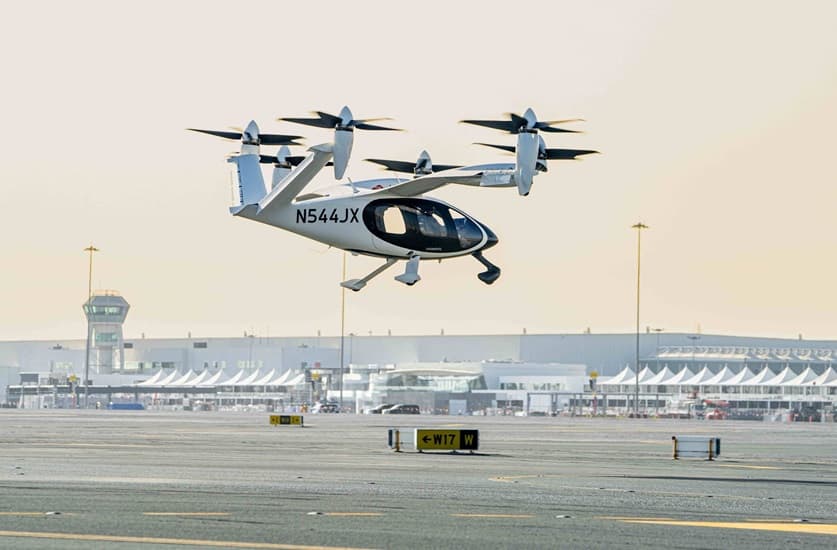
Dubai's Roads and Transport Authority (RTA), in cooperation with Joby Aviation, carried out the first crewed flight of an electric vertical take-off and landing air taxi between two different sites, as the aircraft took off from Joby's test site in Margham and flew to Al Maktoum International Airport in a 17-minute flight, making Joby the first company in the world to complete a crewed electric air taxi flight between two points within the UAE.
The authority announced the completion of 60% of the construction works on the first dedicated air taxi station near Dubai International Airport, being built by Skyports Infrastructure, as construction reached the highest point of the station, the first of its kind globally, according to the Emirates News Agency (WAM).
The authority explained that it is working on building 3 additional vertiports in cooperation with Emaar Properties, Atlantis The Royal and Wasl Asset Management Group as part of their development projects, while it is preparing, in cooperation with Joby, to expand the scope of air taxi testing operations ahead of starting passenger transport in 2026, in coordination with the General Civil Aviation Authority, the Dubai Civil Aviation Authority and Dubai Air Navigation Services.
For his part, Mattar Al Tayer, Director General and Chairman of the Board of Executive Directors of the RTA, explained that carrying out the first crewed electric air taxi flight is a new qualitative achievement added to Dubai's record of innovation and translates the future vision of Sheikh Mohammed bin Rashid Al Maktoum, Vice President and Prime Minister of the UAE and Ruler of Dubai, for Dubai to be the best city in the world in quality of life and the most prepared for the future of smart and sustainable transport.
He added that the successful completion of the first flight between two different sites confirms the success of the operational steps the authority has put in place to develop Dubai's air mobility system and its ability to operate within shared airspace, and paves the way for a new phase of integration of smart transport systems in the emirate, which strengthens global partners' confidence in Dubai's regulatory and technical environment.
He stated that the progress made in building the air taxi station near Dubai International Airport, along with the cooperation with 3 major developers to build new vertiports, strengthens the authority's efforts to expand the construction of air taxi stations and vertiports, ensuring distinguished air mobility services for Dubai's residents and visitors.
For his part, JoeBen Bevirt, Founder and CEO of Joby Aviation, explained that there is remarkable progress in the air taxi project on all fronts, and that preparations are continuing to launch the commercial passenger service in Dubai next year.
He added that this work is being carried out side by side with the RTA and infrastructure partners, affirming that Dubai is today closer than ever to turning urban air mobility into a daily reality for residents and visitors of the UAE.
Duncan Walker, CEO of Skyports Infrastructure, stated that vertiports are the cornerstone of a successful advanced air mobility system, affirming that the station reaching this pivotal milestone marks a historic moment as Dubai prepares to become the first city in the world to make advanced air mobility a tangible reality, offering an ultra-fast, zero-emission mode of transport.
The Joby S4 air taxi is distinguished by its vertical take-off and landing capability and its reliance on electric power with zero operating emissions. It features 6 propellers and 4 battery packs that allow it to fly a distance of 160 kilometers at speeds of up to 320 kilometers per hour, and it seats 4 passengers in addition to the pilot, with a low noise level that allows efficient operation in urban areas.
The main air taxi station near Dubai International Airport covers an area of 3,100 square meters spread over 4 floors, including two parking floors, two take-off and landing pads, and dedicated facilities for cargo and passengers, with a capacity of up to 42,000 landings annually to serve about 170,000 passengers. Skyports Infrastructure is responsible for designing, building and operating the infrastructure, while the RTA oversees the governance of operations and ensures integration with other modes of transport.
To view the post on the Emirates News Agency website, click here.