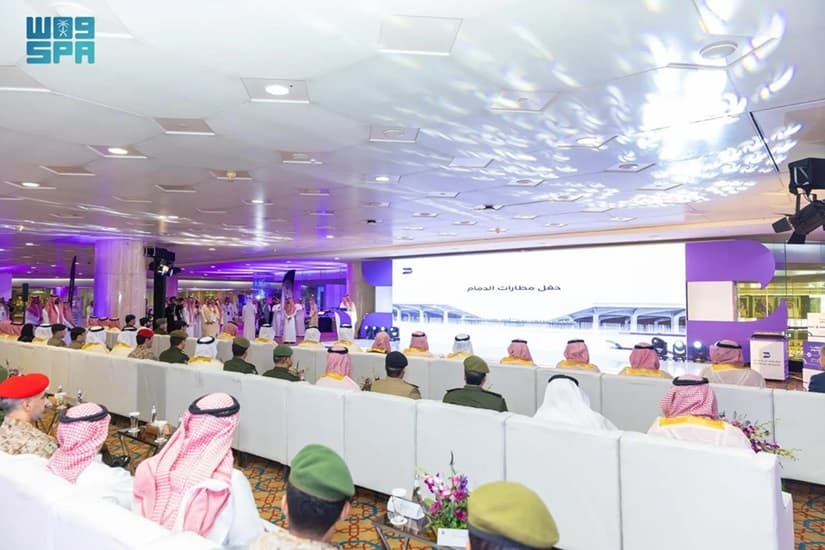
Prince Saud bin Naif bin Abdulaziz, Emir of the Eastern Province, launched the ceremony announcing the new identity and master plan of King Fahd International Airport, alongside the master plans of Al-Ahsa International Airport and Al Qaisumah International Airport. He also launched the Dammam Airports strategy.
The Emir of the Eastern Province opened a series of integrated development projects with a total value exceeding SAR 1.6 billion, comprising 77 development projects to upgrade infrastructure and improve the passenger experience, according to the Saudi Press Agency.
He also opened e-gates for completing passenger procedures, in the presence of Minister of Transport and Logistic Services and Chairman of the Board of the General Authority of Civil Aviation (GACA) Eng. Saleh bin Nasser Al-Jasser, GACA President Abdulaziz bin Abdullah Al-Duailej, and Director General of Passports Maj. Gen. Dr. Saleh bin Saad Al-Murabba.
The Emir of the Eastern Province stressed that the rapid development and growth witnessed by the aviation sector is an extension of the support and attention the Saudi leadership gives this vital sector, out of its belief in the importance of strengthening infrastructure and expanding the air connectivity network in a way that serves comprehensive development goals and reinforces the Kingdom's position as a global logistics hub in line with the targets of Saudi Vision 2030.
He noted that these development projects represent a qualitative leap toward achieving integration in the transport system, providing the best services to travelers, and stimulating investment in this strategic sector.
The strategic plan aims to serve more than 19.3 million passengers annually at King Fahd International Airport by 2030, a growth rate of more than 100% compared with 2022, in addition to raising air cargo capacity to more than 600,000 tons annually, growth of more than 1,000%, reflecting the scale of ambition and the future vision for Dammam Airports.
The most prominent features of the future projects include the first expansion in the history of King Fahd International Airport, aimed at raising operational capacity for aircraft movements to 77 aircraft per hour and raising passenger capacity to 32 million passengers annually.
They also include a comprehensive upgrade of general aviation facilities and the development and expansion of the airport's infrastructure to keep pace with the highest international operating standards, reflecting Dammam Airports' commitment to becoming a regional logistics hub that serves the goals of the Kingdom's Vision, with actual passenger growth reaching 35% at the end of 2024 compared with 2022.
For his part, Minister of Transport and Logistic Services and GACA Chairman Eng. Saleh bin Nasser Al-Jasser stressed that the rapid development of the civil aviation sector in the Kingdom comes thanks to the unlimited support of the leadership and reflects the transport system's commitment to achieving the targets of the National Transport and Logistics Strategy by improving service quality, increasing capacity, and empowering the private sector in infrastructure projects.
GACA President Abdulaziz bin Abdullah Al-Duailej, for his part, stressed that the Aviation Program, which stems from the National Transport and Logistics Strategy, is a key pillar for enhancing air connectivity and achieving the Kingdom's goal of becoming a global hub for air transport and logistics.
He pointed to the continuous support of the Emir of the Eastern Province for developing the aviation system in the Eastern Province, and the important role played by the Eastern Province Development Authority in enhancing integrated development in line with the targets of Saudi Vision 2030.
He explained that the master plan is one of the executive outputs of the Aviation Program, which reinforces the targets of the National Transport and Logistics Strategy and contributes to achieving comprehensive air connectivity and increasing the efficiency of airport infrastructure. He added that the authority is working to empower operators and raise the efficiency of operations and services, enhancing the passenger experience and the quality of infrastructure, as well as integration among all relevant entities to upgrade the region's airports.
To view the post on the Saudi Press Agency, click here.