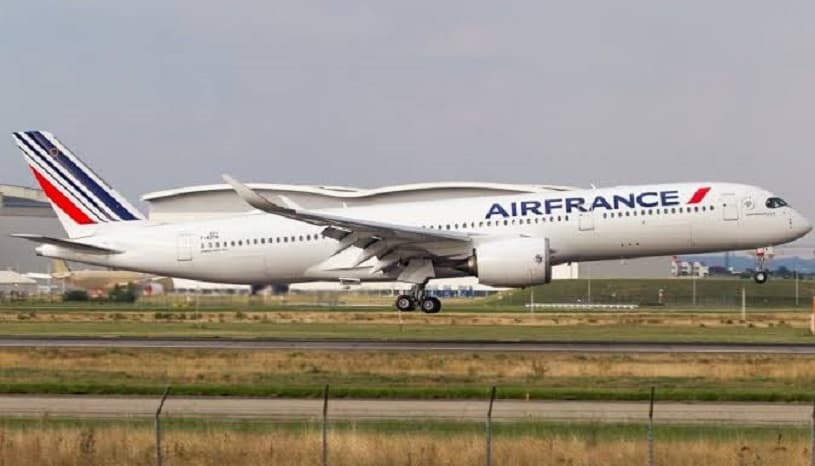
French Ambassador to Egypt Stéphane Romatet affirmed that Air France's launch of its new Airbus A350 aircraft to Cairo from Charles de Gaulle Airport in Paris, which is the aircraft's second destination in the world after Toronto, is an important step in the company's journey.
Speaking at Air France's press conference, the ambassador added that the launch of this model represents an important stage in French-Egyptian relations, because there is a need to increase capacity on the "Paris-Cairo" route, in addition to upgrading the services provided.
Romatet said that France and Air France share one goal, which is to attract many tourists and travelers from France to Egypt, noting that Air France operates 6 flights per week to Cairo International Airport.
The ambassador pointed out that operating the aircraft on this route sends a positive message that there is more confidence in the Egyptian market, explaining that choosing Cairo for this model is no coincidence, as these serious plans are meant to affirm our commitment and confidence in the Egyptian market.
In a related context, Frédéric Bourban, Regional Sales Director of Air France-KLM, stated that operating the company's new Airbus A350 comes as part of its strategy of commitment to reducing the environmental impact of aircraft, as this model is environmentally friendly, adding that the company is proud to operate this new generation of aircraft on its flights to and from Egypt, where the airline's operating history extends back more than 80 years.
He explained that this model has 324 seats, divided into 266 seats in Economy class, 34 seats in Business class and 24 seats in Premium Economy, revealing that Air France received its first aircraft of this model last October, and adding that the aircraft serves 6 international destinations, including Cairo.
He affirmed that the company is committed to its strategy of limiting its environmental impact by taking and implementing tangible measures, including reducing weight on board, limiting and recycling waste, enhancing the environmental experience, reducing noise emissions and carbon dioxide emissions, and eliminating single-use plastics.
He noted that this aircraft consumes 25% less fuel than other aircraft (2.5 liters per passenger/100 km), thanks to the integration of materials that are 67% lighter, comprising 53% composites and 14% titanium, in addition to reducing noise emissions by 40% and carbon dioxide emissions by 25%.
It is worth noting that the cabin upgrades on the new Airbus A350 give passengers many advantages, including more spacious Business, Premium Economy and Economy cabins, with windows 30% larger, in addition to a different pressurization system that provides a more comfortable cabin atmosphere and regularly renewed air, all with lighting that adapts to the different phases of the flight, as well as on-board Wi-Fi. It is one of the quietest cabins among new-generation twin-aisle aircraft.
On another note, Air France decided to operate flights between Toulouse and Paris Charles de Gaulle airports partially on biofuel, an initiative that came to affirm the importance of biofuel for the aviation sector and Air France's commitment to contributing to its development.
It is worth mentioning that Air France is a global airline and a member of the SkyTeam global alliance, which comprises 20 airlines and offers its customers 16,600 daily flights to 1,070 destinations in 177 countries.
The Air France-KLM group is a leader in international traffic departing from Europe, as its fleet of 537 aircraft covers 314 destinations in 116 countries through its five airlines: Air France, KLM Royal Dutch Airlines, Transavia, HOP! Air France and Joon. It operates 2,300 flights daily, most of them departing from Paris Charles de Gaulle and Amsterdam Schiphol airports, and its leading Flying Blue loyalty program, which ranks first in Europe, has more than 15 million members.