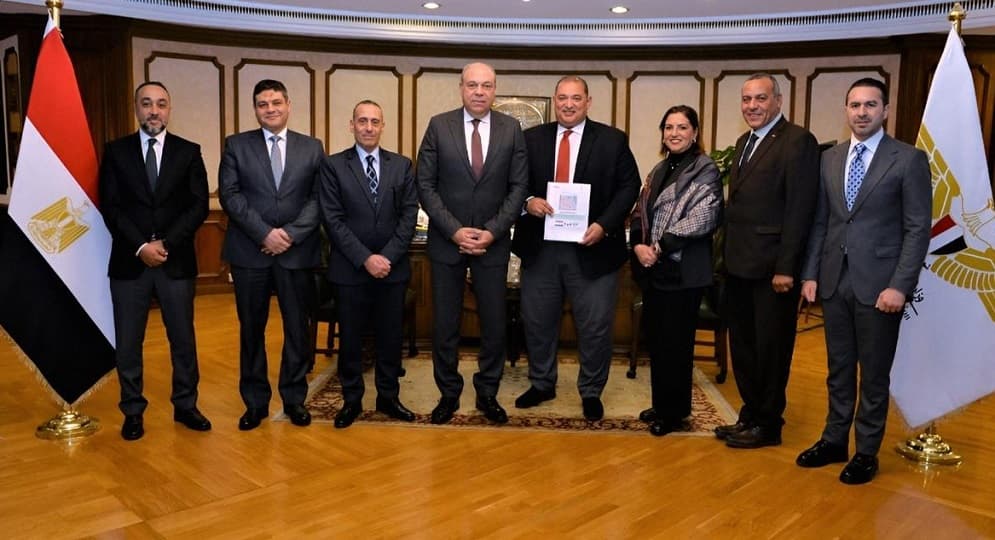
Minister of Civil Aviation Dr Sameh El-Hefny attended the handover of Egypt’s national aviation action plan through 2028 to the International Civil Aviation Organization (ICAO). Egyptian Civil Aviation Authority Chairman Sameh Fawzy presented the plan to Mohamed Rahma, director of ICAO’s Air Transport Bureau. Attendees included Reem Orabi, Egypt’s alternate representative on the ICAO Council; Ahmed Sokkar, deputy authority chairman for airports and air navigation; and Captain Mohamed Salah, deputy chairman for aviation safety.
The plan was developed through cooperation between the Egyptian Civil Aviation Authority and the European Union Aviation Safety Agency, with participation from Egyptian airlines, Cairo Airport Company, Egyptian Airports Company and the National Air Navigation Services Company.
Implementation will be overseen by the permanent national committee for the state’s aviation action plan, chaired by the authority’s chairman. Its members include Captain Karim Gamil, adviser to the chairman and committee rapporteur, and Eng. Abdel Ghaffar El-Sayed, director general of fixed equipment and an airworthiness inspector. This structure is designed to ensure effective monitoring and continued implementation in line with ICAO’s latest international standards.
El-Hefny praised the committee’s work and thanked the participating airlines—EgyptAir, Air Cairo, Nile Air, Air Arabia, Nesma Airlines and AlMasria Universal Airlines—as well as Cairo Airport Company, the National Air Navigation Services Company and Egyptian Airports Company. He said the plan represents a promising economic and industrial opportunity, positioning Egypt as a regional leader in sustainable aviation and clean energy and reinforcing its role as a regional air transport and services hub.

The plan forecasts international air transport growth of 6% annually through 2027 and 7% annually through 2050, requiring immediate operational measures to ensure sustainable growth consistent with international commitments. Its main pillars follow ICAO guidance and include improving operational and air navigation efficiency, developing aircraft technology and modern standards, introducing sustainable aviation fuel (SAF), developing green airports and improving routes within Egyptian airspace.
It adopts 25 operational measures for several Egyptian airlines to reduce fuel consumption and emissions, including improved continuous-descent flight paths and reduced use of ground power units. These measures aim to improve fuel efficiency and lower emissions over the next three years.
ICAO Air Transport Bureau Director Mohamed Rahma praised Egypt’s sustainable aviation action plan and its contribution to sustainable development across different activities. He described it as an advanced model of sustainable strategic planning aligned with ICAO principles and documents, providing a practical framework that balances economic growth with environmental protection. He said Egypt is making steady progress towards a stronger global position in sustainable aviation.
The national civil aviation action plan is intended as an ongoing institutional process involving government bodies, industry and private airlines, ensuring the sector’s environmental and economic sustainability while strengthening its regional and international competitiveness.