Yasmine Fouad: Egyptian airports are an important platform for promoting ecotourism, and the Civil Aviation Ministry is a key climate-action partner.
A 2% share of sustainable aviation fuel (SAF) is targeted by 2030.
Cooperation aims to develop a pioneering airport waste-management model.
El-Hefny: The Civil Aviation Ministry is adopting an integrated strategy to implement ICAO’s international environmental sustainability standards.
Cooperation among state ministries and institutions supports sustainable biofuel production.
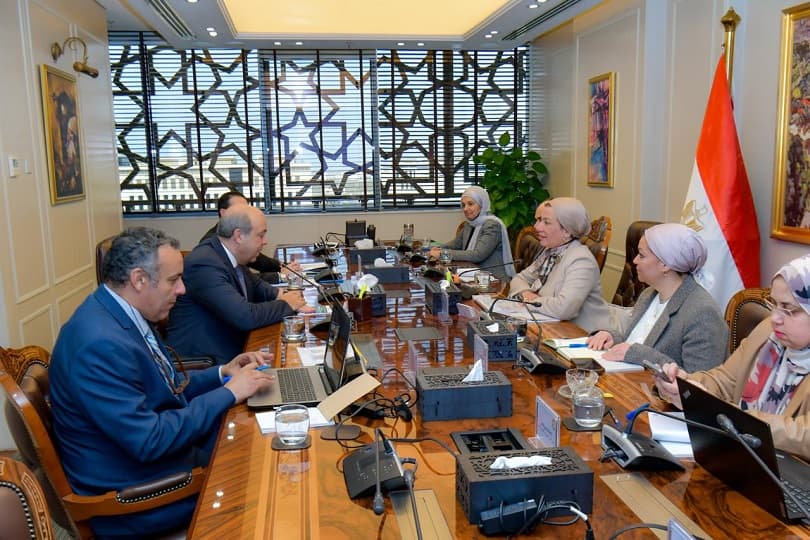
Environment Minister Yasmine Fouad received Civil Aviation Minister Sameh El-Hefny to discuss cooperation on addressing climate change, using sustainable aviation fuel (SAF) and promoting ecotourism.
Fouad stressed the importance of joint action and expanding cooperation between the ministries to support environmental work, including promoting tourism, ecotourism and nature reserves in Egypt. She presented films produced by the Environment Ministry, including its “Stories from Its People” campaign, marine conservation material and a promotional video about Red Sea protected islands, for screening at airports as part of an ecotourism promotion plan. Cooperation will also encourage the Civil Aviation Ministry to use environmentally friendly products on the green list, such as replacing plastic cups with paper alternatives and plastic cutlery with wooden utensils, with the participation of the private hotel sector.
The environment minister highlighted the Civil Aviation Ministry’s role in climate action and implementing Egypt’s nationally determined contributions. She reviewed cooperation on the National Climate Change Strategy 2050, particularly its second objective concerning adaptation priorities for aviation and airports, especially vulnerable coastal airports. The ministries are also cooperating on an interactive climate-impact map under a protocol between the Egyptian Environmental Affairs Agency and the Military Survey Department of the Armed Forces Engineering Authority, with participation from the Egyptian Meteorological Authority and the Water Research Institute of the Ministry of Water Resources and Irrigation.
She said the first phase had been completed and work was under way on the second. This uses climate models approved by the international climate body and adapted to Egypt, incorporating historical meteorological and water-resources data to project climate impacts across Egypt through 2100 and help protect investments and future development.
Fouad also reviewed cooperation on the National Adaptation Plan (NAP), including two studies relevant to aviation: climate impacts on coastal areas and on critical facilities and infrastructure. Cooperation also takes place through the SCALA project, which supports greater climate ambition in land use and agriculture through national plans and contributions. An early warning system is being developed with the Egyptian Meteorological Authority and the World Food Programme (WFP) to support national adaptation planning and provide small farmers with climate data, advance warnings of extreme conditions and guidance to protect crops. She called for cooperation to revive the early warning systems initiative launched at COP27.
The ministers discussed establishing a climate-change unit within the Civil Aviation Ministry, particularly in connection with the Transforming Financial Systems for Climate (TFSC) project. Institutional support for climate units across ministries would help collect reporting data through a measurement, reporting and verification (MRV) system. The Environment Ministry will contribute capacity-building and training as part of its plan to establish a digital emissions-monitoring system in every ministry, supplying data for national reports, including biennial reporting and the update of nationally determined contributions at the start of the new year. They also discussed preparing a plan for the Carbon Offsetting and Reduction Scheme for International Aviation (CORSIA), in accordance with ICAO requirements.
Fouad expressed interest in working with the Civil Aviation Ministry to establish a pioneering airport waste-management system, starting at Cairo or Sharm El-Sheikh Airport as a replicable model. This would involve assessing current conditions and identifying the procedures, equipment and appropriate waste-management approach required.
El-Hefny said climate change is a global challenge with a significant impact on aviation because of the sector’s sensitivity and direct dependence on environmental conditions. He reaffirmed the ministry’s commitment to implementing ICAO’s international standards and procedures to achieve environmental sustainability and support global climate action.

The aviation minister praised cooperation among the relevant state ministries and institutions to support sustainable biofuel production. He noted that climate change affects every sector but has a particularly clear impact on aviation. He emphasized adherence to ICAO standards and procedures and support for national efforts to manufacture and use sustainable biofuels as a key means of reducing aviation carbon emissions. The ministry and its affiliated companies are pursuing an integrated strategy whose economic and environmental objectives support regional and international cooperation toward a more sustainable future for aviation.
El-Hefny explained that the ministry is working on several fronts, including a shared vision with the ministries and agencies responsible for environmental and climate issues. It maintains coordination with ICAO to keep pace with climate developments and implement effective programs with other countries to exchange expertise, training and technology. These include commitment to CORSIA, which monitors and reports carbon emissions and seeks carbon-neutral growth in international aviation. He also stressed the importance of attracting further domestic and international investment in sustainable biofuel production infrastructure and adopting ICAO initiatives and recommendations.
The meeting was attended by Ali Abu Senna, Chief Executive Officer of the Egyptian Environmental Affairs Agency; Yasser Abdallah, head of the Waste Management Regulatory Authority; Yasmine Salem, Assistant Environment Minister for Government Coordination; Soha Taher, head of the Environment Ministry’s Central Department for Climate Change; engineer Abdel Ghaffar El-Sayed Abdel Ghaffar, Director General of Fixed Equipment and an airworthiness inspector at the Civil Aviation Authority; and Captain Karim Gameel, adviser to the authority’s chairman.