Ahmed Ali: The New A321 Joining the Fleet Supports Our Network Expansion Plans... and the "neo" Model Arrives in 2020
A European-Gulf Partnership to Be Announced Next January to Expand Our International Network
30% of the Company's Shares to Be Floated on the Stock Exchange in Early 2018 to Broaden Ownership
Egyptians Abroad Account for Only 30% of Our Customers on International Flights
By Akram Medhat
The aviation industry is characterized by constant development; otherwise no airline would withstand the fierce competition, especially from large entities. All airlines therefore seek to modernize and expand their fleets. Nile Air has been a pioneer in this important industry, becoming the largest private airline in Egypt, and it has now revealed a comprehensive development in its investments and the operation of its domestic and international flights, as well as new aircraft joining its fleet with which it supports tourism and aviation, and indeed the economy in Egypt in general.
In this context, Eng. Ahmed Ali, CEO of Nile Air, affirmed that the Egyptian market is strong and promising despite the circumstances it is going through, which encourages the company to expand its investments by buying more aircraft and increasing its domestic and international flights to serve domestic and inbound tourism and business travelers.
On the sidelines of the press conference held in Sharm El-Sheikh to celebrate the first flight to Sharm El-Sheikh Airport of the new Airbus A321 that joined the fleet, the company's CEO revealed that the company is expected to carry 1.2 million passengers on its flights by the end of 2017, noting that the company's activity grew by 32% this year, making it the second-largest operator at Cairo International Airport and the fastest-growing airline in the Arab world according to OAG.

He stated that Nile Air has achieved the highest on-time performance rates for its flights, reaching 92%, and that only 1.1% of the company's flights were canceled in 2016, a rate that will not be exceeded in 2017.
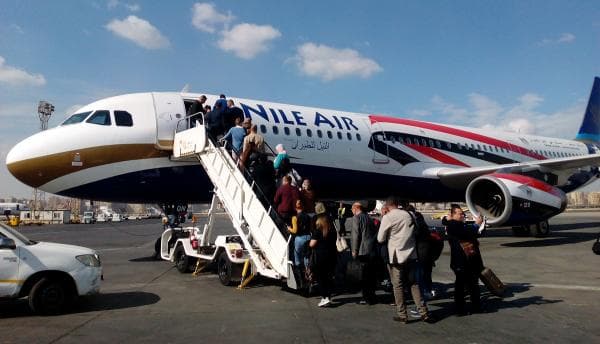
The new Airbus A321 joined the fleet this month and operated its first flight from Cairo to Sharm El-Sheikh last Saturday, November 25. It has a capacity of more than 200 seats, features a design of the Egyptian flag on both sides of the fuselage and carries the slogan "Invest in Egypt... Invest in Nile Air" in Arabic and English, to emphasize the company's role in promoting Egypt as a global tourist destination chosen by investors and tourists alike. The company's CEO revealed that painting the aircraft with this livery cost $300,000.

The arrival of this aircraft reinforces the continued growth of the company's fleet and confirms Nile Air's commitment to supporting the Egyptian economy and the aviation and tourism sectors, with plans to increase its fleet size in the coming years. He said: "We are proud of the role the company plays in developing aviation to, from and within Egypt, and the new aircraft will play a pivotal role in continuing our rapid expansion in aviation and facilitating the movement of businesspeople, tourists and Egyptians in the region."

It is worth noting that Nile Air's new aircraft is not the first in its fleet with a distinctive design: in 2016, Nile Air unveiled a special livery on one of its aircraft featuring images of many of Egypt's tourist treasures.

As part of the expansion of the company's activity and its domestic and international network, Ahmed Ali, CEO of Nile Air, stated that a European-Gulf partnership is scheduled to be announced next January. This cooperation aims to give the company's customers the opportunity to reach points or stations that Nile Air does not fly to.
Domestic Flight Activity
Eng. Ahmed Ali, CEO of Nile Air, affirmed that although 2016 was a difficult year for airlines due to the stagnation of inbound tourism to Egypt, Nile Air launched its domestic flights from Cairo to Sharm El-Sheikh in July 2016, and the company made sure it would be the first destination of the new A321 that recently joined the fleet, in addition to launching Luxor and Aswan flights last December, with the aim of expanding the company's domestic flights to various tourist cities.
He said on the sidelines of the press conference in Sharm El-Sheikh that when the Cairo-Sharm El-Sheikh route was launched in July 2016, it started with 3 weekly flights, but it has now reached 18 weekly flights due to demand following its success. He revealed that traffic on flights between Cairo and Sharm El-Sheikh grew by 36% as a result of the recovery of domestic tourism and foreign traffic, as Arab and foreign passengers account for about 50% of travelers on Nile Air flights between Cairo and Sharm El-Sheikh.

He stated that adding another tourist city in Egypt as the company's fifth domestic destination is under study, following the success of the current four destinations, namely Sharm El-Sheikh, Hurghada, Luxor and Aswan, in addition to examining the operation of international routes from Red Sea cities to boost inbound tourism.
On the other hand, the head of Nile Air explained that domestic ticket prices have not changed since the floatation of the pound in November 2016, starting from 620 pounds, the lowest domestic air fares, while offering a high-quality level of service to the company's customers on board, whereas international ticket prices were affected by the floatation and have been adjusted.
Expanding the Fleet with the Latest Models
Ahmed Ali added that over the coming years the company will continue to expand its fleet to meet growing demand and to operate the latest global aircraft models, including the new Airbus A321neo, making the company the first operator of this model in Egypt.
The aircraft was designed with a capacity of 220 seats in two classes, economy and business, and allows increased and expanded operations to Europe, the Middle East, Africa and domestic destinations in Egypt. It incorporates the latest new-generation engine technology, saving about 15% of fuel, with the ability to operate over a longer range, as well as lower maintenance costs and harmful carbon emissions.

Nile Air's fleet currently comprises 7 Airbus aircraft of two types: the A320-200 with 162 seats, divided into 8 business class and 154 economy class seats, and the A321-200 with a capacity of 204 seats, divided into 8 business class and 196 economy class seats. He noted that the company's aircraft are among the newest models, with an average age of only 7 years.
He said Nile Air was the first Egyptian company to order two A321neo aircraft, last April, to be received by 2020, given the strong demand for this model due to its advantages, and that until then other aircraft will join the fleet as part of the continued expansion into various markets and airports and the increase in flight operations.
The company currently serves 23 domestic and international destinations, operating more than 500 flights per month from Cairo to many international airports, including domestic flights from Borg El Arab and Cairo airports to Luxor, Aswan, Sharm El-Sheikh and Hurghada, as well as flights to Arab countries, most notably Saudi Arabia, the UAE, Iraq, Kuwait and Sudan, in addition to Turkey, with the newest Airbus fleet and the youngest in average age among all Egyptian airlines. It also provides the highest level of service quality, including business class on all its aircraft.
He pointed out that Nile Air is distinguished by its presence on all global distribution systems, namely Amadeus, Sabre and Galileo, since signing with them in 2014, which account for 96% of total global flight bookings.
He added that Egyptians abroad account for only about 30% of passengers on the company's flights, as the target is tourism and investment traffic that supports the Egyptian economy.
Ahmed Ali explained that Saudi Arabia is Nile Air's most served international market, covering 10 cities in the Kingdom, noting that the company's plan does not target only traditional markets with high operations, but that it is also keen to be the first airline to operate at new airports.
On another note, Nile Air's CEO explained that the company's sponsorship of the national team is not for advertising purposes, as there are many less costly and more beneficial means and mechanisms, but stems from the company's patriotic side, noting that these values are instilled in all of Nile Air's roughly 900 employees.
He pointed to the company's attention to service quality and the efficiency of staff on its flights, which is why the company "Nile Academy" was established for training aviation workers.

Nile Air's Investments... and the Stock Exchange as a Turning Point
He revealed the establishment of a catering company ("supplying aircraft with food and beverages"), with a factory for this purpose to be set up next December.
On the other hand, Nile Air intends to float 30% of its shares on the Egyptian Exchange at the beginning of next year, 2018, with the aim of broadening ownership. This step was announced when the company was established in 2006, but it had been scheduled to take place during the first half of this year, 2017.

It is worth noting that Nile Air is an Egyptian joint-stock company established in 2006 under the provisions of Investment Law No. 8 of 1997 and its executive regulations. It is the largest private airline in Egypt, started operations in 2010 and was established with an issued and paid-up capital of 200 million pounds, which it increased in 2012 to 300 million pounds with the aim of expanding its operations.