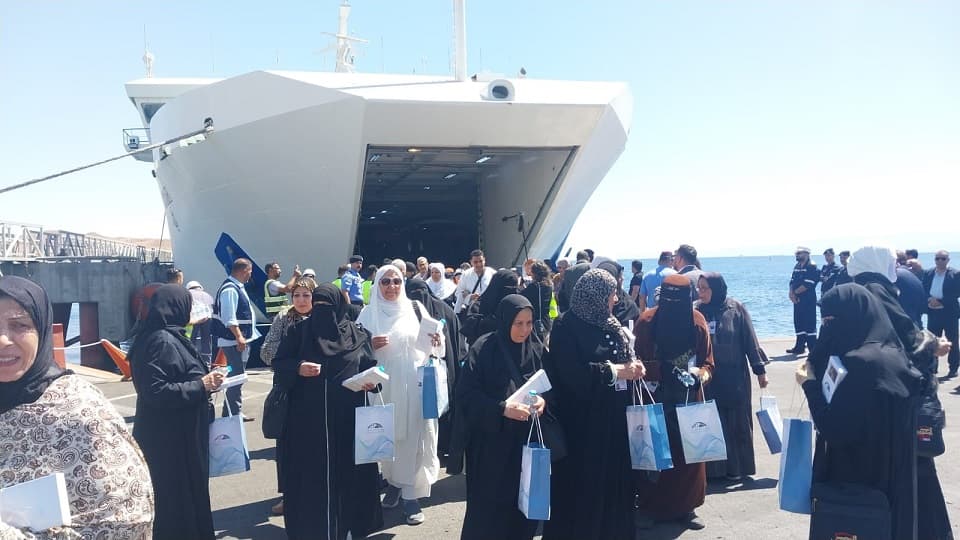
Ministry committees present at all points along the land tourism Hajj route through sea and land ports
Land tourism Hajj trips continue to depart from Egypt's Nuweiba seaport, heading from the Arab Republic of Egypt to the Kingdom of Saudi Arabia for pilgrims to perform the 1447 AH-2026 Hajj, with 32 tourist buses carrying 1,424 pilgrims having arrived in Saudi Arabia so far.
This comes as part of this year's plan for moving land tourism pilgrim groups, under the direct supervision of the Ministry of Tourism and Antiquities and in implementation of the directives of Minister of Tourism and Antiquities Sherif Fathy to take all the necessary organizational measures to ensure the easy and safe travel of Egyptian tourism pilgrims and provide them with the utmost care and comfort.
For her part, Samia Samy, Assistant Minister for Travel Company Affairs, Head of the Egyptian Tourist Hajj Affairs Office and Head of the Supreme Committee for Hajj and Umrah, stressed the ministry's keenness to have its committees of representatives of the Central Department of Travel Companies present at all points along the land tourism Hajj route through sea and land ports, with committee members in place before the first Egyptian tourism pilgrim arrives. Land tourism Hajj trips are set to continue until all 6,000 pilgrims have arrived, by 18 May.


She noted that the ministry has committees at Nuweiba seaport in Egypt, Aqaba port in the Hashemite Kingdom of Jordan, the Halat Ammar crossing on the Jordanian-Saudi border and the Nawariyah area in Makkah, which is the final reception point for buses carrying land tourism pilgrims before they enter their accommodation in Makkah.
These committees follow the tourism Hajj trips continuously, receive pilgrims as soon as they arrive and provide them with all the necessary support and facilities, as well as intervening immediately to solve any problems and remove any obstacles pilgrims may face, in coordination with the relevant authorities in Jordan and Saudi Arabia, to ensure they arrive safely in Saudi Arabia and until they return home after the rituals. This is part of the ministry's intensive preparations to ensure the smooth and safe travel of pilgrims and make sure they receive all services from travel companies in line with the regulations set by the ministry, ensuring distinguished services throughout the Hajj period. The committees also submit round-the-clock periodic reports on tourism pilgrims' conditions to ensure their comfort and safety.

The ministry's committees have completed the advance preparations needed to receive pilgrims and held preparatory meetings with the security authorities at the various ports responsible for receiving pilgrims, as well as with officials of the Arab Bridge Maritime Company, to ensure all procedures are ready, coordinate working mechanisms and ease pilgrims' crossing at every stage of the journey.
Samia Samy stated that modern tourist buses have been provided to transport tourism pilgrims to their accommodation in Saudi Arabia, most of them 2025 and 2026 models, with the ministry's General Department of Tourist Transport carrying out careful tourism and technical inspections of these buses by specialists, to make sure they are safe and technically fit before departure, ensuring the highest standards of quality and safety.
Under the regulations governing tourism Hajj this year, approved by the Minister of Tourism and Antiquities, buses carrying land pilgrims must have modern specifications, be no older than a 2020 model, be equipped with a GPS device and a speed limiter and have a capacity of at least 40 passengers, to ensure better service for tourism pilgrims and enhance their comfort and safety.
This year, the ministry also applied an integrated system to track the buses carrying land tourism pilgrims inside and outside Egypt's borders through the ministry's tourist vehicle tracking center. The system has been operating highly efficiently since the first trips set off, tracking buses in real time and accurately monitoring their routes throughout the journey, before and after they cross the Egyptian border, from Egypt until they reach Saudi Arabia, allowing the ministry's committees to intervene immediately when needed and strengthening the safety and security provided to Egyptian tourism pilgrims.