By Akram Medhat
Hajj is an obligation on every Muslim man and woman who is able to undertake it, and it is required once in a lifetime. It has 4 pillars: ihram, tawaf (circumambulation), sa'i, and standing at Arafat.
There are three types of Hajj:
Tamattu': entering ihram for Umrah during the months of Hajj and completing it, then entering ihram for Hajj from Mecca or near it on the Day of Tarwiyah, the eighth of Dhu al-Hijjah.
Qiran: entering ihram for Umrah and Hajj together; the pilgrim does not leave ihram until the Day of Sacrifice.
Ifrad: entering ihram for Hajj from the miqat, or from another place before passing the miqat according to each pilgrim's country, and remaining in ihram until the Day of Sacrifice.
How to Perform Umrah
Ihram
When one wishes to enter ihram for Umrah, he performs ghusl and applies perfume, then puts on the ihram garments, which consist of two white pieces of cloth, a lower wrap and an upper wrap. The right shoulder is uncovered only during the Tawaf of Arrival. A woman wears whatever clothes she wishes without any adornment. He then prays two rak'ahs and makes the intention to enter ihram for Umrah.

He then says: "Here I am for Umrah. Here I am, O God, here I am. Here I am, You have no partner, here I am. Truly all praise, grace and sovereignty belong to You. You have no partner." A man raises his voice when saying it, while a woman says it only loud enough to be heard by those beside her. They then recite the talbiyah and remember God frequently.
Tawaf
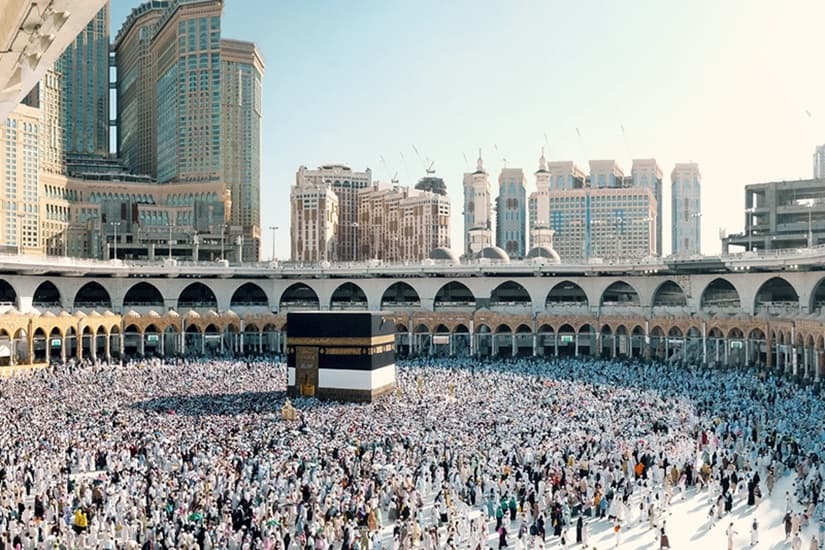
When the pilgrim arrives in Mecca, he enters the Grand Mosque with his right foot first and begins 7 circuits of tawaf around the Holy Kaaba, starting from the Black Stone, saying "In the name of God, God is the Greatest" each time he passes it in every circuit, and ending there. He touches the Stone with his right hand and kisses it if possible, without pushing through the crowd, or points to it from a distance, and remembers God and supplicates as he wishes.

When he reaches the Yemeni Corner, he touches it without kissing it; if this is not easy, he does not push through the crowd for it nor point to it. Between it and the Black Stone he says: "Our Lord, give us good in this world and good in the Hereafter, and protect us from the punishment of the Fire."
During tawaf, a man does two things: the first is "idtiba'", which is uncovering the right shoulder, and the second is "raml", which is walking briskly with short steps during the first three circuits, then walking normally in the rest.
After finishing the tawaf, proceed to the Station of Ibrahim and recite: "And take the Station of Ibrahim as a place of prayer." He then prays two rak'ahs behind it, reciting Surat Al-Kafirun and Surat Al-Ikhlas after Al-Fatihah; if this is not possible, anywhere in the Grand Mosque will do.

Sa'i
The pilgrim then goes out for sa'i through the Safa Gate and climbs Safa facing the Kaaba, reciting "Indeed, Safa and Marwah are among the symbols of God..." to the end of the verse. He raises his hands in supplication, praises God and proclaims His greatness, and says: "There is no god but God alone; He fulfilled His promise, supported His servant and alone defeated the confederates." He repeats it three times, and there is no harm in saying it fewer times.
He then descends from Safa toward Marwah on foot. When he reaches the two green markers, he walks quickly ("harwala"), which is for men only, and walks normally upon reaching the second marker. He repeats this in every circuit, climbs Marwah and says what he said on Safa. The circuit from Safa to Marwah counts as one, and the return counts as another. During sa'i, he says whatever remembrance and supplication he can or recites the Quran.

When he completes his sa'i, a man shaves his head or only shortens his hair, leaving the head to be shaved for Hajj, so that if the time before Hajj is short, there is no need to wait for the hair to grow back. A woman trims a fingertip's length from the ends of her hair on all sides of the head.
With this, the Umrah is complete; he leaves ihram entirely and the prohibitions are lifted, so that ordinary clothes, perfume, marriage and other things become permissible for him.
However, in the case of tamattu' Hajj, you must offer a sacrificial animal on the Day of Sacrifice, either a sheep or a seventh share of a camel or a cow. If you cannot find one, you must fast 10 days: three during Hajj before the Day of Arafah, and seven when you return to your family.
How to Perform Hajj
If you are performing ifrad Hajj, or qiran combining it with Umrah, enter ihram from the miqat you pass through. If you are performing tamattu', enter ihram for Hajj from where you are on the Day of Tarwiyah.
The Day of Tarwiyah in Mina
This is the eighth of Dhu al-Hijjah, when the pilgrim performing tamattu' enters ihram from where he is, doing upon entering ihram for Hajj the same as for Umrah: bathing, applying perfume, praying and putting on the ihram garments. He then makes the intention to enter ihram for Hajj and recites the talbiyah, saying: "Here I am for Hajj. Here I am, O God, here I am..." to the end of the talbiyah.
The pilgrim then goes to Mina, where he prays the Dhuhr, Asr, Maghrib, Isha and Fajr prayers, shortening them (four-rak'ah prayers are prayed as two rak'ahs), each at its own time without combining them.

The Day of Arafah
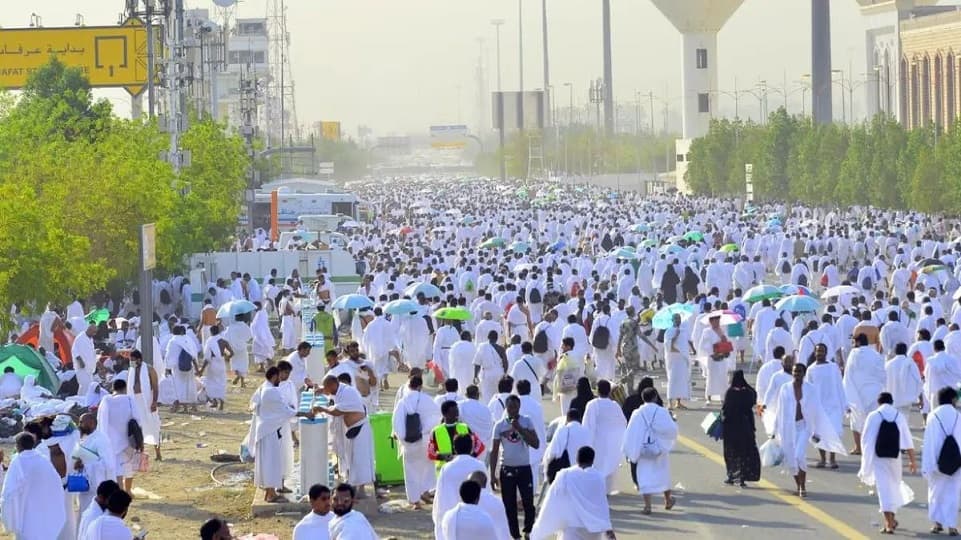
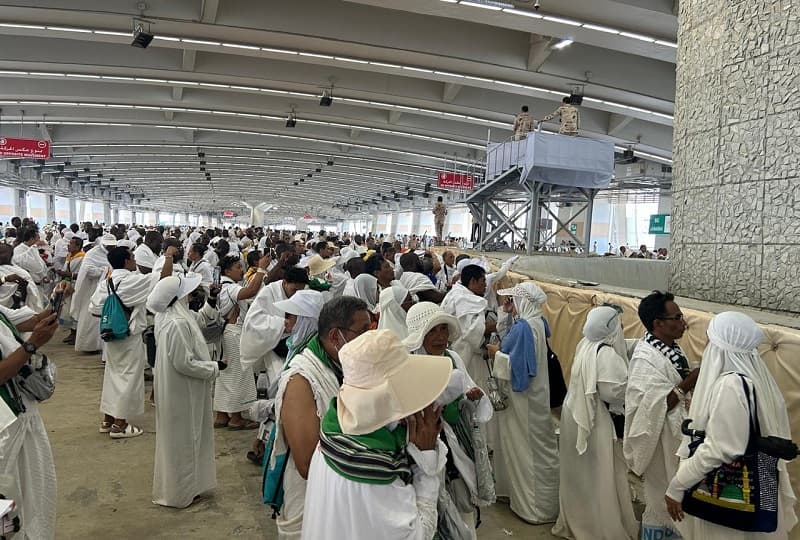
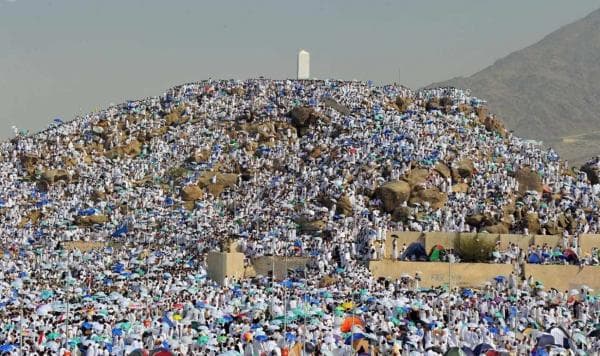
When the sun rises on the ninth of Dhu al-Hijjah, the "Day of Arafah", the pilgrim proceeds to Arafat, where he prays Dhuhr and Asr shortened and combined at the time of the earlier prayer, that is, with one call to prayer and two iqamas. After the prayer, he devotes himself to remembrance and supplication as he can, raising his hands and facing the qiblah, until the sun sets. Climbing the Mount of Mercy at Arafat is not prescribed for the pilgrim.

Overnight Stay at Muzdalifah and Stoning Jamrat al-Aqabah
When the sun sets, the pilgrim proceeds calmly to Muzdalifah reciting the talbiyah, prays Maghrib and Isha there combined and shortened, and stays overnight until he prays Fajr on the tenth of Dhu al-Hijjah, the first day of the blessed Eid al-Adha.
Before sunrise on the tenth day, pilgrims proceed to Mina, taking 7 pebbles from Muzdalifah to throw at Jamrat al-Aqabah one after another, saying "God is the Greatest" with each pebble; each is roughly the size of a chickpea. Collect the remaining pebbles from Mina.

The Sacrifice and the First Release From Ihram
When he has finished, the pilgrim slaughters the sacrificial animal and eats from it, then shaves his head if he is a man, while a woman only trims a fingertip's length from the ends of her hair. With this, the first release from ihram is complete, after which wearing ordinary clothes is permitted and the prohibitions of ihram are lifted, except for marital relations.
Tawaf al-Ifadah
The pilgrims then go down to Mecca to perform Tawaf al-Ifadah at the Sacred House, as well as sa'i if performing tamattu', or if you did not perform sa'i with the Tawaf of Arrival when performing qiran or ifrad. With this, marital relations become permissible for you. Tawaf al-Ifadah may be delayed until after the days of Mina, going down to Mecca after finishing the stoning of the jamarat.
Stoning the Jamarat on the Days of Tashreeq
After tawaf and sa'i, he returns to Mina and stays overnight during the three days of Tashreeq, the eleventh, twelfth and thirteenth of Dhu al-Hijjah, and stones the three jamarat over two or three days. He begins with the first jamrah, which is the farthest from Mecca, then the middle one, then Jamrat al-Aqabah, each with 7 successive pebbles, saying "God is the Greatest" with each pebble. After stoning each jamrah he supplicates as he can, but after Jamrat al-Aqabah he leaves without supplicating.
Farewell Tawaf and Completing Hajj
When the pilgrim wishes to return to his country, he does not leave Mecca until after performing the Farewell Tawaf around the Holy Kaaba, from which no one is exempt except women who are menstruating or in postnatal bleeding, as the Prophet (peace be upon him) said: "Let no one depart until his last act is at the House."
Visiting the Prophet's Mosque
Visiting the Mosque of the Prophet (peace be upon him) in Medina is not part of Hajj or Umrah. The pilgrim heads to Medina before or after performing the rituals with the intention of visiting the Prophet's Mosque and praying in it, as a prayer there is better than a thousand prayers elsewhere, except in the Grand Mosque in Mecca.

When you arrive at the mosque, pray two rak'ahs to greet the mosque, or the obligatory prayer if it has begun, then go to the tomb of the Prophet (peace be upon him) and greet him, saying: "Peace be upon you, O Prophet, and the mercy of God and His blessings."

Then take two steps to your right to stand in front of the tomb of Abu Bakr al-Siddiq (may God be pleased with him), saying: "Peace be upon you, O Abu Bakr, successor of the Messenger of God, and the mercy of God and His blessings. May God be pleased with you and reward you well on behalf of the nation of Muhammad."

Then take two more steps to stand in front of the tomb of Al-Farouq, Omar ibn al-Khattab (may God be pleased with him), saying: "Peace be upon you, O Omar, Commander of the Faithful, and the mercy of God and His blessings. May God be pleased with you and reward you well on behalf of the nation of Muhammad."
It is also Sunnah for you to visit Quba Mosque and pray in it, and to go out to visit those buried in Al-Baqi', the tomb of Othman ibn Affan (may God be pleased with him), the martyrs of Uhud and the tomb of Hamza ibn Abdul Muttalib (may God be pleased with him), and to pray for them.