This year's prices are lower than last year's when calculated in dollars after the flotation, and there is no market monopoly
By Akram Medhat
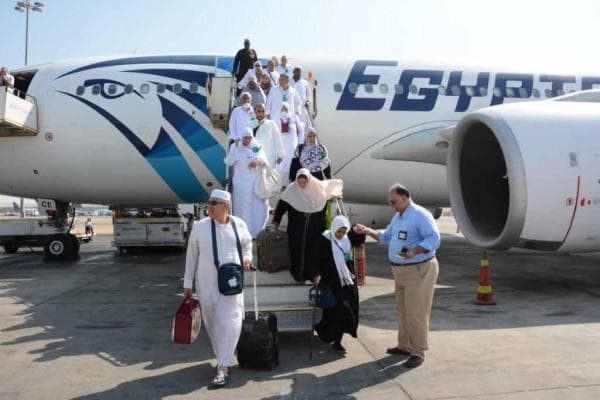
EgyptAir sent a clarification containing answers to the questions circulating in tourism circles and defending its position on ticket prices for the 1438 AH/2017 Hajj season, which saw a large increase that came as a shock to pilgrims and tourism companies.
Out of a commitment to objectivity in covering issues related to the sector, it was incumbent on "Travel Yalla News" to present these questions and EgyptAir's answers defending its position, leaving readers to judge and the other parties concerned the right to comment and respond.
The following are the questions and their answers:
Are this year's Hajj airfares exaggerated, as some say?
EgyptAir was very keen to avoid raising Hajj prices, but given the liberalization of the exchange rate and the nature of aviation costs, about 85% of which is in hard currency, covering fuel, service and departure fees at Jeddah and Medina airports, overflight and the like, this naturally led to a higher price in Egyptian currency. This became apparent when the company announced its ticket prices for the various Hajj levels, which in reality are lower than last year's prices.
Can you explain how the prices are lower than last year's?
The price offered last year for tourist Hajj was EGP 6,600, equivalent to $750, when the exchange rate was EGP 8.80, while this year a price of EGP 10,600 was offered, equivalent to $590.
The price of EGP 14,100, equivalent to $780, used to sell for EGP 7,100, or $810; the price of 14,900, equivalent to $825, sold last year for EGP 7,600, or $865; and the price of EGP 16,400 ($910) was EGP 8,100, or $925, last year.
The company was keen to offer a variety of prices, as well as not to increase them, given the many considerations the company keeps in mind when setting Hajj prices.
What is behind the high operating cost that pushes up the price?
Hajj flights are of a special nature, requiring intensive operation within a short time, and the nature of the operation means the load factor does not exceed 45% at best, as the outbound flight is full in one direction only, and likewise the return flight. The operation therefore actually amounts to 4 legs, and this is why the operating cost rises.
Is the ticket price within the rules applied when pricing package tours?
In fact, no, because the international rate is for the air ticket to be 40 to 50% of the program's value. If we look at the average tourist Hajj price last year, it was EGP 57,000 excluding airfare, while this year's average is EGP 115,000 excluding airfare. The difference is clear, not to mention premium Hajj prices, which exceeded EGP 400,000 this year.
Does EgyptAir have a monopoly on carrying Hajj pilgrims this year?
Of course not, as there are 5 Egyptian airlines and 3 Saudi airlines carrying pilgrims from Egypt to Saudi Arabia, and the competition lies in offering the best schedules and services, in which EgyptAir certainly comes first in terms of service and punctuality, as attested by previous Umrah seasons, which saw flight punctuality exceeding international standards.
Given these facts, why do most companies consider the prices high and reject them?
The reasons are clear, as indicated earlier. The question is: are hotel and rituals costs being paid at last year's prices, or at their equivalent at today's exchange rate? The answer is clear from the average Hajj prices announced by the Chamber of Tourism Companies compared with the previous year.
Is there really a price of EGP 25,000?
This price exists, but for one day only. It sold last year for EGP 12,400, equivalent to $1,420, and this year for $1,380. This price cannot be considered the basis, as no more than 500 seats at most are offered on that day, while more than 40,000 seats are offered at the prices mentioned above.
In the end, the question we pose here after laying out all these justifications is: are these reasons convincing, and do they satisfy public opinion? There is also an important question the company did not answer: the flotation took place in November 2016, so were Umrah tickets at these same figures at their highest price during Ramadan? And what changed in airfares to Saudi Arabia for them to see this abnormal rise?
We know that Hajj is a season with special operating conditions and prices, and all tourism programs are very high compared with last year, because there are many price factors controlled by the Saudi side. But can aviation not play a role in easing the pressure without encroaching on its right to legitimate profits?
I stress that the national carrier EgyptAir is not being accused of overpricing its tickets, as no one should pass judgment on a matter whose details or technicalities they do not know. However, full transparency and clarity are required, not merely listing justifications, to protect this great institution from fierce attacks of which it may be innocent, especially as it is not alone in the market either. Finally, we thank EgyptAir for this important clarification.
And besides, why single out aviation, when the price of Hajj through the lottery reaches EGP 60,000 and tourist Hajj EGP 105,000? What, then, is to be expected of the air ticket?!
Read also:
EgyptAir Hajj Ticket Prices Start From EGP 11,000, and Express Tourist Hajj Reaches 29,000
New Tourist Hajj Prices for 2017 After Their Increase
"Central Bank" Makes SAR 3,000 Available per Pilgrim for the Ticket and Visa From the Three Banks
EgyptAir: Hajj Ticket Issuance Begins July 31, With First Flights on August 9