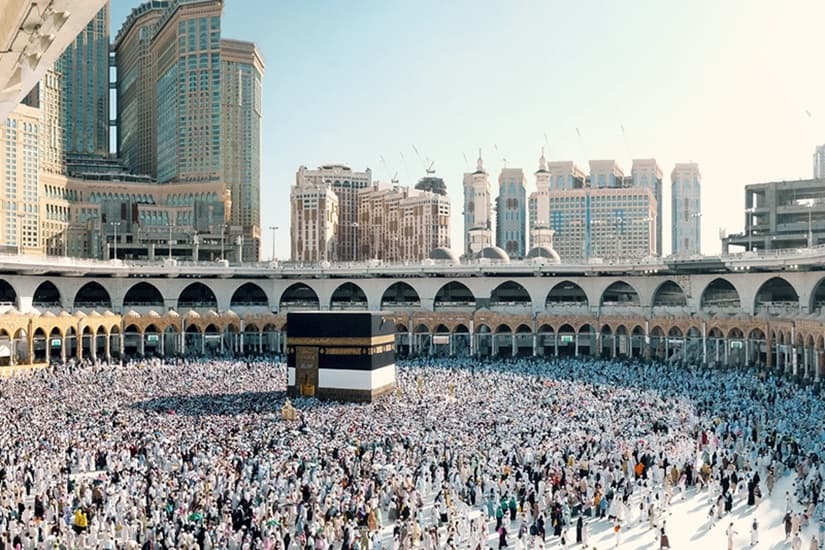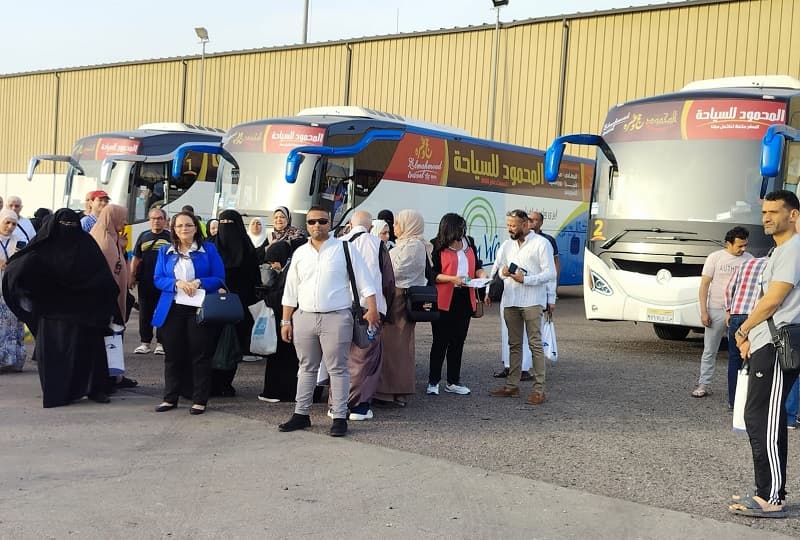
The Ministry of Tourism and Antiquities has launched a new integrated electronic system to track the tourist buses carrying land tourism pilgrims this year, 1447 AH-2026, for the first time beyond Egypt's borders, a qualitative leap aimed at strengthening real-time oversight, raising operational efficiency and ensuring the highest levels of safety, discipline and service quality for tourism pilgrims.
This comes in line with the directives of Minister of Tourism and Antiquities Sherif Fathy on the need to develop the tourism Hajj system, especially land Hajj, and strengthen follow-up and oversight mechanisms by expanding the use of the latest technological solutions.
For her part, Samia Samy, Assistant Minister of Tourism and Antiquities for Travel Company Affairs and Head of the Supreme Committee for Umrah and Hajj, explained that for the first time the tourist buses carrying land tourism pilgrims will be tracked by GPS devices from the moment trips set off from Egyptian territory, passing through Nuweiba seaport and then Jordan's Aqaba port, until they reach Saudi Arabia, whether Makkah or Madinah.
She stressed that what distinguishes this system in this year's Hajj season is that monitoring now extends to the route within the Hashemite Kingdom of Jordan and the Kingdom of Saudi Arabia, not just Egyptian territory, allowing the movement of tourist buses to be monitored continuously throughout the journey, an unprecedented development in the supervision and follow-up of land tourism pilgrims.
She noted that land tourism pilgrims this season number 6,000, transported on 130 tourist buses, adding that these trips are followed through an integrated system that is not limited to real-time monitoring via the ministry's tourist vehicle tracking center, but also extends to field follow-up through the ministry's committees deployed at all ports and bus routes, from Nuweiba seaport and Jordan's Aqaba port to the Halat Ammar land crossing on the Jordanian-Saudi border, then Madinah and the Nawariyah area in Makkah, until pilgrims reach their accommodation in the holy lands. The same system will be applied on return trips, ensuring tight oversight, regular trips and a rapid response to any emergency.
Samia Samy also praised the fruitful cooperation and continuous coordination between the various entities implementing the tracking system, commending the technical efforts of the Egyptian Company for Tracking Services and Information Technology (ETIT), in cooperation with the Central Department of Travel Companies, represented by the General Department of Tourist Transport headed by Eng. Hossam El Badawy, and the ministry's tourist vehicle tracking center headed by Eng. Ola El Makaky, which contributed to preparing this system for optimal implementation, ensuring operational efficiency, accurate monitoring and real-time follow-up of tourist buses from departure until arrival in Saudi Arabia.
The application of this system marks a qualitative leap in organizing and following land tourism Hajj trips, and reflects the Ministry of Tourism and Antiquities' keenness to develop its work system and keep pace with the state's drive toward digital transformation, helping to provide more efficient and safer services for Egyptian pilgrims.