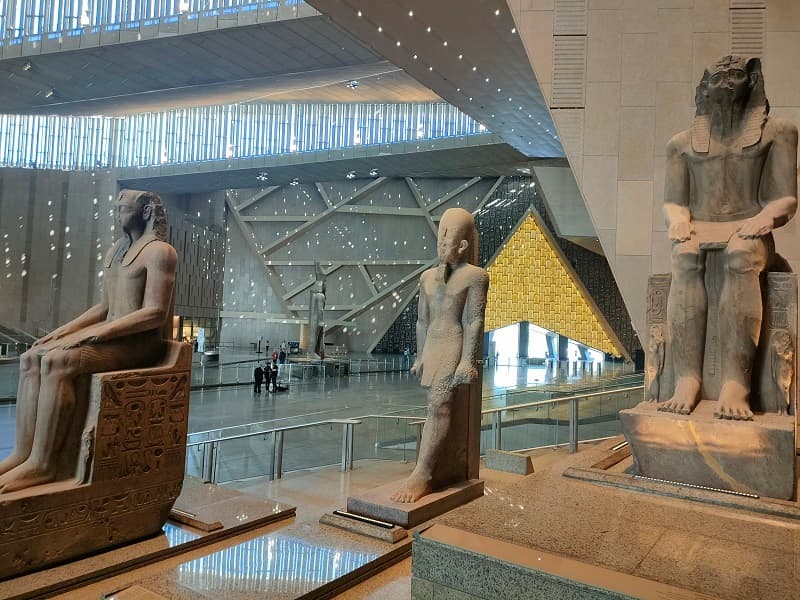
For the first time, the Grand Egyptian Museum has unveiled its Grand Staircase, which holds 60 monumental artifacts arranged along the stairs according to a display scenario with 4 themes. On each, you can enjoy the art of sculpture through different eras, from the Old Kingdom through the New Kingdom to the Greco-Roman period. The Grand Staircase ends with a magnificent panoramic view of the eternal Pyramids of Giza, seen for the first time from inside the museum.
Travel Yalla News made the climb up the staircase for the first time since the Grand Egyptian Museum was built, after visits to the Grand Staircase were opened to Egyptian and foreign visitors as part of the museum's trial operation ahead of its opening in the coming months.
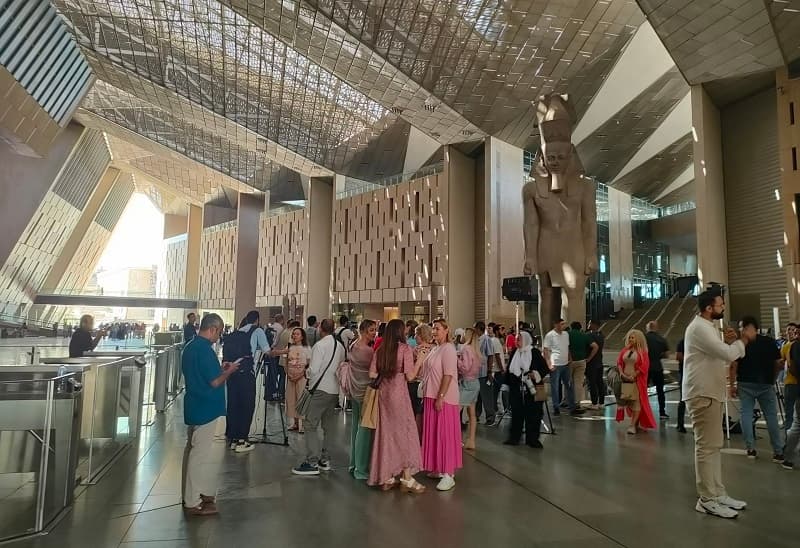
From the museum's outer plaza you hear music that carries you back through time to the era of the ancient Egyptians, then you enter the Grand Hall, where you are greeted by the statue of King Ramses II, one of the largest, heaviest and most masterfully carved statues of solid granite.


Together we head to the Grand Staircase, one of the museum's galleries. You can go up by escalator to watch a moving panorama of all the artifacts on the stairs, then walk down the steps among the statues to enjoy them up close and read their labels. The Grand Staircase gallery sets the Grand Egyptian Museum apart from the world's other museums, presenting 4 themes in a distinctive museum display scenario:

The Royal Image
This presents an outstanding collection of statues of kings, which went through many stages of development and change in royal art in ancient Egypt. Even so, the features and faces of the kings are easy to recognize in the statues.

Among the most important statues displayed on the Grand Staircase under the Royal Image theme:
A statue of King Seti I in pink granite.
A quartzite statue of King Senusret III or Amenemhat IV from the Middle Kingdom, showing two princesses, which was reused in the reigns of King Ramses II and King Merneptah.
A quartzite statue of King Seti II from the New Kingdom.
A statue of King Amenhotep III.
A statue of Queen Hatshepsut.
A red granite statue of the Roman Emperor Caracalla.
The head of a statue of King Akhenaten.


Sacred Houses (Places of Worship)
Responsibility for building temples of all kinds rested with the king, who was also in charge of maintaining and beautifying temple facilities. Mortuary temples were dedicated to kings after their deaths, and each temple was regarded as the dwelling of the deities, whose spirits resided in the statues placed in front of the temples.
Among the most important pieces displayed under this theme:
Two columns and a lintel in red granite of King Sahure from the Old Kingdom.
A sphinx statue of King Amenemhat III.
The gateway of King Amenemhat I.
Two columns and a lintel of King Sobekemsaf I from the Middle Kingdom.
A naos of King Senusret I.
An obelisk of King Merneptah.
The top of an obelisk of Queen Hatshepsut.
A naos of King Ramses II.
A naos of King Nectanebo II.


Kings and Gods (The King and His Relationship with the Gods)
In ancient Egypt there was a close relationship between kings and gods, based on a division of responsibilities between them. The gods took charge of everything to do with the sky, the Nile, the desert and the afterlife, while the king was the link between the gods and humankind and the center of all existence, as the god's representative on earth. He was responsible for ruling Egypt, maintaining the security and stability of the state and securing its borders.
This section displays an outstanding collection of statues of deities, pair statues and statues of sacred triads. Among the most important pieces:
A sandstone statue of the god Ptah.
A statue of King Senusret I in Osiride form.
A statue of King Ramses II under the protection of a deity.
A pink granite triad of the god Ptah, King Ramses II and the goddess Sekhmet.
A pair statue of King Amenhotep III with the god Ra-Horakhty.
A pair statue of King Ramses II and the goddess Anat.
Two statues of the god Serapis from the Roman period.


The Journey to Eternal Life (A Journey to the Afterlife)
For the ancient Egyptians, death was the gateway to the afterlife, where resurrection and eternal life awaited. That is why the kings of ancient Egypt took care to preserve their bodies after death, and they were buried either in pyramids or in royal tombs.
This section displays a collection of royal sarcophagi, including:
The sarcophagus of Queen Meresankh III from the Old Kingdom.
The sarcophagus of Prince Khufu-Djedef.
The sarcophagus of Princess Nitocris.
The sarcophagus of Djehutymes.
The sarcophagus of Hor-sa-Iset I.
The sarcophagus of Thutmose I.


Panorama of the Pyramids
After the journey to the afterlife, the Grand Staircase ends on its fourth level with a unique panoramic view of the three Pyramids, seen for the first time from inside the Grand Egyptian Museum, the greatest symbol of the crossing to the afterlife.


Read also:
Grand Egyptian Museum Unveils the Grand Staircase to Visitors for the First Time: Video and Photos