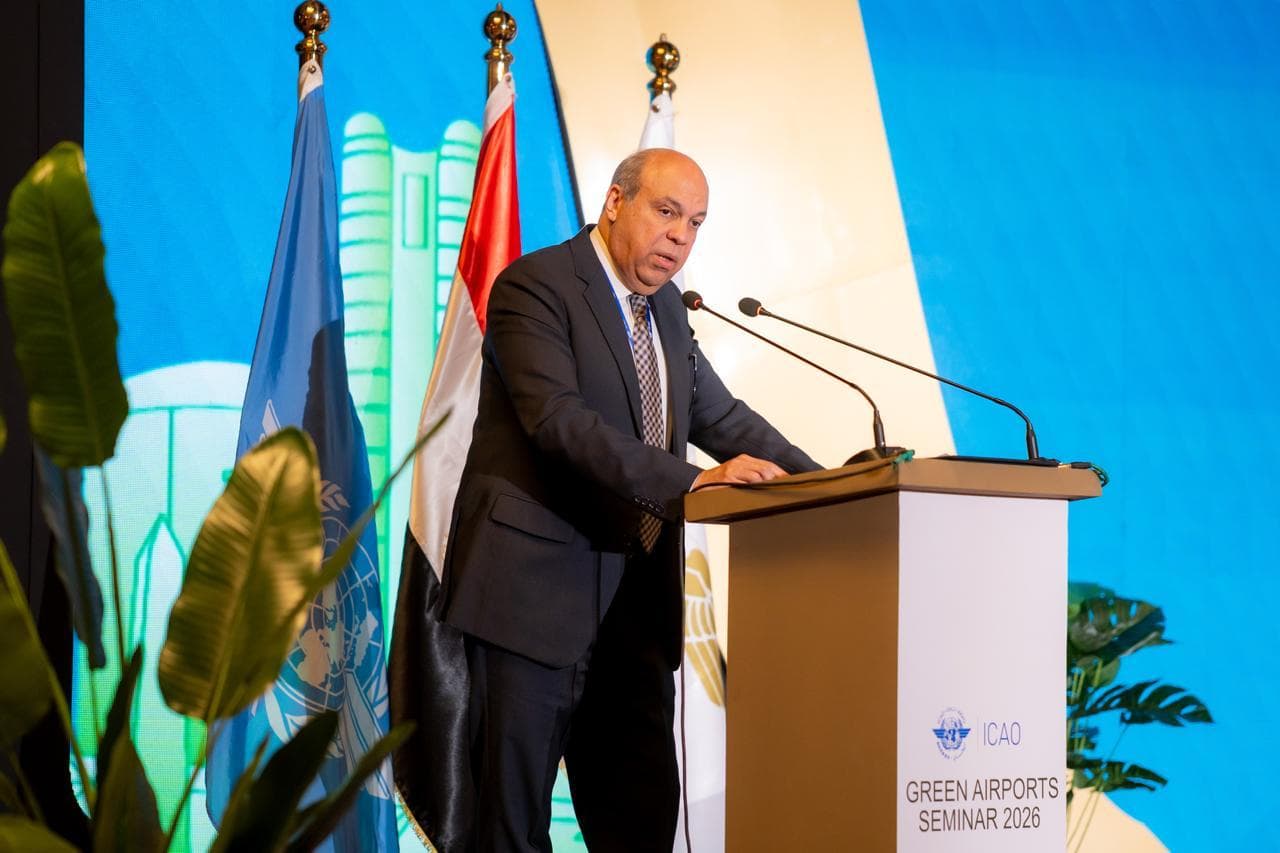
Egyptian Civil Aviation Minister Dr. Sameh El-Hefny opened the International Civil Aviation Organization’s (ICAO) Green Airports Seminar 2026, hosted in Cairo on October 29–30. Senior representatives of international and regional organizations, aviation industry experts and airport officials from around the world attended, underscoring Egypt’s active role in international efforts to advance civil aviation sustainability and keep pace with global developments.
The opening was attended by MP Sahar Talaat Mostafa, chair of the House of Representatives’ Tourism and Civil Aviation Committee; MP Amr Darwish, the committee’s deputy chair; Mohamed Rahma, regional director of ICAO’s Middle East Office; Justin Erbacci, director general of Airports Council International (ACI World); Sameh Fawzy, head of the Egyptian Civil Aviation Authority; Eng. Ayman Arab, chairman of the Egyptian Holding Company for Airports and Air Navigation; Magdy Ishak, chairman of Cairo Airport Company; and Captain Wael El-Nashar, chairman of the Egyptian Airports Company. Other civil aviation executives, representatives of international organizations, experts and specialists also attended.
In his opening address, El-Hefny said sustainability had become a strategic necessity for the future of international aviation. Continued growth in air traffic, he explained, brings challenges that require greater operational efficiency, lower carbon emissions, improved resource management and stronger airport resilience to climate change. The green transition is a key pillar of civil aviation development and its ability to respond to global change.
He said the central challenge was to balance the aviation industry’s continued growth and vital role in connecting people and economies with the need to reduce its environmental impact. This requires infrastructure development, modern operating practices and more efficient use of energy and resources. Airports, he added, play a pivotal role in translating environmental goals into practical projects and measures with tangible, measurable results.
Measurable energy savings and expanded solar power
The minister outlined improvements in Cairo International Airport’s environmental performance. Total energy consumption fell by around 4% despite passenger traffic increasing by more than 9%, improving energy efficiency per passenger by 12.2%.
The airport’s solar power capacity has reached approximately 4 megawatts, generating an estimated 6.4 million kilowatt-hours annually. This is complemented by smart building management systems, energy-efficient lighting, wider digitalization and improved water and waste management to increase operational efficiency and reduce environmental impacts.

El-Hefny said sustainability initiatives extended across Egypt’s airports. The new terminal at Borg El Arab International Airport incorporates a solar power system with capacity of nearly 1.5 megawatts, alongside energy-saving systems and water treatment and reuse facilities. Hurghada International Airport is also taking part in the Green Hurghada initiative in cooperation with the Ministry of Environment and the United Nations Industrial Development Organization (UNIDO), supporting sustainable environmental practices.
Several Egyptian airports have received international recognition for their environmental and sustainability efforts. Cairo International Airport has won Airports Council International awards, Hurghada International Airport has received a Zero Waste award, and Alexandria International Airport has been recognized for waste recycling initiatives and the application of circular economy principles.
International initiatives and sustainable aviation fuel
On international efforts to reduce aviation’s environmental impact, El-Hefny said Egypt was participating in the FIRE project, launched by ICAO and the United Nations Environment Programme with support from the Global Environment Facility. The project aims to replace firefighting foams containing PFAS substances with more environmentally safe alternatives. It is being implemented at Cairo and Sharm El Sheikh international airports, protecting the environment while maintaining aviation safety requirements.
He also highlighted cooperation with ICAO and the European Union through the ACT-SAF programme to support sustainable aviation fuel development. A national feasibility study for the fuel was launched in Cairo in July, paving the way to identify opportunities and technical and economic requirements, and to prepare a national policy and roadmap for future production and use in Egypt.
In December 2025, Egypt issued the second edition of its national action plan to reduce carbon dioxide emissions from international aviation, coordinated with ICAO and developed with relevant civil aviation stakeholders. The plan focuses on operational efficiency, better ground operations and services, reduced fuel consumption, and stronger monitoring and evaluation through clear performance indicators that measure progress and identify opportunities for improvement.
El-Hefny stressed that achieving sustainability targets requires moving from setting goals to implementing practical solutions based on reliable data and measurable indicators. It also requires closer international cooperation, exchanges of expertise and technology, capacity building and financing mechanisms that allow sustainable solutions to be scaled up, particularly in developing countries. Together, these measures support a more efficient, sustainable aviation sector that is resilient to climate challenges.
International cooperation for green, resilient airports
In a recorded video address, ICAO Secretary General Juan Carlos Salazar emphasized the need to intensify international efforts to build green and resilient airports by expanding clean energy use, protecting critical infrastructure and adapting operating processes to climate change.

Salazar thanked Egypt and the Egyptian Holding Company for Airports and Air Navigation for hosting the seminar. He stressed the importance of cooperation among governments, airports, international organizations and investors, and of sharing expertise to support climate action in aviation.
He said these efforts aligned with ICAO’s 2050 strategic vision of air transport for all, with zero fatalities and net-zero carbon emissions. He also highlighted the launch of the Finevest Hub platform to connect green aviation projects with financing, along with capacity-building programmes including ACT-CORSIA, ACT-SAF and ACT-LTAG to help countries implement their environmental objectives.
Mohamed Rahma, regional director of ICAO’s Middle East Office, said aviation sustainability went beyond reducing carbon emissions. It also involves strengthening airports’ ability to adapt to climate change and maintain operations during extreme weather, protecting service efficiency and infrastructure safety.

Rising temperatures, water scarcity and changing weather patterns in the region, he explained, require climate resilience to be incorporated into airport planning, design and development. Infrastructure modernization projects offer an opportunity to apply sustainability standards from the outset, improving resource efficiency and reducing future risks.
Rahma emphasized coordination among civil aviation authorities, airports, airlines, air navigation service providers, and energy and finance stakeholders. Sharing expertise and successful experiences can help countries turn sustainability goals into practical solutions suited to their circumstances and resources, strengthening regional cooperation to build more efficient and climate-resilient airports.
Digital transformation and operational efficiency
Eng. Ayman Arab, chairman of the Egyptian Holding Company for Airports and Air Navigation, said growing air traffic required improved airport management and operational efficiency to accommodate more passengers while reducing the environmental impact of operations. Cairo International Airport handled more than 31 million passengers in 2025, while total passenger traffic across Egypt’s airports reached approximately 62 million.
Digital transformation and modern operating systems, he said, are central to better services and smoother passenger flows. Biometric gates, self-service baggage drop and the removal of paper passport cards for Egyptian citizens at Cairo International Airport help simplify travel procedures, reduce paper consumption and shorten waiting times.

Modern radar and air navigation systems, together with greater real-time data sharing among air traffic control, airports, airlines and ground handlers, can improve aircraft traffic management and reduce waiting and taxiing times. This, in turn, cuts fuel consumption and emissions and improves operational efficiency.
Arab highlighted the importance of integrating energy efficiency and climate adaptation into the earliest planning and design stages of airport development projects. Cairo International Airport’s Terminal 4 project offers an opportunity to do so by incorporating future operational and sustainability requirements from the design stage.
He stressed the need for viable financing models and wider private-sector partnerships to support infrastructure projects and airport modernization. Particular attention should be paid to small and regional airports, enabling them to benefit from modern technological and operational solutions.
He concluded by calling for practical recommendations with clear implementation measures and measurable performance indicators to support airport development, improve operational efficiency and enhance readiness for future growth and climate challenges.
ACI World Director General Justin Erbacci said airports were major engines of economic development, supporting trade and tourism, creating jobs and connecting communities and markets. Sustainable development is therefore essential to maintaining their efficiency and their ability to continue fulfilling these roles.
The green transition, he explained, requires more efficient energy use, expanded renewable energy, electrification of ground vehicles and equipment, better water and waste management, reduced noise and biodiversity protection.

Strengthening airport resilience to climate change requires coordinated efforts by governments, airports, financial institutions and energy suppliers, along with access to the necessary technology, expertise and resources, particularly in African and developing countries.
The seminar’s sessions examine airport infrastructure development, operational and energy system efficiency, digital solutions and artificial intelligence to reduce emissions, clean energy and sustainable aviation fuel, and improved resource, waste and noise management. They also explore climate resilience in airport planning and design, innovative financing mechanisms and international cooperation to implement environmental projects.
Egypt’s hosting of the seminar underscores its civil aviation sector’s commitment to integrating sustainability into development and modernization plans. This supports the efficiency of Egyptian airports and their readiness for global change, while strengthening Egypt’s contribution to international efforts to build a more sustainable, efficient and resilient aviation industry.