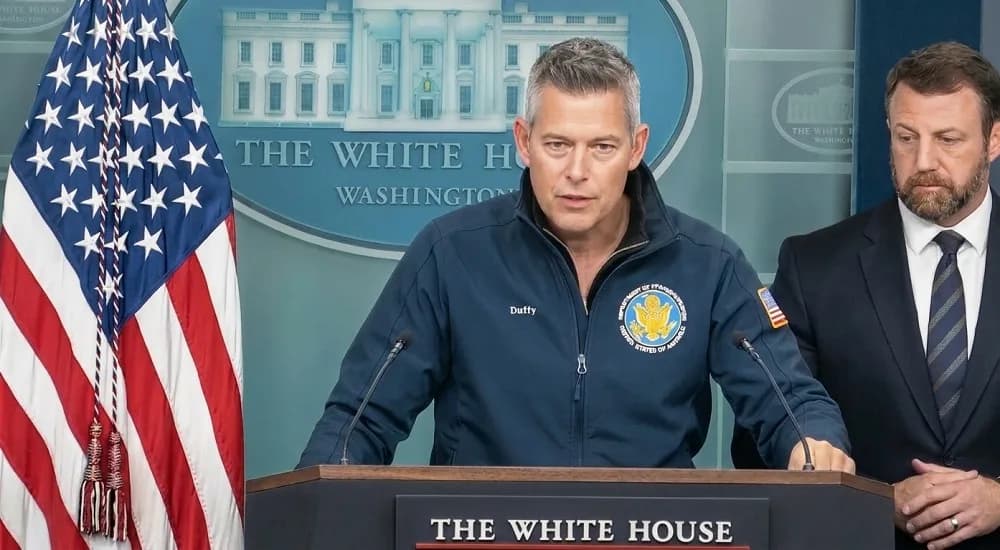
U.S. Transportation Secretary Sean Duffy outlined the details and causes of the nationwide flight suspension imposed by the Federal Aviation Administration (FAA), following disruptions to communications and radar systems used for air traffic control that affected the stability of data and communications between air traffic controllers and aircraft. He stressed that the decision was taken as a precautionary measure to ensure passenger safety.
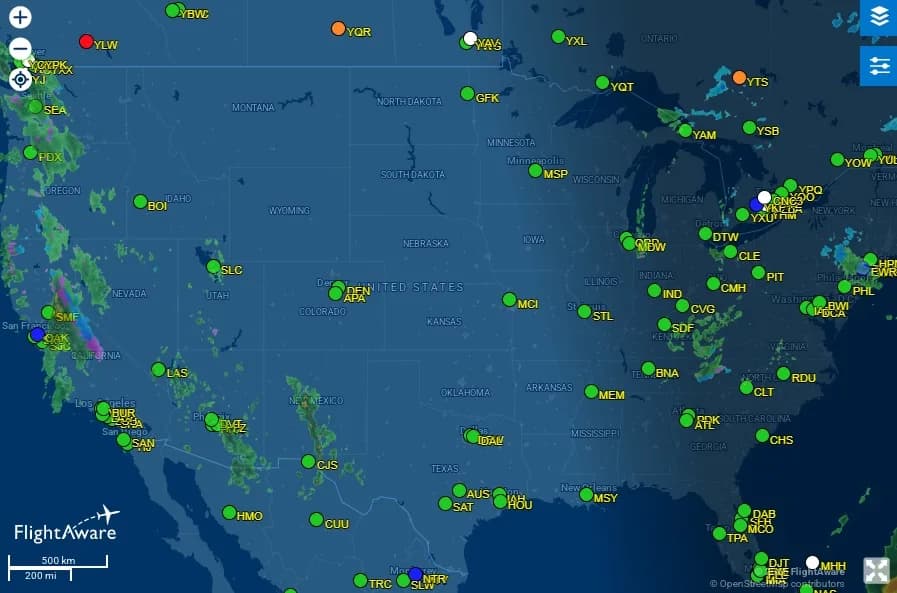
Speaking at a joint press conference with Homeland Security Secretary Markwayne Mullin, Duffy said the disruptions began at 3:36 p.m. on Friday, November 13, affecting air traffic control centers and Terminal Radar Approach Control facilities (TRACONs) across the country.
He explained that the U.S. air traffic control system consists of airport control towers, followed by approach control facilities, and then control centers responsible for tracking aircraft throughout their journeys. Irregularities in radar data and communications with aircraft were detected at approach control facilities and the main control centers, he added.
Duffy said authorities decided to issue the nationwide ground stop after encountering inconsistencies in data and communications, although there had been no complete outage of communications networks or radar systems. More than 3,500 aircraft were in the air when the decision was issued, and they began landing gradually under established procedures for handling such situations. The number of aircraft in U.S. airspace subsequently fell to fewer than 400 by the time he addressed the press conference.
He praised the training of pilots and air traffic controllers, as well as their ability to manage the situation and bring aircraft safely back to the ground, according to the U.S. Department of Transportation's official website.
Duffy noted that the flight suspension did not halt certain essential air operations, including medical evacuation flights, flights carrying shipments of medicines and critical medical supplies, and law enforcement operations. These flights continued under the necessary safety procedures, he stressed.
Aging Air Traffic Control Systems
Explaining the technical causes of the incident, the U.S. Transportation Secretary attributed the disruptions to outdated technology underpinning the air traffic control system. He said the system still relies on aging analog communications networks based on Time Division Multiplexing (TDM), while switches and routers came under pressure due to increased data traffic. This resulted in irregular information flows and ultimately led authorities to suspend air traffic.
He explained that some of the older communications switches had already been replaced with modern equipment based on Internet Protocol (IP). These newer devices were not affected by the disruptions that hit the older equipment, he said, highlighting the need to complete the modernization of the entire air traffic control system rather than relying on partial solutions.
Duffy said U.S. President Donald Trump had called on Congress last year to provide the funding needed to build an entirely new air traffic control system. Around $15 billion had been allocated to the Federal Aviation Administration (FAA) under previous administrations over a period of 25 years to upgrade the system, but little progress had been made in modernization efforts, he noted.
He added that the One Big Beautiful Bill included an initial funding allocation of $12.5 billion at President Trump's request. The portion of the modernization project covered by this funding is scheduled to be completed before the end of Trump's term, he said, while stressing that the allocation represents only part of the total cost and that additional financial resources will be needed to complete the project.
The Transportation Secretary called on Congress to act to provide the necessary funding for a fully modernized system encompassing new equipment, software and communications networks, rather than continuing to make scattered repairs to the existing infrastructure. He emphasized that upgrading the technological infrastructure supporting air traffic control is a matter of aviation safety, not a partisan or political issue.
Duffy also called on Congress to provide $50 billion in emergency funding to modernize the aging air traffic control systems, following the flight suspension crisis, which resulted in the cancellation of more than 6,600 flights, according to Reuters.
Flight Resumption and Outlook for a Return to Normal Operations
On the latest developments, Duffy announced that U.S. airspace had reopened at 8:15 p.m. Eastern Time on Friday, after authorities confirmed that air traffic control centers and airport approach control facilities were operational again.
However, he explained that flights would not resume immediately or at full capacity, as airlines needed to ensure the availability of aircraft crews, pilots and cabin crews required to operate scheduled services.
Authorities will work with airlines to operate as many flights as possible on Friday night, depending on available resources and crew availability, Duffy said. Airlines would then continue repositioning aircraft and resuming services from Saturday morning. He cautioned that a full return to normal air traffic operations would take some time because of the disruption caused during the hours-long suspension.
The Transportation Secretary stressed that aging equipment remains a persistent source of problems for the air traffic control system. He cited previous incidents involving communications disruptions at Newark Airport and in other areas of New York, warning that continued reliance on outdated technology could lead to similar failures unless modernization efforts are completed.
Responding to questions about the possibility of cyberattacks targeting the system, Duffy said the available indications pointed to aging equipment and analog communications networks as the source of the problem. Technical measures taken by specialist teams to ease pressure on communications switches and restart the networks had helped restore operations at control centers and approach facilities, he explained.
He added that the newer equipment installed as part of the modernization effort had not been affected by the outage, while leaving the task of ruling out any deliberate malicious activity to cybersecurity teams and the relevant authorities.
Duffy also ruled out any connection between the outage and the FAA's new SMART system, explaining that it operates independently of the affected radar and surveillance systems. The system provides air traffic controllers with information on aircraft routes and weather conditions, while leaving the decision to accept or reject its recommendations to human operators. He confirmed that SMART was not connected to the networks affected by the disruptions.