By Akram Medhat
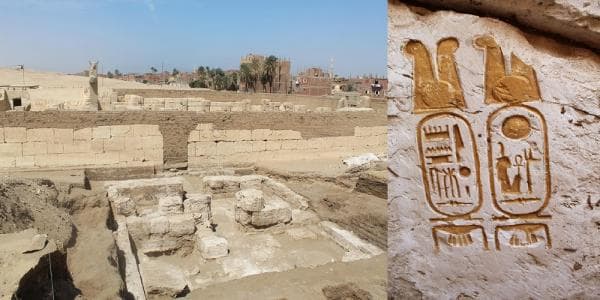
The New York University archaeological mission working at the Temple of Ramses II in Abydos uncovered the hall of Pharaoh Ramses II's palace attached to his temple in Abydos in Sohag Governorate, as well as the temple's dedication and foundation stones, during archaeological excavations around the temple area aimed at completing the uncovering of its architectural elements.

In this context, Dr. Mostafa Waziri, Secretary General of the Supreme Council of Antiquities, said the discovery will, for the first time, change the shape and map of the temple, which was discovered about 160 years ago, and will also add new knowledge to our understanding of the layout and shape of temples and their annexes in the Ramesside period.
He pointed out that the architectural picture of this temple's annexes, including the hall and the palace, mirrors the annexes of the temple of his father, King "Seti I", located 300 meters to the south.
For his part, Ayman Ashmawy, head of the Egyptian Antiquities Sector, explained that the hall consists of walls built of limestone and mud brick, and its floor was paved with limestone slabs. Inside the second hall, the mission also found a sandstone column base and a lintel of the same type of stone bearing the name of Ramses II, in addition to other stone blocks bearing remains of scenes of stars that decorated the hall's ceiling.
Dr. Sameh Iskander, head of the archaeological mission, explained what the excavations on the southern side of the temple revealed, as a stone walkway was found in front of the southwestern gate of the temple, which turned out to lead to the entrance of a building appearing for the first time, whose walls bear the remains of an inscription of the cartouche of Ramses II.
He added that one of the rarest archaeological discoveries was uncovered for the first time, namely the temple's dedication and foundation stones, on which the royal titles of Pharaoh Ramses II were engraved. On the last stone at each of the temple's four corners and the link between them appeared the royal cartouches of its founder, King Ramses II, engraved with his coronation and birth names on a gold-colored background topped by the sun disk.