By Akram Medhat
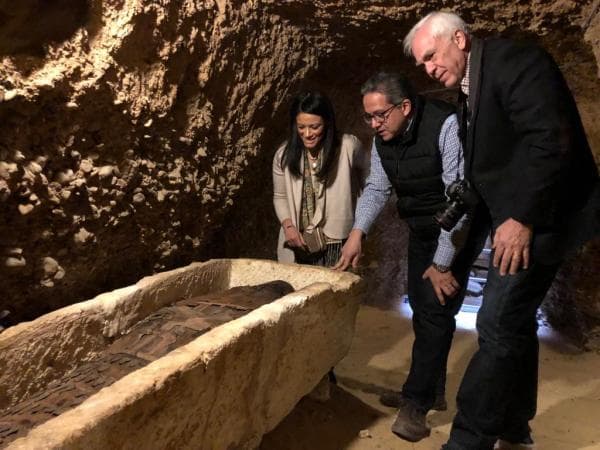
Today, Dr. Khaled El-Enany, Minister of Antiquities, announced the first archaeological discovery of 2019 in the Tuna el-Gebel archaeological area in Minya Governorate, where the joint archaeological mission of the Ministry of Antiquities and the Center for Archaeological Research and Studies at Minya University uncovered 3 burial shafts, each leading to rock-cut tombs containing many mummies.

The discovery was witnessed by Dr. Rania Al-Mashat, Minister of Tourism; Maj. Gen. Kassem Hussein, Governor of Minya; Dr. Mostafa Waziri, Secretary General of the Supreme Council of Antiquities; Dr. Mostafa Abdel Nabi, President of Minya University; and members of the House of Representatives for the governorate, in addition to a number of ambassadors and cultural attachés of 11 foreign countries in Egypt, namely Spain, Malta, Lithuania, Kazakhstan, the Czech Republic, Ireland, Poland, Serbia, Belarus, China and Japan, and their families, given their interest in these events and in telling the world about Egypt's discovery of more about its unique civilization.


In his speech, El-Enany explained that for the third year in a row, a new archaeological discovery is being announced in Minya Governorate, coming on the sidelines of an invitation to ambassadors and Egyptian and international news agencies to the heart of Upper Egypt to see Minya's antiquities, their greatness and its new discovery. He promised to announce more archaeological discoveries during the current year, noting the ambassadors' delight at seeing the mummies face to face in their original burial places, as they always see them inside museums and display cases, and they described this moment as enjoyable.
Details of the Discovered Tombs
El-Enany said the tombs are family tombs belonging to the middle class of society, or rather the upper segment of the middle class. They consist of burial chambers containing a large number of mummies of people of different ages in a good state of preservation, including mummies of children, some wrapped in linen and others bearing inscriptions in Demotic script, in addition to a number of mummies of men and women, some of which still retain remains of colored cartonnage, while others bear Demotic inscriptions beneath the feet.

Dr. Mostafa Waziri also reviewed the burial methods inside the tombs, which varied between burials inside stone or wooden coffins and burials on the tomb floor, and burials were also found inside niches. He noted the discovery of some ostraca and papyrus fragments, which, through the study of their inscriptions, archaeologists were able to date to the period between the beginning of the Ptolemaic era and the early Roman and Byzantine eras.
For his part, Wagdy Ramadan, head of the archaeological mission, noted that the mission began its work this season at the end of last November to complete the excavation of its first season, which began in February 2018 and continued until the end of April of the same year. During that season, the mission uncovered a rock-cut tomb consisting of an entrance leading to a sloping staircase carved into the ground, which leads to a rectangular hall containing a number of burials. To the west is a rectangular chamber with mummies and a large stone sarcophagus, and to the north another chamber was found containing stone coffins placed inside niches, a burial style considered unique in the Tuna el-Gebel archaeological area.


In a related context, Fathy Awad, Director of the Tuna el-Gebel archaeological area, said it was used as a necropolis for the 15th nome from the end of the New Kingdom and the beginning of the Late Period, with Ashmunein as its capital. It is famous for containing many important archaeological sites, including the tomb of Petosiris, discovered in 1919 by Gustave Lefebvre, the Roman waterwheel, the sacred necropolis for burying the animals and birds symbolizing the god Thoth, the ibis and the baboon, the tomb of Isadora and the Roman necropolis. The area also contains two of King Akhenaten's boundary stelae, as part of the boundaries of the city of Akhetaten.