Yousra stresses the greatness of the archaeological discoveries and makes a point of visiting the inside of the tomb
El-Enany: Saqqara will see major development, and the ambassadors asked to attend archaeological discoveries
Waziri: The tomb of Khuwy is the most beautiful in the area and has preserved the quality of its inscriptions' colors for 4,400 years
By Akram Medhat
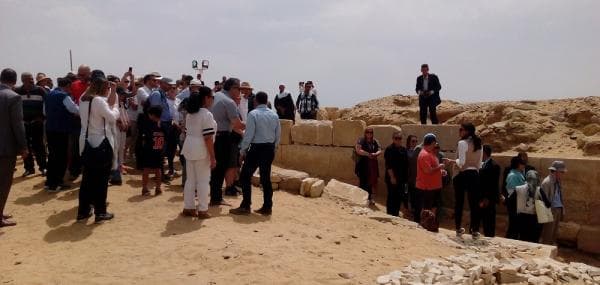
The Saqqara archaeological site yesterday received a visit from 54 foreign ambassadors accompanied by their families, along with Dr. Khaled El-Enany, Minister of Antiquities, to view the latest archaeological discovery in the area, the tomb of Khuwy, a nobleman of the king and a judge during the Fifth Dynasty of the Old Kingdom. Actress Yousra surprised those present with her keenness to learn about the great archaeological discoveries.

For his part, Dr. Khaled El-Enany, Minister of Antiquities, said that 54 ambassadors and representatives of foreign countries, most notably France, the Netherlands, Belgium, Armenia, Japan, the Czech Republic, Greece, Bulgaria and Belarus, brought their wives and children with them.


He added that the Saqqara area is rich in archaeological discoveries and that this is the fifth visit to it, noting that it was the first archaeological site the Prime Minister visited in 2019, at 8 a.m. on the first day of January.
He stated that the area will undergo major development and the addition of services that will make tourists spend more than 4 hours there, instead of only two hours, visiting its tombs and pyramids.

He pointed out that there are 260 archaeological missions in Egypt from 24 countries, and although some ambassadors have no archaeological missions, they are keen to visit the archaeological discoveries and have sent official letters to the ministry asking to be included on the list of ambassadors who accompany archaeological inaugurations.

For his part, Dr. Mostafa Waziri, Secretary General of the Supreme Council of Antiquities, explained that the Egyptian mission's work at the Saqqara archaeological site began on February 27, and the excavations led to the discovery of the tomb of Khuwy, which is the most beautiful in the area. Khuwy was a nobleman, meaning a person close to the king, and a judge during the Fifth Dynasty of the Old Kingdom. The tomb is 4,400 years old, yet it has preserved the quality of its inscriptions and colors as if they had been made yesterday, to the extent that the handprint of one of the painters can still be seen on the drawings inside the tomb.

Waziri explained that the use of the color green in tomb inscriptions held a special status, as it required the king's approval, and since Khuwy held the title of nobleman, meaning close to the king, he obtained that approval, noting that the green color was made from the rust of metals.
Description of the Tomb
It is worth noting that the Egyptian archaeological mission headed by Dr. Mohamed Megahed succeeded, during excavation and scientific documentation work at the pyramid complex of King Djedkare of the Fifth Dynasty in South Saqqara, in uncovering a unique tomb belonging to a man named Khuwy, who held the positions of nobleman to the king and judge in the late Fifth Dynasty of the Old Kingdom.


The tomb consists of a superstructure in the form of an offering chapel built in the shape of the letter (L). The chapel's stones were evidently removed in ancient Egyptian times and reused elsewhere, as the mission found only the remains of the lower walls, which were built of white limestone.

In the northern wall of the tomb, the mission also found the entrance to its substructure, whose design imitates the pyramids of the Fifth Dynasty, a design discovered for the first time inside tombs of individuals rather than kings of that period.
This part of the tomb begins with a descending corridor leading to a small hall, and from there to an antechamber inscribed with scenes depicting the tomb owner seated before an offering table, as well as an offering list and a scene of the palace facade.

The mission uncovered a second, uninscribed chamber used as a burial chamber, containing the remains of a completely shattered white limestone sarcophagus. However, the mission was able to uncover the human remains of "Khuwy" among the stones, on which traces were found of oils and "resin", a substance the ancient Egyptians used in mummification.
In a related context, Dr. Mohamed Megahed, head of the Egyptian archaeological mission in Saqqara, said this discovery further demonstrates the importance of the reign of King Djedkare in particular and the end of the Fifth Dynasty in general, as during its last excavation season the mission also succeeded in uncovering for the first time the name of the king's wife, Queen "Setibhor", carved on a granite column that had been lying on the southern side of her temple. He added that work is underway on a comprehensive restoration of the pyramid of Djedkare and the funerary temple.
He added that the pyramid complex and the queen's temple had been uncovered earlier, during the 1950s, and archaeologists had no information about the name of their owner or her titles. The pyramid complex of Queen "Setibhor", located northeast of the pyramid of her husband "Djedkare", is considered one of the largest pyramid complexes built for a queen during the Old Kingdom, and one of the first pyramids built in South Saqqara at the end of the Fifth Dynasty.
The mission has completed the architectural restoration of the interior of King Djedkare's pyramid, and is completing restoration work and archaeological documentation of the pyramid complex of the king and his wife Setibhor, to discover more information about the history of the end of the Fifth Dynasty and the beginning of the Sixth Dynasty, which witnessed a radical shift in ancient Egyptian thought and belief, with the appearance of the Pyramid Texts for the first time inside the pyramid of King "Unas", heir to the throne of King Djedkare, as well as the halt in the construction of sun temples, which all the kings of the Fifth Dynasty before Djedkare had built.